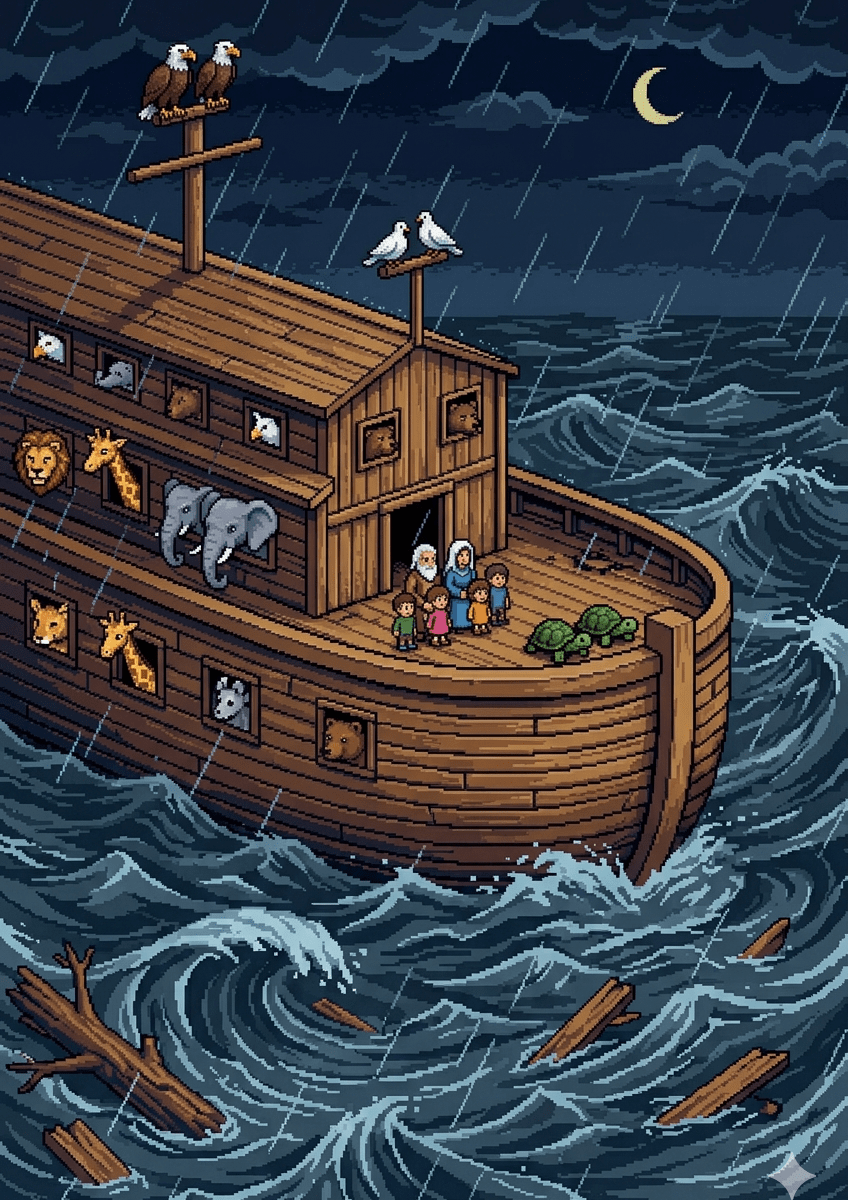


Here is are my extra thoughts on Magnar Kartveit’s chapter “Noahs Paradox” in his book Gud, Pest og Plage.
Magnar Kartveit’s book is written in Norwegian, so his quotes below are (currently) left in Norwegian. My review is written in Norwegian as well, but these extra responses have been left in English. See my review of his book Gud, Pest of Plage here.
Kartveit believes there is a paradox surrounding syndefloden. He writes that man was made in God’s image and that after the flood God commanded that no one be murdered. How could God wipe out everyone with a flood, even though they were so sinful? What does that say about their worth? Kartveit believes that Peter had this same burning question and that he has the answer to it: after his death, Christ preached to those who died in the flood. However, what is confusing is that Kartveit believes the flood didn’t even happen.
My answer to this chapter will come in three parts:
- It was right for God to send the flood;
- If there was no flood, then there is no paradox;
- To whom did Jesus preach?
God is Just, Not Unreasonable (“Urimelig”)
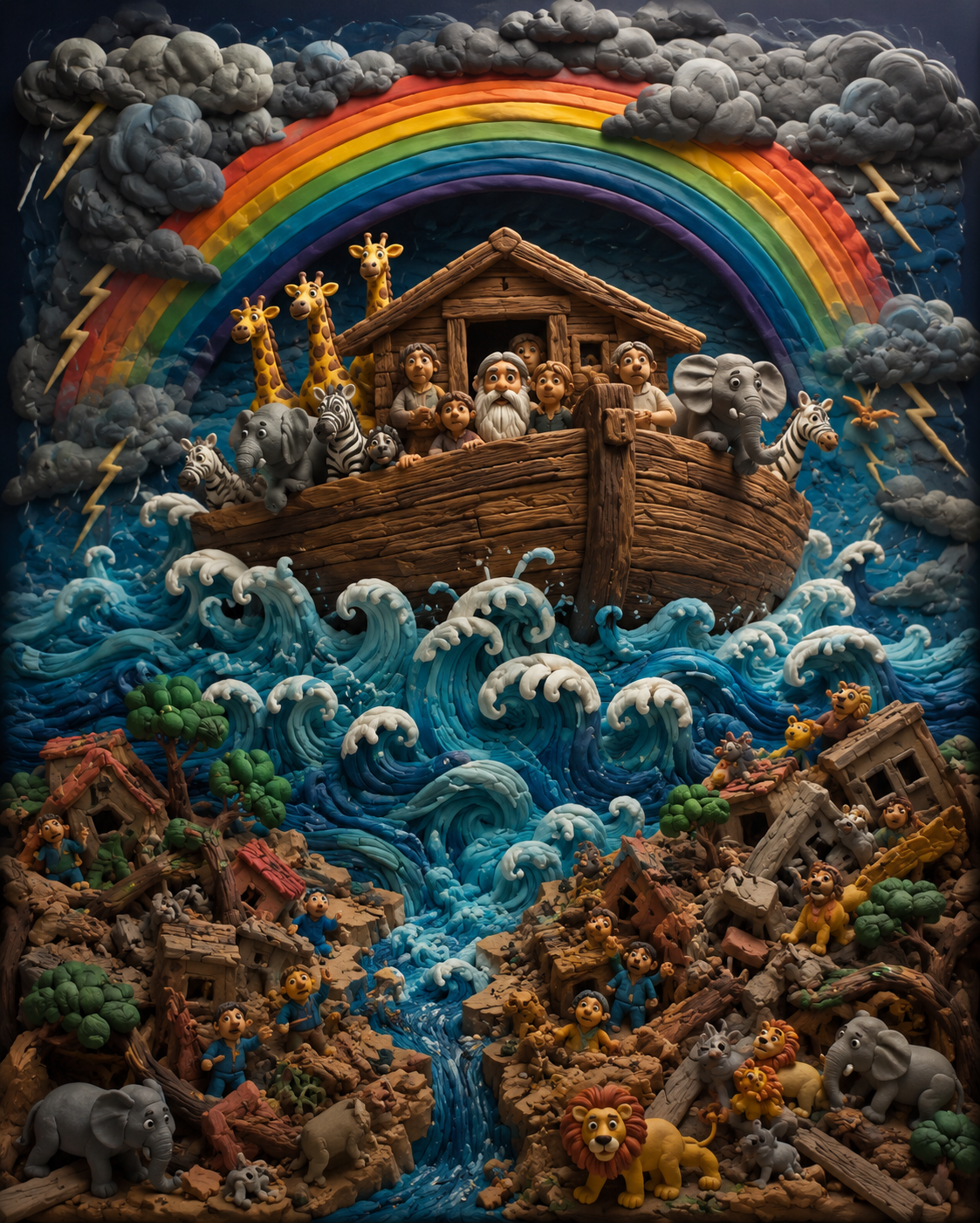
Kartveit asks, “How can God affirm that human beings are created in God’s image, and that it is forbidden to kill, immediately after the story of the flood? Is it reasonable that the animals should suffer for humanity’s sins? This is Noah’s paradox.” («Hvordan kan Gud framheve at mennesket er skapt i Guds bilde, og at det er forbudt å drepe, rett etter fortellingen om flommen? Er det rimelig at dyrene får svi for menneskenes synder? Det er Noahs paradoks.») (p. 40).
“What value do their lives have?” («Hvilken verdi har deres liv?»). Very much indeed! The problem is that they have not considered the value of everyone else around them. Near the end of the chapter, Kartveit writes, “God is righteous because he brings violence to an end and saves the righteous Noah.” («Gud er rettferdig fordi han lar volden få en slutt og redder den rettferdige Noah.») (p. 47).
But that alone isn’t why God is righteous. Psalm 145:17 says, “The Lord is righteous in all his ways and kind in all his works” (see Ps 11:7; 2 Chron 12:6). Psalm 89:9 announces that God is coming to judge the earth “with righteousness, and the peoples with equity.” Abraham himself knows this. In Genesis 18:25 he says to God, “Shall not the Judge of all the earth do what is just?” And he did do what was just. In Genesis 19 He destroyed Sodom and Gomorrah and in his mercy spared the (barely righteous) Lot and his family.
Was it right for God to wipe out the whole of humanity with a flood? Genesis 6:5 tells us it was because “The Lord saw that the wickedness of man was great in the earth, and that every intention of the thoughts of his heart was only evil continually.”
The flood is the third expulsion we have seen in Genesis.
- Adam and Eve were expelled (exiled) from the Garden.
- Cain was exiled to wander the earth.
- Now all people will be exiled to death for their sin and uncleanness.
5 The Lord saw that the wickedness of man was great in the earth, and that every intention of the thoughts of his heart was only evil continually.
Unlike Abraham who was to follow the Lord by “doing righteousness and justice” (18:19), mankind resembles Cain in his wickedness (4:8) destroying those made in God’s image (1:28).
6 And the Lord regretted that he had made man on the earth, and it grieved him to his heart. 7 So the Lord said, “I will blot out [see Gen 7:22-23; Exod 32:10, 32] man whom I have created from the face of the land, man and animals and creeping things and birds of the heavens, for I am sorry that I have made them.” 8 But Noah found favor in the eyes of the Lord.
Michael Morales writes that “Yahweh’s retreat to the heavens may be explained by the continual pollution of the earth by man’s sin after the flood.” Noah was blameless (Ps 15:2; Gen 17:1). The earth was filled with violence (6:11), which goes against God’s intentions for creation (Gen 1:4, 10, 12, 18, 21, 25, 31). All people were corrupt (as Israel will be later, Exod 32:7, which brought God’s hot wrath upon them).
As David Clines notes regarding the flow of Genesis, “There is an ever-growing ‘avalanche’ of sin, a ‘continually widening chasm between man and God.’ There is a movement from disobedience to murder, to reckless. killing, to titanic lust, to total corruption and violence, to the full disruption of humanity.” Clines goes on to say, “God responds to the extension of human sin with increasingly severe punishment: from expulsion from the garden to expulsion from the tillable earth, to the limitation of human life, to the near. annihilation of mankind, to the ‘dissolution of mankind’s unity?'” Clines also points us to God’s grace: “God not only punishes Adam and Eve, but also withholds the threatened penalty of death; he not only drives out Cain, but also puts his mark of protection upon him; not only sends the Flood, but saves the human race alive in preserving Noah and his family.” (Theme of the Pentateuch, 70).
No Flood, No Paradox
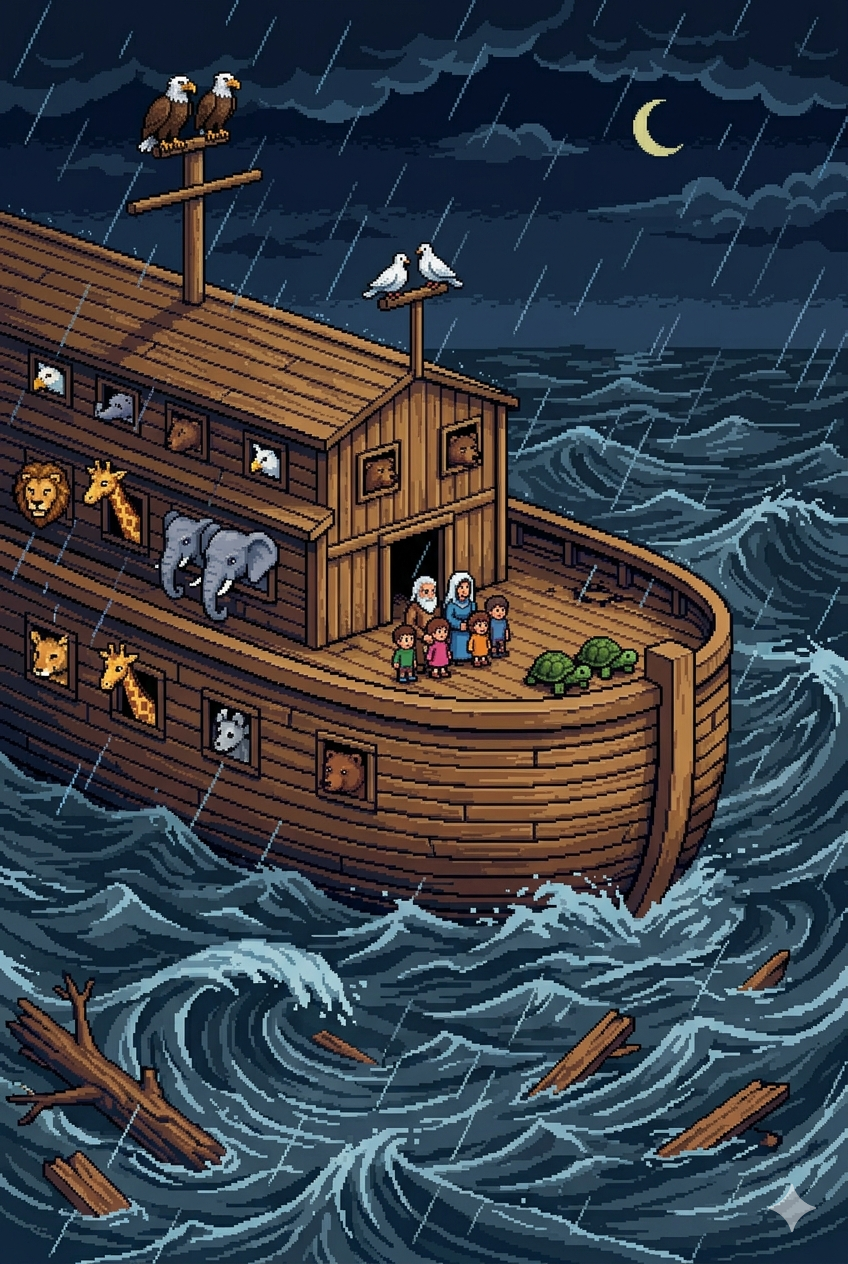
Kartveit writes that the story of Noah and the flood was taken from ancient near eastern sources like Enuma Elish. Kartveit doesn’t leave a local flood as an option. According to Kartveit, the flood didn’t happen at all as proven by science (although he provides no sources).
Yet Kartveit still has a problem with the fact that all these poor people died as well as how unreasonable («urimelig») it was for God to wipe them all out. Kartveit quotes Peter Harland, who posed the thought that the flood says those people have little value as people. However, is that true? Let’s think for a second.
If the flood didn’t happen, then God didn’t wipe anyone out.
No one died.
Following Kartveit’s logic, there is no paradox.
Yet Kartveit believes that Peter saw the same “problem” as him, so Peter wrote that Jesus descended to and preached to the dead. All those who died in the flood (even though they didn’t really die) heard the gospel preached by Jesus. But if they didn’t die, to whom did Jesus preach?
To Whom Did Jesus Preach?
Here is the full text in 1 Peter 3:
18 For Christ also suffered once for sins, the righteous for the unrighteous, that he might bring us to God, being put to death in the flesh but made alive in the spirit, 19 in which he went and proclaimed to the spirits in prison, 20 because they formerly did not obey, when God’s patience waited in the days of Noah, while the ark was being prepared, in which a few, that is, eight persons, were brought safely through water. 21 Baptism, which corresponds to this, now saves you, not as a removal of dirt from the body but as an appeal to God for a good conscience, through the resurrection of Jesus Christ, 22 who has gone into heaven and is at the right hand of God, with angels, authorities, and powers having been subjected to him.
In his commentary on 1 Peter, Tom Schreiner lists four options and argues for the final option:
4. Jesus proclaimed his victory and his judgment over evil angels (211).
This is the view of the majority of commentators (e.g., Achtemeier, Kelly, Elliot, Davids; cf. Heiser). Schreiner argues against the same view Kartveit holds (212–13). The word for plural “spirits” (pneumasin) is used exclusively for angels in the NT (except for in Heb 12:23 where it is paired with “righteous”).
While “prison” (phylakē) is often used for a holding place for humans (Acts 5:19; 8:3; 2 Cor 6:5), “the word is never used to denote the place of punishment for human beings after death” (212). The term does come up in Rev 20:7 when the devil, himself an evil angel, is bound for one thousand years. Jewish intertestamental texts clearly teach that the evil angels are imprisoned (1 Enoch 10:4; 15:8, 10; 18:12–14; 2 En 7:1–3; 18:3; Jubilee 5:6). The fact that Jesus “went” (1 Pet 3:20) after he was raised from the dead (3:19) shows that he made his proclamation as the risen Lord over all creation.
As Kartveit writes, he cannot see a reason for the flood coming because of these angels/sons of God. And as he notes, rightly, the Bible doesn’t explicitly make that connection. But what did happen to those angels? Jewish intertestamenal literature had quite a bit to say, and it was a common belief that those angels were held in prison for having sex with women. While the flood may not have come because of them, they were imprisoned due to their actions, having transgressed important boundaries God had established.
But Why Would Jesus “Preach” to Fallen Angels?
We need to understand what “preach” means. Schreiner remarks that this term usually refers to the preaching of the gospel, but the word can be used in a neutral sense (cf. Rom 2:21; Gal 5:11; Rev 5:2). The meaning of the word depends on its context. Usually in the NT one “heralds” the gospel, but in this instance victory over demonic powers is heralded. This does not impose a foreign meaning on the word, and it harmonizes with the emphasis on victory in this text (cf. Col 2:15). This also fits with Enoch’s role in 1 En. 12:4, where he goes and tells (poreuou kai eipe) the Watchers that they will be judged.
Schreiner again notes, “In v. 19 he [Jesus] proclaims his victory over them [the imprisoned angels] as the crucified and risen Lord, and in v. 22 he subjects them to himself as God’s vice-regent” (214–15). See Col 2:15.
Schreiner gives us Peter’s main point in these verses. Peter does not write verses 19 and 20 because he is uncomfortable with all those people who died in the flood (that didn’t really happen). Schreiner writes, “The message for Peter’s readers is clear. In their suffering Jesus still reigns and rules. He has not surrendered believers into the power of the evil forces even if they suffer unto death. Jesus by his death and resurrection has triumphed over all demonic forces, and hence by implication believers will reign together with him” (225).
Kartveit writes that “death is an unreasonable punishment for the nature of the human heart and for the destruction of creation…” («Selv om døden er en urimelig straff for hjertets natur og for ødeleggelsen av skaperverket…») (p. 47). But is it actually unreasonable («urimelig»)? God is the Judge of all the earth (Gen 18:25) who shall judge every thought and intention of the heart, every word spoken (Matt 12:36).
Peter also picks up the topic of the flood again in his second letter. There he writes that while others mock that it hasn’t happened (2 Pet 3:6), one day God will come again in judgment (3:7). But if the flood was only a literary story (that makes some of us feel uncomfortable), maybe the future day of judgment is just a literary story. Are we allowed to erase all the parts of the Bible when they make us feel uncomfortable? Is God as Judge merely a story? Jesus’ resurrection too? Tom Schreiner adds, “God intervened at creation (v. 5), judged the world by the flood (v. 6), and he will intervene and destroy the world in the future” (452).
Final Thoughts
Think what you will of the “science” against a worldwide flood. Kartveit thinks science has disproven the flood, and he doesn’t even entertain the notion of a local flood in Noah’s day. The Bible says there was a flood, and both Jesus and Peter warn their audience by pointing to Noah and the flood. If fallen sinners can’t understand God without his revelation, perhaps fallen sinners won’t be able to fully understand God’s world either on their own? I think science is fantastic and extremely beneficial for us. But if I have to choose, I’m going to go with what the Bible has to say.
Resources
Books
- 1–2 Peter and Jude av Tom Schreiner
- 1 Peter av Dennis Edwards
- 1 Peter av Joel Green
Article
- Peter Gentry writes on being God’s image
Find my review and my notes on the other chapters here
- Bokanmeldelse/ Review
- Forandring i Gudsbildet (ch 3)
- Noahs Paradox (ch 4)
- Abraham skal ofre sin elskede sønn (ch 5)
- Guds vrede (ch 7)
- Yahweh eller Satan?
- Satans begynnelse og slutt (ch 8)
- Møter vi samme Gud i Det Gamle og Det Nye Testemente? (ch 15)

