
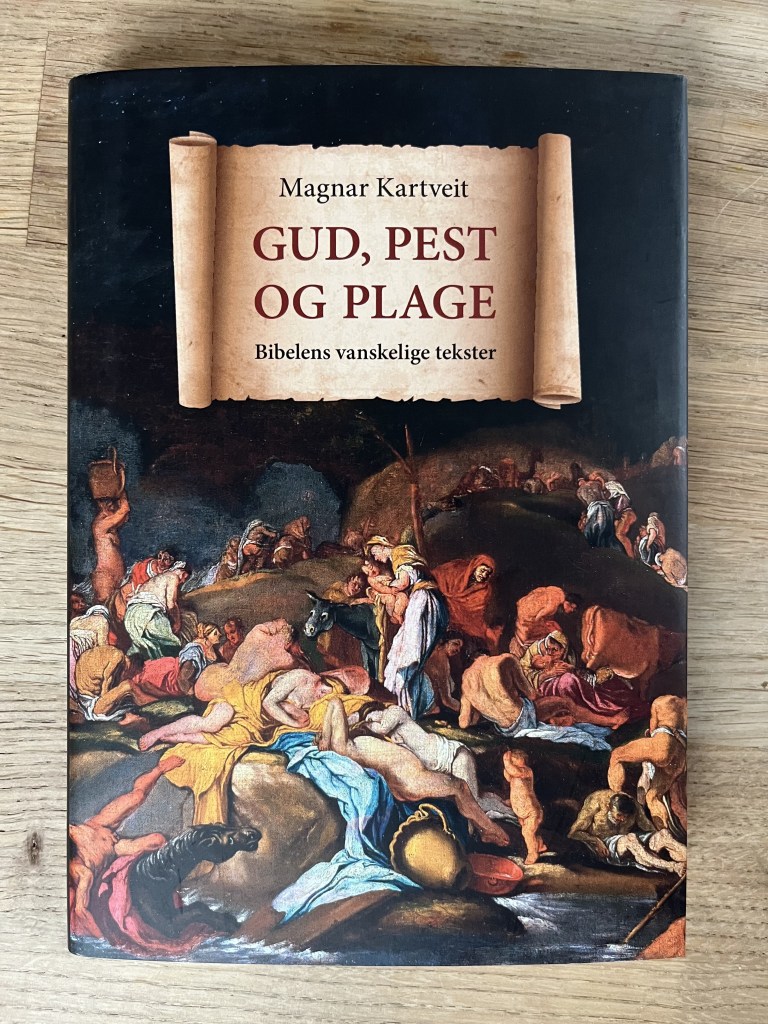
Here are my extra thoughts on what Magnar Kartveit writes in his eighth chapter, “Satans Begynnelse og Slutt” in his book Gud, Pest og Plage.
Magnar Kartveit’s book is written in Norwegian, so his quotes below are (currently) left in Norwegian. My review is written in Norwegian as well, but these extra responses have been left in English. See my review of his book Gud, Pest of Plage here.
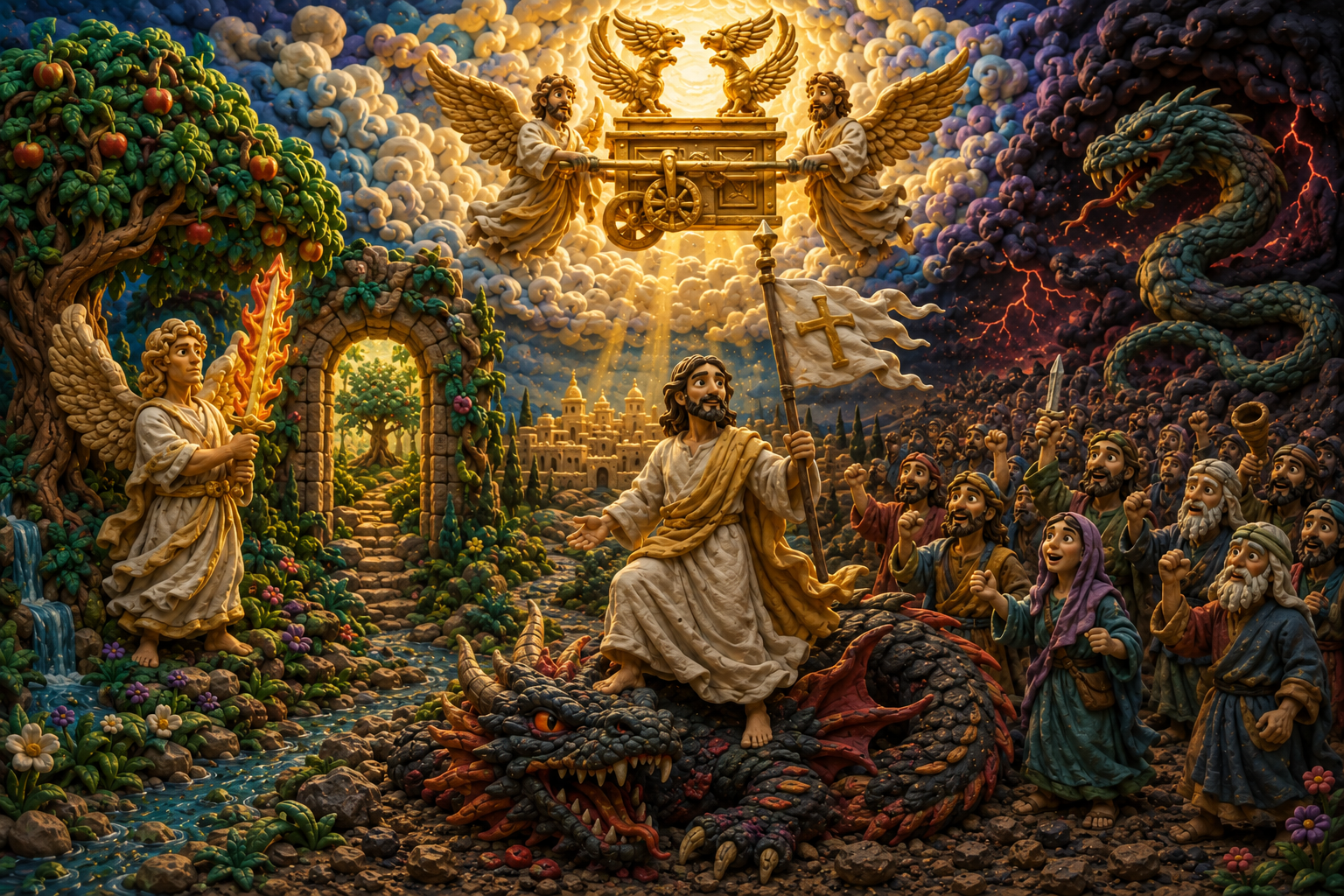
In this chapter Kartveit talks about how the story of 1 Chronicles 21 “is Satan’s birth.” («er Satans fødsel»). But, you ask, didn’t John write in Revelation 12:9 and 20:2 that the devil is the “ancient serpent”? Yes, he did, but Kartveit disagrees with John when he writes, “But the Old Testament thinks differently, for the serpent is an animal—that is, earthly—whereas the satan in the book of Job is part of the heavenly council, that is, supernatural. The serpent in Paradise is nothing more than an animal, but later interpreters attributed supernatural qualities to him and made him into the devil.” («Men GT tenker annerledes, for slangen er et dyr, altså jordisk, mens satan i Jobs bok er med i det himmelske rådet, altså overnaturlig. Slangen i paradiset er ikke noe annet enn et dyr, men senere tilla fortolkerne ham overnaturlige egenskaper og gjorde ham til djevel») (p. 85).
According to Kartveit, John was incorrect. The OT tells us that the snake is just an earthly snake, while Satan is a heavenly being. However, just a few pages before this, Kartveit believes that 1 Chron 21 changes the younger text of 1 Samuel 24. That is, “The Old Testament changes such explanations in later texts.” («GT endrer slike forklaringer i yngre tekster.») (p. 82).
Even if John did change the meaning of Genesis 3, why would that be a problem? If, according to Kartveit, the OT (1 Chron 21) can change the OT (2 Sam 24), why can’t the NT change the OT?
To continue this line of thinking, Genesis 1–2 tells us God alone created the earth. Yet both John (John 1) and Paul (Col 1) tell us Jesus created the world. In Isaiah 6, Isaiah stands before Yahweh, but John tells us Isaiah actually spoke of Christ (John 12:40-41). Was John wrong?
A Mere Animal?
Is the Leviathan of Isaiah 27:1—“the fleeing and twisting serpent”—a mere animal? Are the leviathan and the behemoth in Job mere animals too? According to Robert Fyall, the book of Job is using familiar imagery from both Canaanite and Mesopotamian myths not to make the Leviathan seem like “make believe,” but instead as “an attempt to embody in narrative the great truth of good and evil” (27). The horrible beast of Canaanite myths is actually really, the deadly ancient serpent. Job’s point is that we can neither understand nor control these spiritual beasts, but God can. See also Isa 51:9–10, and Pss 74:14–15, 89:10[11] and 104:26.
OT narratives are known to be filled with gaps, places where the reader isn’t given specific information in the narrative for some reason or other. Genesis 3 doesn’t give us all the details we might want, but other texts do help, such as Ezekiel 28.
More Than A Serpent?
Michael Heiser writes that even if we reject what the NT says about the devil as a serpent (as Kartveit does), the OT readers already held to the same conclusion. Heiser draws connections with Ezekiel 28 and the Garden of Eden in Genesis 2–3. The Garden of Eden was where God’s divine council was located. When the serpent told Eve that she would become like “God” if she ate the forbidden fruit, the word for God there is elohim, which can be either singular or plural depending on context (like the words dyr and hus in Norwegian, or deer and sheep in English). The serpent would be saying either Adam and Eve would be come like (1) the Lord God or (2) the gods and Yahweh.
Now I don’t think this needs to be the case, but for the sake of the argument, notice God’s use of the word “us” in Gen 3:22: The Lord God said, “Since the man has become like one of us, knowing good and evil, he must not reach out, take from the tree of life, eat, and live forever.” (To see God’s divine council in the Bible, read 1 Kings 22:19-23 and 2 Chronicles 18:18-22; Job 1:6-12; 2:1-7; Ps 82). I don’t necessarily hold this view of Gen 3:22 (I need to study it more), but it is a possibility.
Even though Ezekiel is speaking to the king of Tyre in Ezekiel 28, he uses imagery from the Garden of Eden. Who would the “anointed guardian cherub” have been in 28:14? Heiser writes,
“For example, the divine being of Eden is referred to as a cherub (kerûb) in Ezekiel 28:14—specifically a ‘guardian (hassôkek) cherub.’ This is not surprising, since kerûb comes from Akkadian kuribu, a term for a throne guardian” (65).
Heiser points to an article by Dale Launderville who lists the three roles of a cherub:
- to guard the source of life (Gen 3:24);
- to draw the chariot of God (Ps 18:11 = 2 Sam 22:11; 4 Ezek 1:5-20; 10:1-22);
- to serve as the throne for God (1 Kgs 6:23-28; 8:6-8).
Launderville notes how in Ezek 28:14 “an ‘anointed cherub’ (kerûb mimsah) functioned as a guardian (hassôkek) within the garden of Eden. … In the Mesopotamian tradition, there were numerous composite supernatural beings with human and animal characteristics, for example, the Snake dragon.”
Heiser also points to Bernard Batto and his work as providing a further possible description of the Edenic rebel: “The ‘serpent’ [was] a semi-divine creature with wings and feet like the seraphs in Isaiah 6:2, whose function was to guard sacred persons and sacred objects such as the tree of divine wisdom.”
This doesn’t mean that the snake in the garden was a snake-dragon-angel, but it is a possibility. Another thing to note is that John wasn’t the only person to connect the devil with the ancient serpent! In Romans 16:20 Paul alludes to Gen 3:15 when he tells the Roman church, “The God of peace will soon crush Satan under your feet.” And we see that the OT readers would have made the same connection. The snake in the Garden was not just an earthly snake. The OT and NT writers knew their Bibles well.
Resources
Books
- Now My Eyes Have Seen You by Robert Fyall
- The Unseen Realm by Michael Heiser
- Demons by Michael Heiser
- The Old Testament Use of the Old Testament by Gary Schnittjer
Article
Find my review and my notes on the other chapters here
- Bokanmeldelse/ Review
- Forandring i Gudsbildet (ch 3)
- Noahs Paradox (ch 4)
- Abraham skal ofre sin elskede sønn (ch 5)
- Guds vrede (ch 7)
- Yahweh eller Satan?
- Satans begynnelse og slutt (ch 8)
- Møter vi samme Gud i Det Gamle og Det Nye Testemente? (ch 15)

