
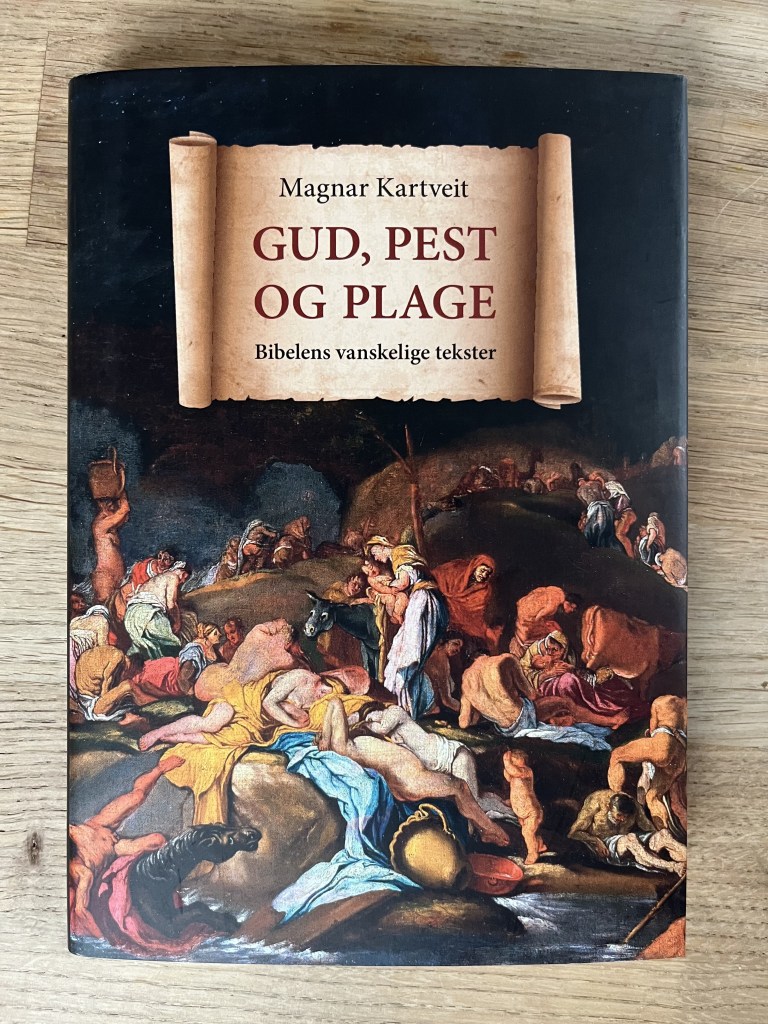
Here are my extra thoughts on what Magnar Kartveit writes in his seventh and eighth chapters.
Kartveit believes the Chronicler changed the text of 2 Samuel 24 from Yahweh inciting David to sin by taking a census to Satan inciting David to sin.
Magnar Kartveit’s book is written in Norwegian, so his quotes below are (currently) left in Norwegian. My review is written in Norwegian as well, but these extra responses have been left in English. See my review of his book Gud, Pest of Plage here.
Even though this is a possibility, Kartveit believes that the Chronicler replaces Yahweh with Satan because he can’t imagine why God would incite David to sin. He writes, “Then God commands David to take a census of the people, and he obeys this command. When the census has been completed, David realizes that he has committed a great sin, and the Lord punishes David and the people with a plague lasting three days. Seventy thousand people die. What kind of God is this, who punishes the people because the king carries out the Lord’s command? Was it a sin to be obedient?” («Så befaler Gud David å holde folketelling, og han følger dette pålegget. Når folketellingen er utført, skjønner David at han har gjort en stor synd, og Herren straffer David og folket med en pest som varer i tre dager. Sytti tusen mennesker dør. Hvilken Gud er dette, som straffer folket fordi kongen utfører Herrens ordre? Var det en synd å være lydig?») (p. 78).
Actually, 2 Samuel 24:1 does tell us why God incited David to count Israel. It was because God was angry with Israel. It says, “The Lord’s anger burned against Israel again, and he stirred up David against them to say, ‘Go, count the people of Israel and Judah.’” God was angry with Israel for some sin that isn’t described to us. And, just as God sends Nebuchadnezzar to judge Israel and then judges him for his sin, God incites David take a census of Israel’s fighting men so that he could judge Israel. Included in this, God judges David for his implicit sin. Unlike Nebuchadnezzar, however, David repents of his sin.
What would have been more helpful is for Kartveit to tackle this issue. Why (and perhaps how) does God incite David to commit this sin? If David repents of it later, then he shouldn’t have done it in the first place. This is what should be tackled. Instead, Kartveit writes, “The author [of the Books of Chronicles] gives a hint of the direction the Bible took in responding to God’s blind wrath.” («Forfatteren [av Krønikerbøkene] gir et hint om hvilken vei Bibelen gikk i møte med Guds blinde vrede.») (p. 79).
What is that “hint”? Kartveit believes 1 Chronicles 21 tells us what actually happened: it was actually Satan who incited David to take a census. Thus 2 Samuel 24 and 1 Chronicles 21 disagree. It seems the Chronicler has tampered with the text. However, Michael Heiser, Gary Schnittjer, and Michael Morales all disagree with this interpretation.
Before I get into that, if the Chronicler disagreed with 2 Samuel 24 and rewrote the scene to make Satan be the cause of David’s sin in 1 Chron 21, why didn’t he also rewrite the scene where God struck Uzzah dead for touching the ark of the covenant in 1 Chron 13:7–10? Kartveit believes that the explanation that God struck down Ussa gives us a picture of an immoral God. Why not then change that scene to make God look better? He writes,
“But I do not have to accept that Uzzah fell because the Lord struck him. The Old Testament changes such explanations in later texts, and therefore I am not compelled to see the Lord’s anger behind Uzzah’s death. That explanation gives a picture of God that we consider immoral. The author of the Books of Chronicles probably had a similar reaction when he edited the story of David’s census and removed the Lord’s wrath as the initiating cause.” (emphasis mine)
(«Men at Ussa faller fordi Herren har slått, behøver jeg ikke å overta. GT endrer slike forklaringer i yngre tekster, og derfor er jeg ikke nødt til å se Herrens harme bak Ussas død. Den forklaringen gir et bilde av Gud som vi synes er umoralsk. Forfatteren av Krønikebøkene hadde trolig en lignende reaksjon da han redigerte fortellingen om Davids folketelling og fjernet Herrens vrede som utløsende årsak.»)
There is a good explanation within the Bible itself on why God struck down Uzziah/Ussa. And there is a good explanation for 1 Chronicles 21 too.
Satan in 1 Chronicles 21
The Hebrew word satan means “adversary” or “the opposer.” Kartveit believes that since the Hebrew word satan doesn’t have the definite article in front of it in 1 Chron 21:1, it means it is the heavenly enemy Satan (so it reads satan instead of hasatan, the adversary, the Satan). But this isn’t necessarily the case because Hebrew doesn’t have an indefinite article, as Kartveit notes, “Hebrew has no indefinite article, and words without the article can mean several things.” («Hebraisk har ingen ubestemt artikkel, og ordene uten artikkel kan bety flere ting.») (p. 86).
Which Adversary?
So which is it? Was it “an adversary/opposer” who incited David to take a census of Israel or was it “Satan”? Morales writes, “As a functional concept, used without a definite article (i.e. not as a proper noun), śāṭān describes one who intervenes on behalf of YHWH” (136).
As I’ve mentioned, interpreters such as Michael Heiser, Mark Boda, and Gary Schnittjer all see a connection with the angel of the Lord in the episodes with Balaam and his donkey (Num 22:22) and the adversary in 1 Chr 21:1.
Numbers 22:22 reads, “But God was incensed that Balaam was going, and the angel of the Lord took his stand on the path to oppose [לְשָׂטָ֣ן, lesatan] him.”
Numbers 22:32 reads, “And the angel of the LORD said to him, ‘Why have you struck your donkey these three times? Behold, I have come out to oppose [לְשָׂטָ֣ן, lesatan] you [lit., “I have come as a satan”] because your way is perverse before me.’”
In his book Demons, Michael Heiser observes that “the solution is not complicated if 1 Chronicles 21:1 is interpreted in light of Numbers 22:22, 32, the only other instance where” the Hebrew word satan is used “without the article used to describe a divine being” (79). And according to Schnittjer, the Chronicler picked up themes from the heavenly messenger in the Balaam story to explain God’s judgment against Israel (749).
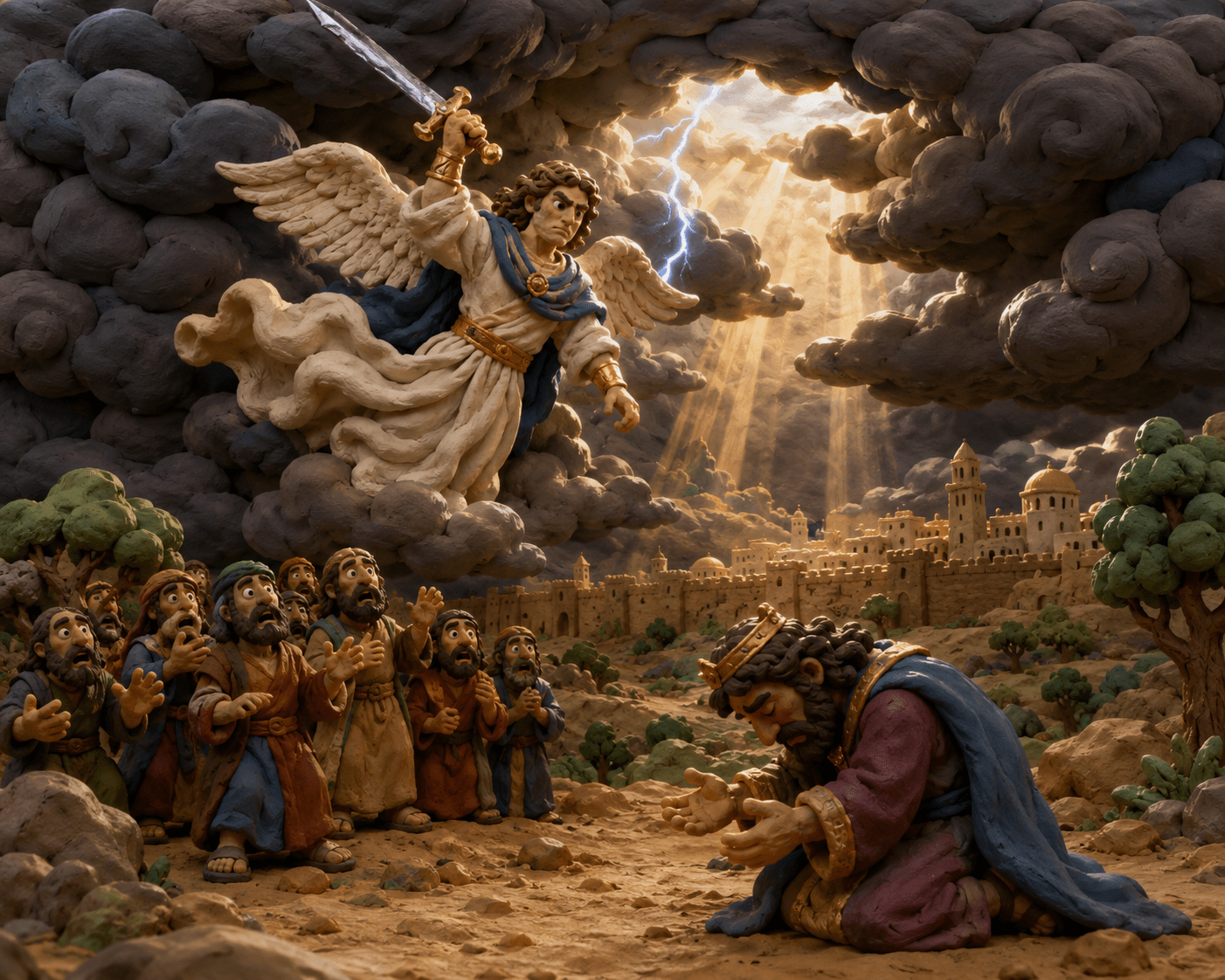
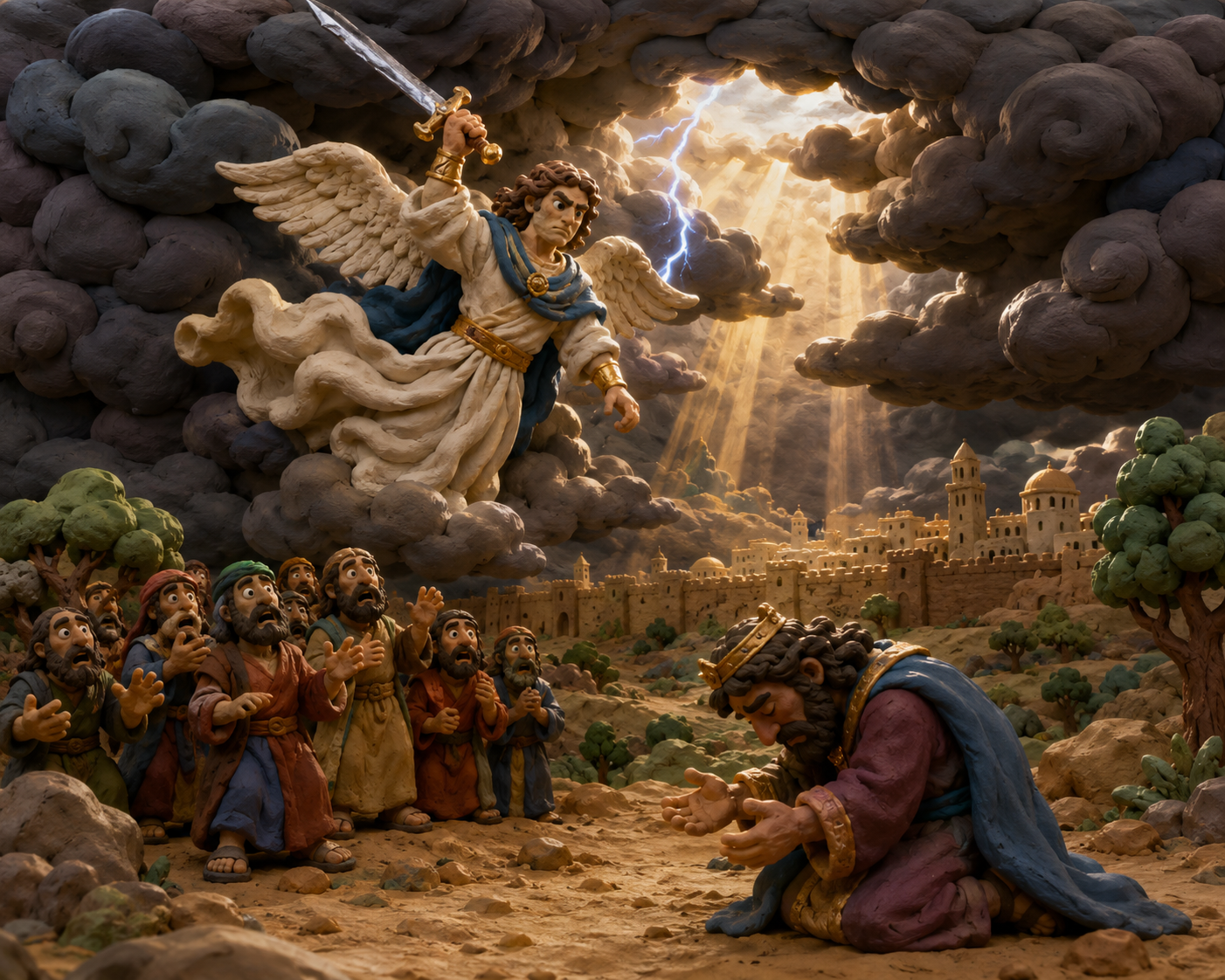
In both chapters the angel of the Lord has a sword in his hand (Num 22:23, 31; 1 Chron 21:16, 27, 30), and he is even present with a sword in a fragment from the Dead Sea Scrolls of Samuel (2 Sam 24:16 4QSam). While the adversary could be a human opposer (human adversaries (satans) against Solomon (1 Sam 29:4; 2 Sam 19:22[23]; 1 Kgs 11:14, 23, 25), the evidence points more to a divine opponent who is not “Satan” but the angel of the Lord functioning in God’s place.
Heiser again writes,
In light what we read in Numbers 22:22 and 32, 1 Chronicles 21:1 ought to be translated, “Then an adversary stood against Israel…” “This adversary is later identified as the angel of Yahweh in both accounts (1 Chr 21:14-15; 2 Sam 24:15-16). If, as evident in other Old Testament accounts, Yahweh and his angel were identified with each other or their distinct identities were blurred (e.g., Gen 48:15-16; Exod 3 [cf. Josh 5:13-15]; Judg 6), then there is no contradiction between the passages. The angel and Yahweh can be co-identified. The answer to the question of who incited David is “Yahweh” in both accounts. (80)
Kartveit believes that Satan replaces God as the one who incites David to sin, and if so, that it is “a fundamental change in the picture of God, and it is very striking that such a change took place.” («…en grunnleggende forandring i gudsbildet, og det er meget påfallende at en slik endring skjedde.») (p. 86). However, if the interpretation I have presented above is true, then there is no change in how God is viewed («forandring I gudsbildet») at all. In fact, to have the angel of the Lord stand in God’s place has already been seen a number of times in the OT (e.g., Gen 48:15-16; Exod 3:2-4; Josh 5:13-15; Judges 6:11–24). There is, in fact, no contradiction between 2 Samuel 24 and 1 Chronicles 21.
Resources
Books
- 2 Samuel by Dale Ralph Davis
- Numbers 20–36 by L. Michael Morales
- The Unseen Realm by Michael Heiser
- The Old Testament Use of the Old Testament by Gary Schnittjer
- 1 & 2 Samuel by David Firth
- 1 & 2 Samuel by Mary Evans
- 1 & 2 Samuel by Robert Bergen
Articles
- The Trinity in the Old Testament
- And He Struggled With the Angel
- He Rides the Clouds
- The Holy Spirit
Find my review and my notes on the other chapters here
- Bokanmeldelse/ Review
- Forandring i Gudsbildet (ch 3)
- Noahs Paradox (ch 4)
- Abraham skal ofre sin elskede sønn (ch 5)
- Guds vrede (ch 7)
- Yahweh eller Satan?
- Satans begynnelse og slutt (ch 8)
- Møter vi samme Gud i Det Gamle og Det Nye Testemente? (ch 15)

