
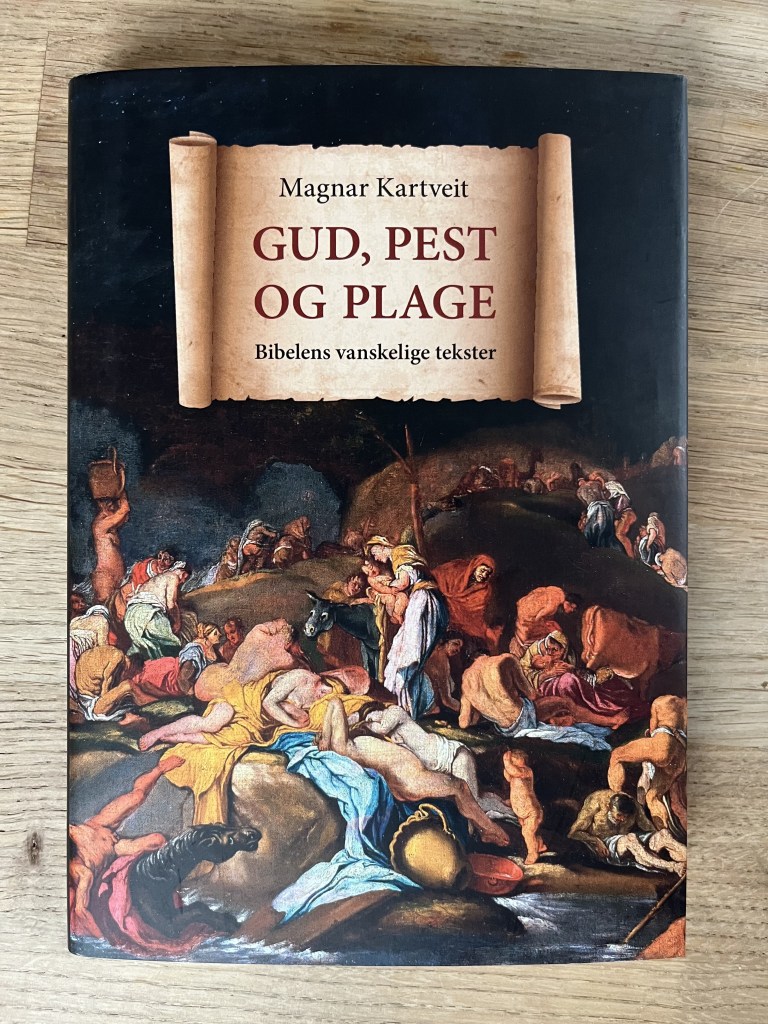
Here are my extra thoughts on what Magnar Kartveit writes in his last chapter, “Møter vi samme Gud i Det gamle og Det nye testemente?” in his book Gud, Pest og Plage.
Magnar Kartveit’s book is written in Norwegian, so his quotes below are (currently) left in Norwegian. My review is written in Norwegian as well, but these extra responses have been left in English. See my review of his book Gud, Pest of Plage here.
In this final chapter, Kartveit believes we meet the same God in the OT and in the NT, but that he is portrayed differently. He believes the NT changes the content and the meaning of words of the OT texts. Kartveit does at least agree that there are texts dealing with both God’s wrath and compassion in both Testaments. However, this chapter was a jumble of thoughts that simply didn’t work well together.
I will begin with what Kartveit writes about the way the NT interprets the OT. He believes that the Hebrews 3–4 quotes and uses Psalm 95 changes the meaning of “rest” in Psalm 95. He writes, “In the Old Testament, the word often means rest in the promised land. In Hebrews, ‘rest’ means eternal life.” («I GT betyr ordet ofte hvile i det lovede land. I Hebreerbrevet betyr «hvile» evig liv») (179).
After this Kartveit writes that we “expect that God’s word in the Old Testament means the same thing over time” («forventer at Guds ord i GT betyr det samme over tid.»), but because ““Jesus fulfills the expectations of the Old Testament, he makes the literal understanding unnecessary through his life and his death, and fills the words with a different content.” («Jesus oppfyller forventningene i GT, gjør han den bokstavelige forståelsen overflødig ved sitt liv og sin død, og fyller ordene med et annet innhold»)” (p. 180). So, Jesus doesn’t “fulfill” these words, he just gives them a different meaning.
How can the NT authors change the meaning of OT texts? Kartveit writes, “God’s word is living, and like living organisms, it changes.” («Guds ord er levende, og i likhet med levende organismer forandrer det seg») (p. 180).
This way of interpreting the Bible just isn’t true. What Kartveit writes sounds very similar to Richard Longenecker’s book, where he wrote that we today cannot replicate the interpretive methods of the NT authors. They did not interpret the OT texts in their original contexts, but changed them through the use of Midrashic techniques to speak about Jesus. The reason why we still read the NT is because it tells us of the Savior of the world and it is inspired by the Holy Spirit. But that doesn’t makes sense. If anyone knew how to interpret the Bible, it was Jesus. And the NT authors interpret the OT in the same way as the OT interprets itself.
First, Hebrews uses the rebels in Ps 95 as an example of how God’s faithful community should not live (Heb 3:16–4:1). Those who rebelled in the wilderness (such as Korah, Num 16) did not get to enter the promised land. However, Hebrews tells us that even Joshua wasn’t able to bring Israel into God’s eternal rest. Hebrews hardly changes the meaning of “rest.” The author keeps the entire biblical storyline in view. What do I mean?
God made the seventh day a day of rest, the holy sabbath. In both the wilderness and Promised Land, every person and animal in Israel would rest on the Sabbath day. All Israel would remember that God is their King, they are dependent upon him, and he gives them life and rest.
The temple in the Tabernacle pointed back to the garden of Eden, where Adam and Eve had a perfect relationship with God in his presence. Israel had a small taste of this through God’s presence in the tabernacle. However, the majority of Israel couldn’t even enter the tabernacle. God gave Solomon rest from Israel’s enemies (1 Kgs 5:4; 1 Chron 22:9-10), but because of his idolatry, the kingdom began to crumble. Because of Israel’s idolatry, the northern kingdom was eventually dispersed by Assyria and the southern kingdom was sent into exile to Babylon. God’s presence left Israel (Ezek 11:22–23).
But as our perfect High Priest, Jesus, the Son of God, has given a complete sacrifice for our sins. He ascended to the Father and is seated at his right hand, ruling and reigning as our King and High Priest. He gives us now spiritually the eternal rest that we will get completely in the new creation.
Hebrews says that its readers (and us today) should not be like Israel who went through the exodus but rebelled and died in the wilderness. We have gone through a second exodus in the death and resurrection of Jesus. We who believe need to remain faithful and obedient to Jesus so that we may enter God’s complete and eternal rest!
Hebrews did not change the meaning of “rest.” The author kept the whole story of the Bible in mind.
God Speaks
Even more so, Hebrews tells us that Psalm 95 is:
- the Holy Spirit’s words then and now (as the Holy Spirit says, Heb 3:7),
- they are the words of Scripture (as “it” is said, 3:15),
- and they are God’s words (4:3, 5, 8)
- spoken through David (4:7).
If all of the Bible is the Holy Spirit’s words (2 Tim 3:16; Jn 16:13), then it is all God’s words. If God is trustworthy and does not lie (Titus 1:2), then his word is trustworthy. If God is all truth (1 John 1,5; 5,20), then his word is too.
In Heb 4:4 we read that the words of Genesis 2:2 are God’s words (“he has spoken”). Jesus himself says in Matthew 19:5 that God spoke Genesis 2:24. Hebrews tells us God spoke in the first creation account; Jesus in Matthew’s Gospel tells us God spoke in the second creation account.
Perhaps these two accounts shouldn’t be separated per the Documentary Hypothesis?
Everyone ought to remember the words of Hebrews 12:25: “See to it that you do not reject the one who speaks.”
Kartveit continues, “Quotations from the Old Testament have received new content. Hebrews’ expression that God’s word is living captures this development. A living word is a word that receives new content when the New Testament quotes it.” («Sitater fra GT har fått nytt innhold. Hebreerbrevets uttrykk om at Guds ord er levende, fanger opp denne utviklingen. Et levende ord er et ord som får nytt innhold når NT siterer det») (p. 183).
I don’t completely disagree with this. Hebrews completes what these texts have always pointed toward. Now that Christ has come we can see and understand what the OT pointed toward. When we understand the whole biblical story, we understand Psalm 95 in a greater way than the OT saints did.
Kartveit notes how both the Qumran community and Paul gave Habukkuk “completely different content” («med helt forskjellig innhold») to point to Jesus (181). I have written about this elsewhere (thanks to Jason Staples), but in a different way from what Kartveit believes.
Resources
Books
- Paul and the Resurrection of Israel by Jason Staples
- Hebrews by Sigurd Grindheim
- Hebrews by Tom Schreiner
- Psalms (two volumes) by James Hamilton
Article
Find my review and my notes on the other chapters here
- Bokanmeldelse/ Review
- Forandring i Gudsbildet (ch 3)
- Noahs Paradox (ch 4)
- Abraham skal ofre sin elskede sønn (ch 5)
- Guds vrede (ch 7)
- Yahweh eller Satan?
- Satans begynnelse og slutt (ch 8)
- Møter vi samme Gud i Det Gamle og Det Nye Testemente? (ch 15)

