

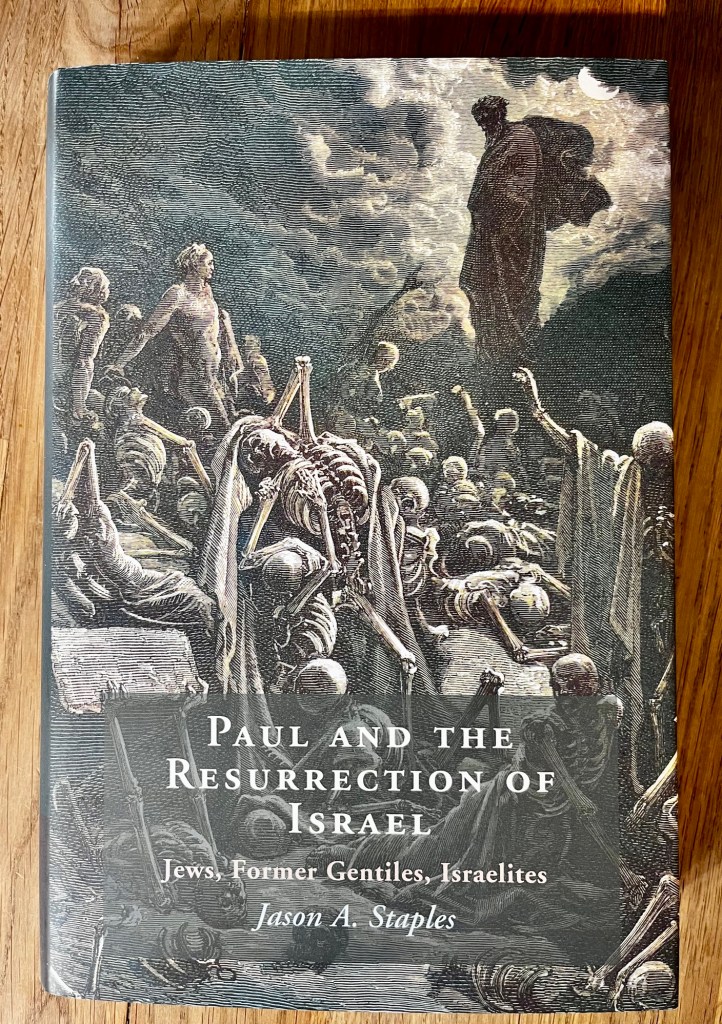
What Is Paul & the Resurrection of Israel About?
Paul & the Resurrection of Israel by Jason Staples offers a coherent explanation of one of the most debated sections in the Bible: Romans 9–11. Many readers, scholars, and theologians have struggled with these chapters:
- Is Paul contradicting himself?
- Are Jews still central to God’s plan?
- How do Gentiles fit into Israel?
- Who is “all Israel”?
- (see my review of Naselli’s book for the interpretive options)
Staples argues that Paul is neither confused nor inconsistent. Instead, he is deeply rooted in Second Temple Jewish thought, and his message reflects a unified vision that God is restoring all Israel through Jesus the Messiah. So, the question remains, who is all Israel, and what does Paul mean by all Israel will be saved?
Why Romans 9–11 Is So Difficult
Romans 9–11 has puzzled theologians for centuries because it seems to say two things at once:
- Gentiles are now included in God’s people;
- Israel continues to have a unique role in salvation history.
Staples resolves this tension by showing that these ideas do not contradict. They hang together within a larger restoration eschatological narrative that many of us evangelicals aren’t aware of but of which other Jews held, only that this narrative would be fulfilled in Jesus Christ.
Jason Staples is assistant teaching professor in the Department of Philosophy and Religious Studies at North Carolina State University. He places himself within the broad movement called “Paul within Judaism,” while also being critical of it too.
Staples’ Core Argument
Staples’ main idea is that
God promised to restore all twelve tribes of Israel, and this promise is fulfilled through Jesus, and it includes both Jews and Gentiles.
This means that Gentiles are not replacing Israel. Rather, they are being incorporated into Israel.
Staples cites prophetic promises from the OT that God would restore the northern kingdom of Israel from the nations. For example, in Romans 9:22–26, Paul quotes from Hosea when he writes,
22 What if God, although choosing to show his wrath and make his power known, bore with great patience the objects of his wrath—prepared for destruction? 23 What if he did this to make the riches of his glory known to the objects of his mercy, whom he prepared in advance for glory— 24 even us, whom he also called, not only from the Jews but also from the Gentiles? 25 As he says in Hosea:
“I will call them ‘my people’ who are not my people;
and I will call her ‘my loved one’ who is not my loved one,” [Hos 2:23]26 and,
“In the very place where it was said to them,
‘You are not my people,’
there they will be called ‘children of the living God.’” [Hos 1:10]
This is fulfilled when gentiles (who are “not God’s people”) follow Jesus Christ as Lord. They receive the Spirit, become Abraham’s seed and thus part of Israel, experiencing the redemption originally promised to them.
A Difference between “Jews” and “Israel”
Many believe that Paul wrote about Jews and Israel interchangeably. They believe it didn’t matter which word Paul used because they both meant the same thing. Staples disagrrees. According to him, the Jews were a subset of the larger superset “Israel.” The idea is that in 1 Kings, Israel splits into the Northern Kingdom of Israel and the Southern Kingdom of Judah. Israel was dispersed by the Assyrians, and Judah was exiled to Babylon.
In Ezra 6:17, the priests, Levites, and the rest of the exiles celebrated the dedication of the house of God by offering sacrifices, twelve male goats, one for each of the tribes of Israel. Sin offerings were offered for the missing tribes because the remnant believed God’s promises about their future restoration.
How is “Israel” Significant?
Paul rarely uses the term “Israel” in his letters, but he uses it thirteen times in Romans 9–11. He refers to “Jews” only twice in these three chapters, but numerous times in his other letters. Why is this? Staples points to Second Temple literature and Josephus and says that “Israel” referred to:
- the people of the biblical past;
- in cultic settings (so referring to the “God the Israel” in prayers); and
- “referring to eschatological Israel, including both Jews and northern Israelites” (58).
Because Israel rebelled against God’s torah, they experienced the covenantal curses, specifically exile (also called “death,” Ezek 37; Deut 30:17–20). God would “redeem, reunify, and restore all twelve tribes of Israel to covenantal favor,” and this would include the inward transformation of the heart as promised through the new covenant. This explains how Jeremiah can give the promise of the new covenant to “the house of Israel and the house of Judah” (Jer 31:31) and how Hebrews can include gentiles in that same new covenant (Heb 8:8–12).
Before Jesus ascended to the Father, the disciples asked Jesus, “Is this the time that you restore the kingdom to Israel?” (Acts 1:6). What happens after this is that the Spirit is given as promised (Acts 2:33, 38) in connection with the new covenant (Ezek 36:26–27; Jer 31:33) so that those who receive the Spirit are God’s people. So when Gentiles begin to receive the Spirit in Acts 10:44–45, they become sons of Abraham (Gal 3:7, 14).
Paul was controversial among other Jews because he insisted that “the eschatological hopes of Israel were already being fulfilled through Jesus,” as well as that uncircumcised non-Jews “could be included as full members of the new covenant” (106).
The Rest—Romans 1, 2, 9–11
This leads us to the book of Romans, which Staples believes is “a defense of how gentile incorporation in the ekklesia following Israel’s messiah is inextricably linked to Israel’s salvation and is paradoxical proof of God’s faithfulness to Israel” (111).
For the rest of the book (chapters 3–7), Staples both surveys and dives deep into Paul’s argument in Romans.
Chapter 3—the Israel Problem and the Gentiles
Staples argues from Romans 1–2 that all humanity, including Israel, stand under sin and God’s impartial judgment (135). As Staples writes, “possession of the Torah, birth, and circumcision provide no security against God’s impartial judgment if one does not behave justly” (142). Both disobedient Jews and sinful Gentiles face judgment alike. So a “disobedient Jew will receive the same punishment as a sinful gentile,” but then at the same time a gentile who doesn’t have the torah who “does the things of the Torah” (Rom 2:14; cf. Deut 6:4; Heb 3:16, 18–19) will receive the same “glory, honor, and immortality” (142).
Chapter 4—Salvation Through Justification
Staples interprets Romans 2 through the lens of the new covenant promises: God transforms hearts so that people can truly obey him. The Torah exposed sin, but it could not repair the hearts. It is only God’s promised work of circumcising hearts and giving the Spirit that enables obedience. Justification, then, is not God declaring the unjust to be just without change, but God making people into “doers of the Torah” who can be rightly declared righteous (146).
Gentile inclusion follows naturally. Through the Spirit, they fulfill the intent of the Torah. Grace (“reciprocal gift-giving,” p. 175) is a relational, transformative gift that produces obedience. This is in accordance with what is promised in Deut 30:6, that Yahweh would circumcise Israel’s hearts in order to love him with all their heart and soul. Thus, the gospel is not “Torah-free” but “Torah-implanted,” as God fulfills his promises by enabling both Jews and Gentiles to live faithfully.
Chapters 5–7—God’s Fidelity, God’s Justice, and Israel’s Mysterious Salvation
Chapters 5–7 cover Romans 9–11 and how uncircumcised gentiles who receive the Holy Spirit does not undermine God’s promises to Israel but represents God’s faithfulness and power to Israel. These chapters explain
- how the uncircumcised were being incorporated and;
- why the reunification and restoration of all twelve tribes of Israel seems not to be happening as anticipated (186–87).
God has been “over-faithful,” even extending redemption to gentiles to fulfill his word and redeem “all Israel” (11:26). A few things Staples looks at would be:
- the imagery of the Potter and the clay and the meaning of “vessels of wrath”;
- how to understand Jesus as the Just one spoken of (perhaps, prophesied?) in Habakkuk 2:4;
- As Staples writes, “Israel’s justification depends on the spirit, and the spirit comes from Israel’s faithful messiah, not from ‘works of Torah’” (264). So since Jesus fulfilled Leviticus 18:5b (Gal 3:11), he can justify Israel through pouring out his Spirit onto them, and he can extend the blessing of Abraham to the nations.
- how to understand Romans 10:6–8;
- how to understand the pruning of the olive tree and grafting in the wild olive branches; and
- Paul’s mystery, “the fullness of the nations,” and how that connects with Gen 48:19 and Ephraim (also the epithet for the Northern Kingdom).
Chapter 8—The End
Staples concludes that God will indeed fulfill his promise to save “all Israel,” and that Gentile believers in Christ are included within this renewed Israel. His reading offers a coherent solution to many debated Pauline texts, and I hope that many scholars of different stripes (OPP, *Reformed, NPP, etc.) will agree with large portions of Staples’s argument. There will be things they quibble with or largely reject. For example, many in the Reformed community will probably disagree with Staples’s argument of the Potter/clay imagery. Others will disagree with Staples’ emphasis on intertestamental, non-canonical texts.
*Many of Staples’s arguments still work within Reformed theology (such as salvation being conditioned upon our works; God circumcising our hearts in order to love him).
Recommended?
Matthew Bates wrote that this book is the most important book on Paul since John Barclay’s book in 2015. What I can tell you is that so much of this book made sense. I still have questions about the implications of Staples’s interpretations. And this requires both a greater knowledge of PwJ interpretations as well as Staples’s own critiques. But what I’ve heard so far from him makes a lot of sense and is worth thinking through.
Staples does a lot of heavy lifting in his book. It is required for his task, but it is oh so worth it. I’ve never heard of Jewish restoration eschatology before this book, but now I want to look more into it. I’ve been wanting to read the Apocrypha and other Second Temple Literature, and if Staples is correct, understanding these neglected books is important in understanding Paul as a first-century Jew who believed Jesus as the Messiah who fulfilled the OT. This is absolutely my favorite book this year, but also my favorite book that I’ve read for a long time. Staples provides greater coherence to Paul’s theology and answers numerous questions. Highly recommended!
Buy it from Amazon or Cambridge University Press!
Related Post:
Lagniappe
- Author: Jason A. Staples
- Hardcover: 435 pages
- Publisher: Cambridge University Press (January 11, 2024)
- Read the Preface, Intro, and Table of contents
- Onscript podcast
Buy it from Amazon or Cambridge University Press!
Review Disclosure: I received this book free from Cambridge University Press. The opinions I have expressed are my own, and I was not required to write a positive review. I am disclosing this in accordance with the Federal Trade Commission’s 16 CFR, Part 255 http://www.access.gpo.gov/nara/cfr/waisidx_03/16cfr255_03.html.
Amazon Affiliate Disclosure: As an Amazon Associate I earn from qualifying purchases.


Welcome to my world. Believe it or not, over 40 years ago, I was taught many of these ideas as an adolescent by an uncle with biblical/historical insight. It changes who you are and how you view the world. Dr Staples has given a great gift to the household of faith with his two books. Joseph, is alive among the nations!
LikeLiked by 1 person
Goodness, I can’t believe I didn’t comment on this before. My apologies. From whom did you hear this 40 years ago? The church, books, etc.? Very interesting that it has come up again.
LikeLike