
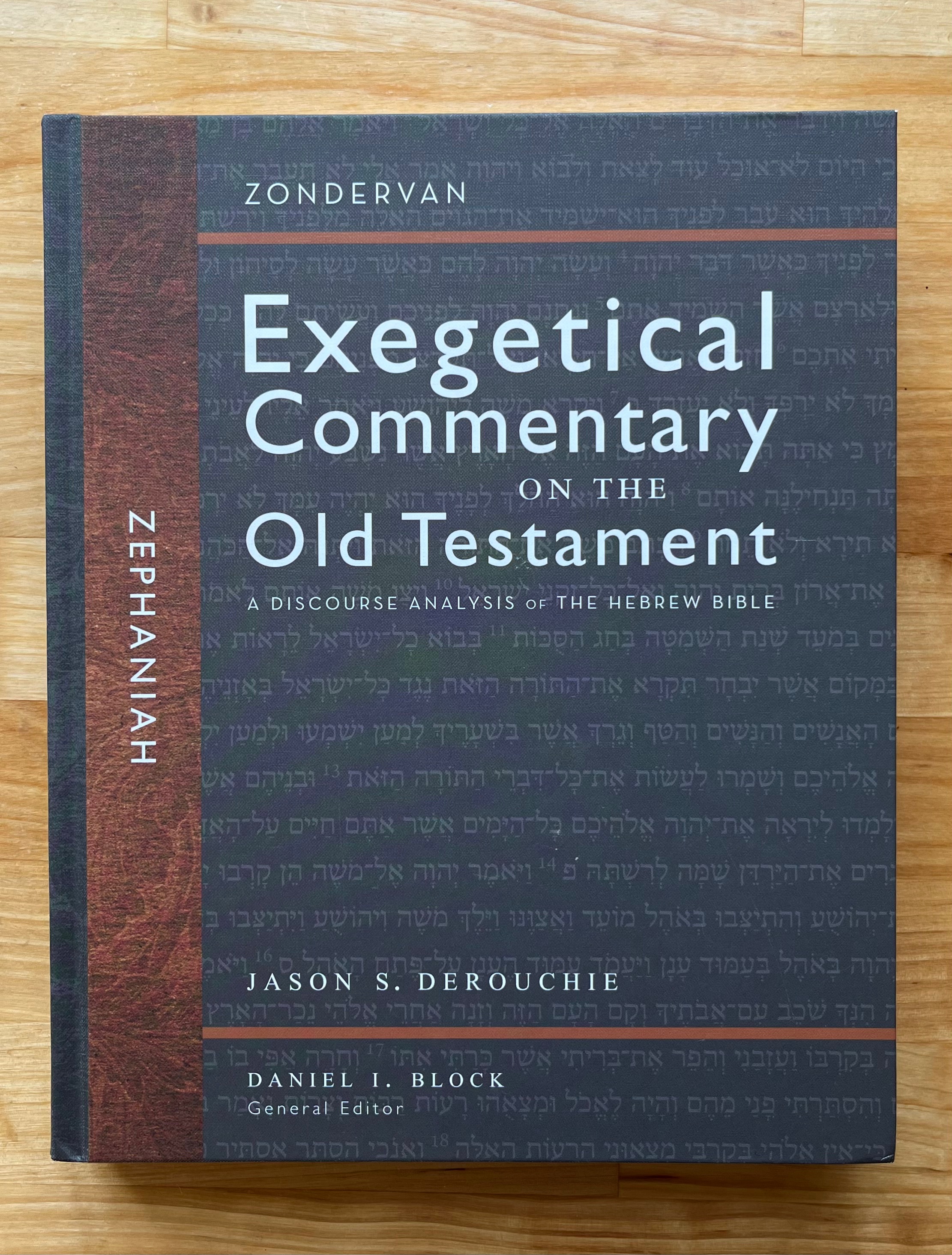
How should we read and preach the book of Zephaniah? In his ZECOT commentary, Jason DeRouchie argues that understanding the book’s structure is essential for grasping its message. Though Zephaniah is only three chapters long and not a typical book pastors reach for to preach from, this commentary shows that it is carefully arranged and theologically rich.
DeRouchie’s volume offers a detailed, text-focused analysis of Zephaniah, with careful attention to literary structure, rhetorical features, and how the book’s message unfolds within the broader biblical canon.
Summary: DeRouchie reads Zephaniah as a unified covenant warning addressed to both Judah and the nations. The book calls the faithful remnant to respond in two key ways: to seek the Lord and to wait for him.
These commands are grounded in two central realities: God’s coming judgment and his promise to restore a remnant. Structurally, DeRouchie argues that everything in Zephaniah builds toward these responses, making the book both tightly organized and theologically purposeful.
At only 53 verses long, I was honestly surprised to see his commentary runs just over 300 pages. His depth in this short book makes more sense when you realize that, after listing key works on Zephaniah, DeRouchie includes eighteen of his own contributions on this short book (many found here).
Jason DeRouchie is the Research Professor of Old Testament and Biblical Theology at MBTS; Content Developer and Global Trainer with Hands to the Plow Ministries; a Pastor of Sovereign Joy Baptist Church. He blogs at Jasonderouchie.com.
An Introduction Matters
After providing his own translation, DeRouchie opens with the usual introductory topics of authorship, date, genre, and audience. In addition, he covers Zephaniah’s macrostructure, hermeneutic, and theology. He finishes up with a helpful section on how to proclaim Zephaniah today.
DeRouchie reads Zephaniah as a unified covenant warning aimed at both Judah and the surrounding nations. The prophets commands to the faithful remnant to seek YHWH together and to wait for Him are grounded in two realities: (1) God’s coming judgment on both Judah and the nations, and (2) His promise to save a remnant from among them.
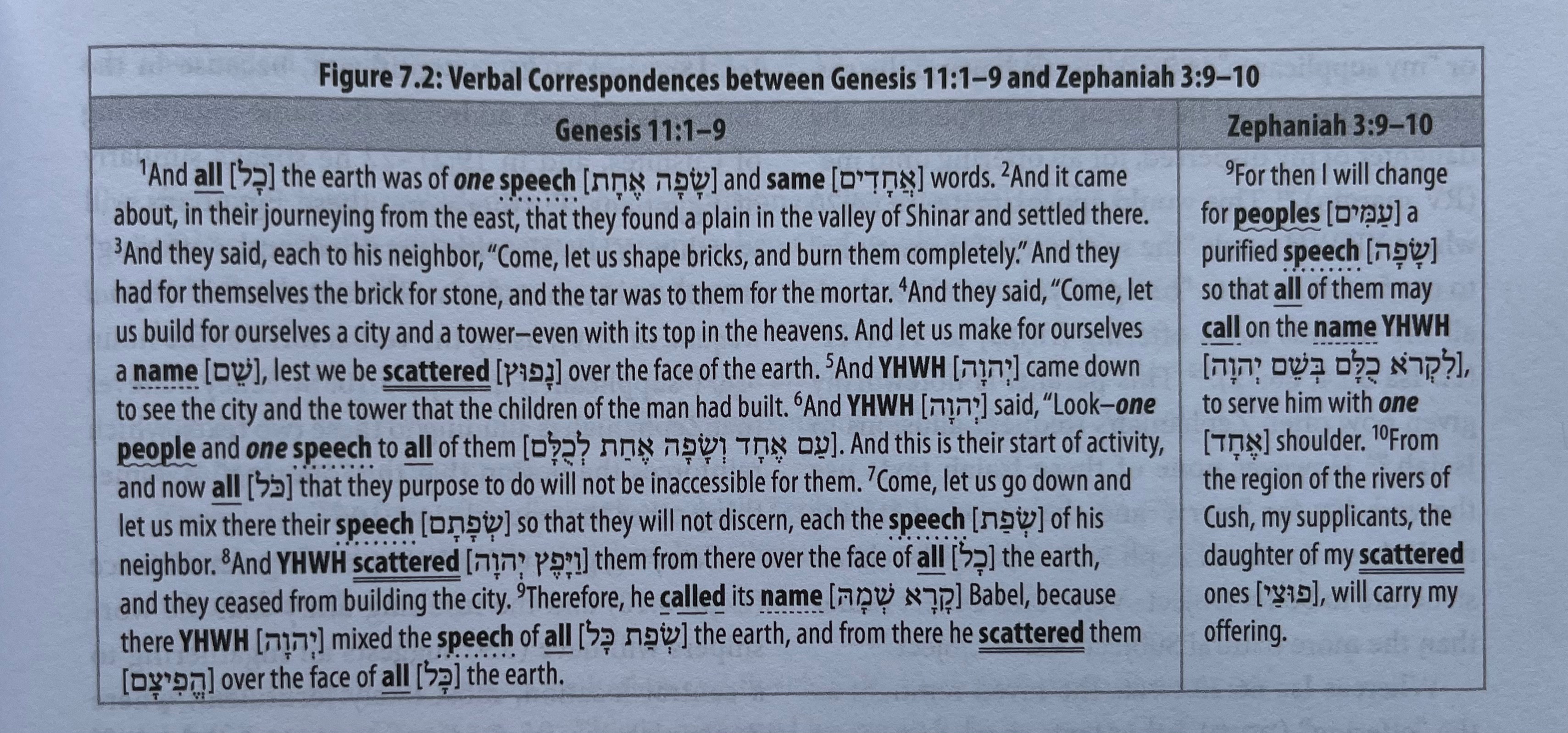
He argues that the book is structured in two main parts, “where exhortations come after an opening setting” (p. 14):
- Setting: the coming judgment (1:2–18)
- Main message:
- Seek the Lord (2:1–3:7)
- Wait for the Lord (3:8–20)
Everything in the book builds toward these key commands that call for a response.
DeRouchie’s Approach to Reading Zephaniah
DeRouchie’s approach is grounded in the idea that understanding Scripture means reading it carefully as a unified whole, paying attention to how each part connects to the rest. Drawing on insights similar to “new form criticism,” he emphasizes literary structure, discourse flow, and rhetorical development (in line with the goals of this series). He balances close attention to grammar (words and phrases) with the broader rhetorical argument of the book.
To trace the book’s argument, he pays attention to sentence connections, shifts in speakers, repeated patterns, key terms, and grammatical features. This allows him to show not just what the text says, but how it communicates its message.
In his discussion of Zephaniah’s hermeneutic and theology, DeRouchie explores the book’s place within the Minor Prophets, its use of earlier Scripture, its vision of the Day of the Lord, and its emphasis on YHWH’s exaltation. When it comes to preaching, he notes that Zephaniah captures the heart of prophetic theology because it addresses the three main themes prophets consistently deal with: sin, judgment, and restoration (49).
Commentary Structure and Features
Each section of the commentary follows a consistent format:
- Main Idea of the Passage – A concise summary in one or two sentences.
- Literary Context – How the passage fits into the larger flow of the book.
- Translation and Outline – DeRouchie’s own translation and structural outline.
- Structure and Literary Form – A look at literary features like key words, motifs, pronoun shifts, parallels, and contrasts.
- Explanation of the Text – Detailed analysis of words, phrases, syntax, and how the material is arranged.
- Canonical and Practical Significance – How the passage fits into the whole Bible and what it means for readers today.
This last section is especially helpful. Given DeRouchie’s work on understanding the Old Testament, his guidance here is consistently insightful and practical.
Example: Zephaniah 3:11–20
One example of DeRouchie’s method comes in his treatment of Zephaniah 3:11–20. Here is an example of his exegetical outline.
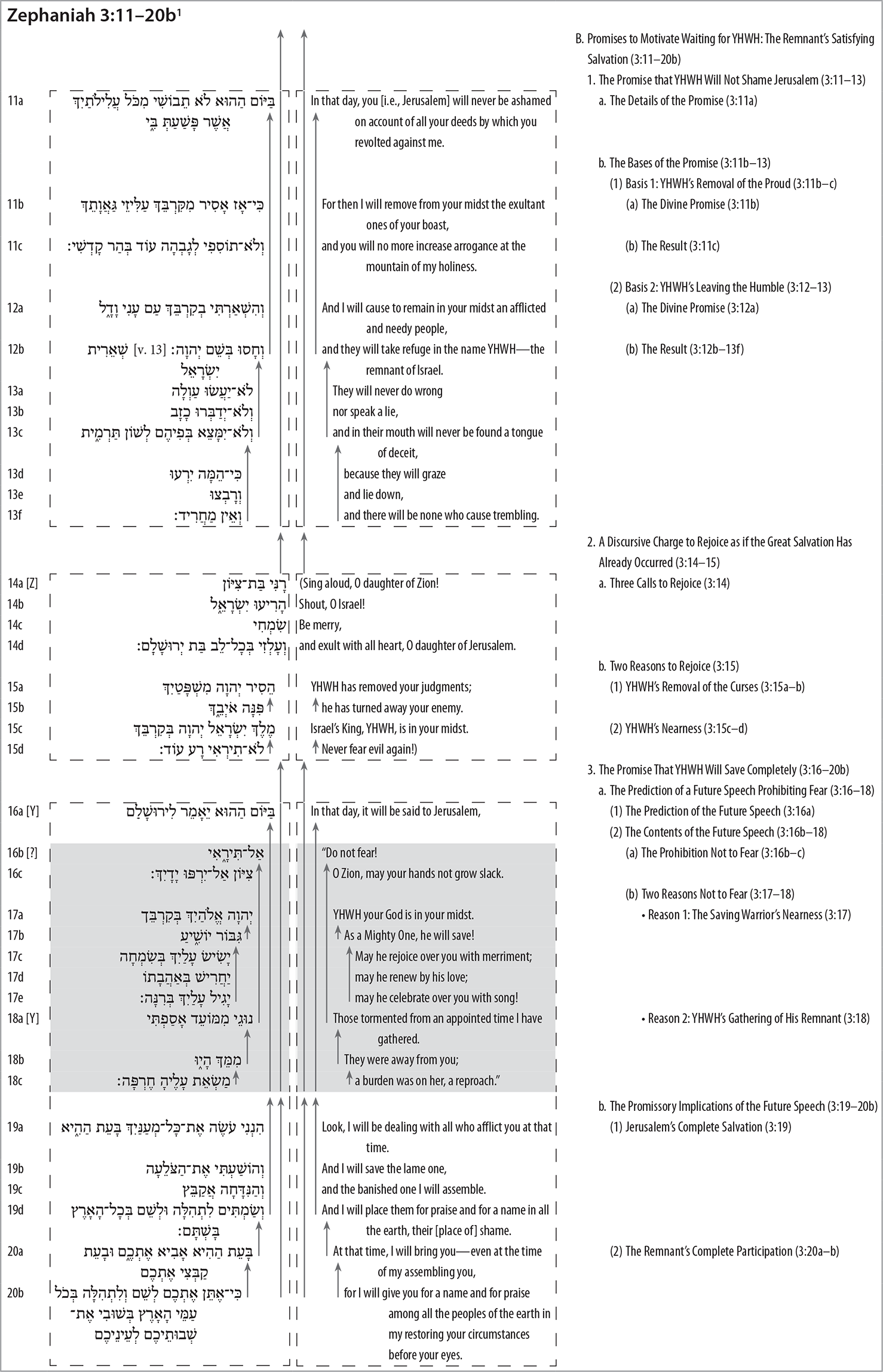
Alongside careful attention to words and phrases, he highlights several rhetorical features:
- Rhetorical underlining – In 3:14, Zephaniah stacks four strong imperatives, more than anywhere else in the book, showing that “the prophet cannot contain his joy” (261).
- Concentration of participants – This verse gathers together key figures from earlier in the book: “daughter,” “Zion,” “Israel,” and “Jerusalem.” In 3:14–20, “All of the main ‘characters’—God, Israel, and the nations—who earlier were bringing judgment or suffering destruction are here joined together” (261–62).
- Heightened vividness – Instead of repeating the same verbal roots (as earlier), Zephaniah uses four different imperatives, adding intensity.
- Change of pace – The rapid-fire commands in 3:14 are followed by two unmarked reasons for joy in 3:15 (262).
- Shift in perspective – Earlier sections emphasized judgment and fear, but in 3:9–20 Zephaniah turns to joy and global salvation. The focus moves from “judgment is coming” to “judgment has passed,” creating what DeRouchie calls “joy amid the waiting” (262).
- Use (and absence) of particles – Unlike 3:11–13, which contains three prose particles, and 3:16–20b, which contains eighteen, 3:14–15 has none. These verses then are “a didactic intrusion encouraging celebration” (262).
In 3:17, the Warrior who punishes rebels is on his way to save those who repent. That Yahweh would rejoice or “exult” was prophesied a thousand years earlier by Moses who promised Israel that sometime after God cursed the sinful nation (Deut 28:63), he would “return to rejoice over you for good, just as he rejoiced over your fathers” (30:9). DeRouchie notes that this may be one of the few places in the Old Testament where God is described as singing (cf. Isaiah 5:1). God both rejoices over the new Zion (Isa 62:5; Zeph 3:17c) and celebrates over his transformed city (Isa 65:17–19; Zeph 3:17e), “where such delight captures his joy over the entire renewed creation” (286).
Recommended?
This commentary is best suited for pastors, teachers, and serious readers who want to understand the structure and message of Zephaniah in depth. DeRouchie excels at showing how the book is carefully arranged and how its theology emerges from that structure.
His emphasis on literary flow and canonical context makes this especially valuable for preaching. Rather than treating Zephaniah as a “minor” or isolated book, DeRouchie demonstrates how its message of judgment and restoration fits within the larger biblical storyline.
For pastors in particular, the included sermon suggestions and clear structural analysis make this a highly practical resource. With this commentary, preaching through Zephaniah becomes not only manageable but compelling.
See his shorter commentary on Zephaniah on The Gospel Coalition or as part of the ESV Exegetical Commentary series for pastors.
Buy it on Amazon or from Zondervan Academic!
Other ZECOT reviews
- Leviticus — Jay Sklar
- Judges — Boda/Conway
- Proverbs — Christopher Ansberry
- Ezra-Nehemiah — Gary Smith
- Hosea — Jerry Hwang
- Joel — Joel Barker
- Obadiah — Daniel Block
- Jonah — Kevin Youngblood
- Nahum — Daniel Timmer
- Habakkuk — Kenneth Turner
- Malachi — Dennis Tucker
Lagniappe
- Series: Zondervan Exegetical Commentary on the Old Testament
- Author: Jason DeRouchie
- Hardcover: 368 pages
- Publisher: Zondervan Academic (July 2025)
Review Disclosure: I received this book free from Zondervan Academic. The opinions I have expressed are my own, and I was not required to write a positive review. I am disclosing this in accordance with the Federal Trade Commission’s 16 CFR, Part 255 http://www.access.gpo.gov/nara/cfr/waisidx_03/16cfr255_03.html.
Amazon Affiliate Disclosure: As an Amazon Associate I earn from qualifying purchases.
 spoiledmilks