
What Is Mere Christian Hermeneutics About?
Summary: Mere Christian Hermeneutics by Kevin Vanhoozer presents a compelling vision for reading the Bible as God’s living and active communication rather than merely a bland historical text. Vanhoozer argues that: Scripture is divine discourse; interpretation is hearing and responding to God’s voice; and the Bible must be read within the whole canon, centered on Christ. His key contribution is the idea of a “transfigural” literal sense, where meaning is deepened across Scripture.
Why Another Book on Hermeneutics?
In a world already full of books on hermeneutics, we can ask a reasonable question: do we need yet another one? Yes, if we want to recover a theological reading of Scripture. Kevin Vanhoozer’s Mere Christian Hermeneutics (by Zondervan) does just this.
Kevin Vanhoozer is Research Professor of Systematic Theology at TEDS, and he serves as theological mentor for the Augustine Fellowship of the Center for Pastor Theologians.
Vanhoozer argues that Scripture is divine discourse. God speaks in and through the text (just read Hebrews 3–4), and interpretation is then an act of hearing and responding to that speech. Meaning is not exhausted by understanding grammar and history. We must read texts within the whole canon and live them out. His contribution to this discussion is the idea of a “transfigural” literal sense: earlier meanings are not replaced but fulfilled and deepened within the unfolding canon.
Structure of the Book: Two Ascents
Vanhoozer structures Mere Christian Hermeneutics as two ascents of a theological “mountain” of interpretation. Both of these ascents are framed by transfiguration.
Before he begins the first ascents, he surveys the lay of the Land of Hermeneutics (chs 1–3), pointing out how various interpretive practices, or “reading cultures,” have led to a fragmented Scripture. These “reading cultures” include scholastic versus monastic, exegesis versus theology, and academy versus church. Doing this shows how interpretation has been split between historical and theological approaches, producing readers who are formed by competing habits. As a result, these readers are often unable to hold together (1) the unity of Scripture (2) as divine discourse. This leads to Vanhoozer’s proposal of a “mere Christian hermeneutic,” which is aimed at reconciling these fractured interpretive communities.
What Is a “Mere Christian Hermeneutic”?
Vanhoozer hopes to do for hermeneutics what C. S. Lewis did for Christian belief in his book Mere Christianity. He writes, “Lewis responded to the plurality of Christian traditions by documenting the widescale agreement about the essentials of the faith. Lewis likened this ‘mere Christianity’… to a hall that connected the various ‘rooms’ in God’s ‘household’” (xxi). Vanhoozer hopes as well that interpreters will leave their “interpretive silos and mingle in the hall to converse with those who read the Bible differently” (xxi).
First Ascent: The Letter of Scripture
The first ascent (chs. 4–5) focuses on the “letter” of Scripture, what the text literally says. Vanhoozer explains what he means by the “literal sense” and distinguishes it from literalistic historical readings.
He writes, “An oft-used term whose familiarity belies its complexity; in the history of biblical interpretation, the straightforward, surface, or nonfigural level of meaning of the textual letter; in this book, the meaning of the human-divine biblical discourse when read grammatically-eschatologically in canonical context, and the norm of theological interpretation” (402).
Vanhoozer though is not exactly clear on what he means by the literal sense verses the reference, and for a critique on that, see this review at Christ Over All (which has a length in proportion to that of Vanhoozer’s book).
In the spirit of retrieval, he retrieves premodern insights that treat the literal sense as theologically rich, arguing that interpretation requires both grammatical-historical and grammatical-eschatological frames of reference (see In All the Scriptures by Piotrowski for a similar argument). This kind of interpretation creates a “trans-figured literal sense,” which places texts within literary, canonical, and redemptive-historical contexts, tracing typological trajectories that connect persons, events, and promises across Scripture while preserving textual integrity (see Hamilton’s Typology for more of this).
Second Ascent: The Reality of Scripture
The second ascent (chs. 6–9) turns to Scripture’s subject matter, what it is actually about. Vanhoozer argues for an “economy of light” where God reveals Himself progressively from creation to consummation. The key hermeneutic to interpretation is seen in Jesus’ transfiguration. Jesus, the first-century Jew, reveals himself as the Christ, the point of divine revelation.
“Transfigural” Interpretation
From this, Vanhoozer develops his method he refers to as “transfiguring interpretation,” combining exegesis with spiritual reading. Vanhoozer writes, “ the Bible’s words are as fully human as is Jesus’ body, and transfiguring interpretation leaves neither behind. Nevertheless, to read the Bible transfigurally is to be attuned to the eschatological realities that unify the histories of Israel and Jesus and help us grasp what the Bible is really about: the glory of God in Christ. Hence to read transfigurally is to read with a doxolog ical aim and interest: to magnify the literal sense and name of its divine author (1 Chr 17:24; Ps 34:3)” (pp. 269–70).
The goal is not to replace the literal sense but to perceive Christ within it. The spiritual sense is thus redefined as the “transfigural” sense, the glory of the literal sense itself. This is seen in Vanhoozer’s excellent discussion of 2 Corinthians 3. The result of all this is a unified vision: Scripture is divine discourse, the canon is its completed form, Christ is its center, and the church is its faithful hearer and doer.
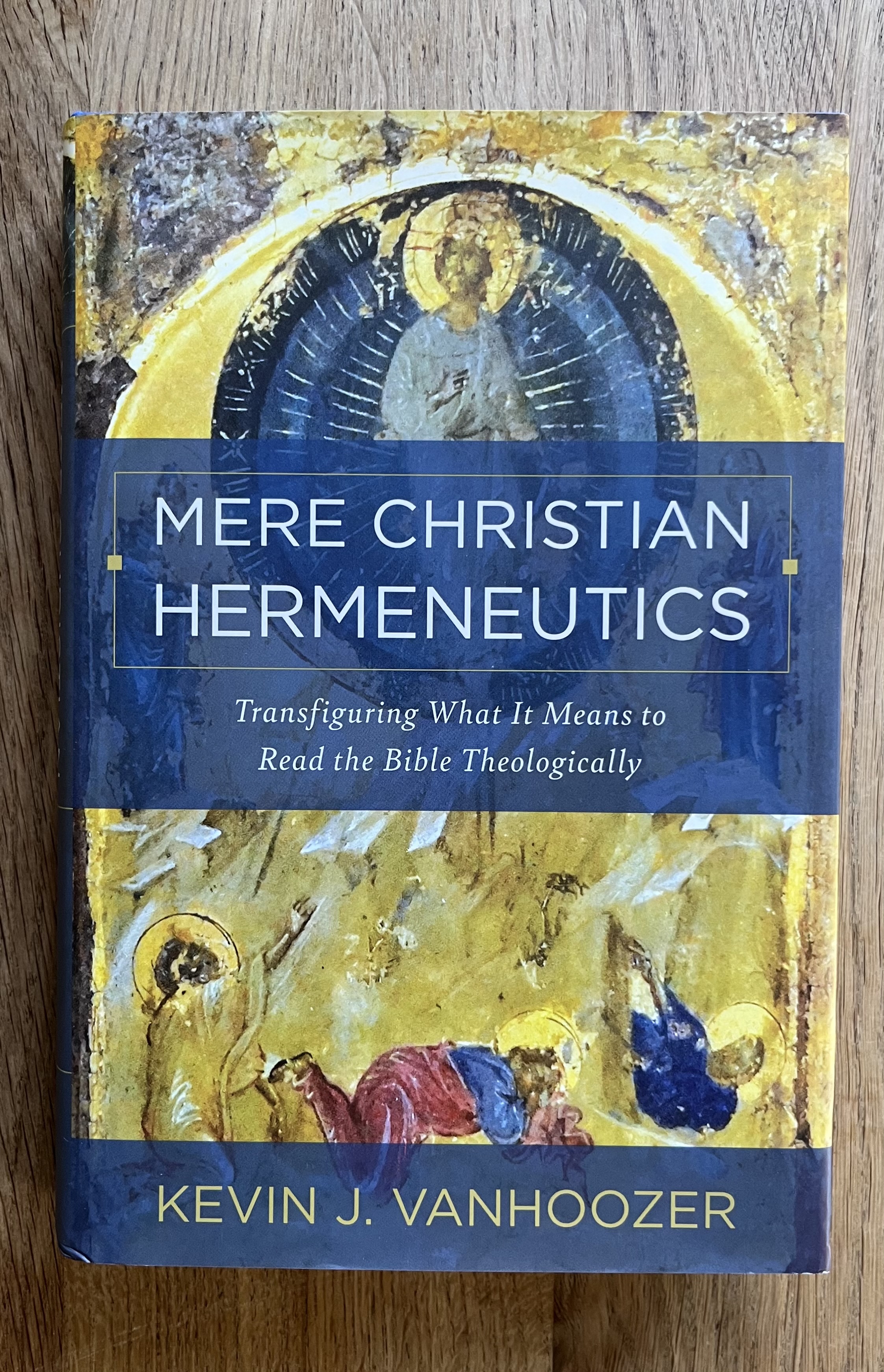
Vanhoozer interprets the Transfiguration as an “an analogy (analogia corporis) between the human body of Christ and the letter of the biblical text, a correspondence grounded in their both being divine accommodations of the one living and active Word of God” (267).
Hidden beneath the humanity of Jesus was something unseen, his divinity. As well, when we open the Bible we see pages in a book, yet hidden from most of the world is its spirituality. Vanhoozer observes, “Jesus’ physical body is to his glorification what the written letter is to its spiritual sense… The transfiguration depicts Jesus’ human body as a medium of divine light. The transfigural analogy teaches readers to approach the Bible ready to hear the voice of God shining in the bright canonical fabric that clothes and presents Christ” (268).
Transfiguration does not mean a change in the “literal,” but instead glorifies it. It did not change Jesus into something else; it allowed the disciples to see what had been “under the veil of his humanity” (268).
The Chocolate Milks
Vanhoozer highlights the spiritual reading Scripture. Through the work of the Holy Spirit, Scripture does something to us as God’s living and active Word. Vanhoozer eschews arguing about origins and interpretive methods of the historical authors or possible/hypothetical editors behind the books of the Bible. Focusing on the final form that we have in our hands, the Bible is both a text about God and his actions within history and the means by which God speaks to us today. The whole Bible shapes how we read each individual book.
The Role of the Church
Vanhoozer’s emphasizes the collective church body as an interpretive community, shaped by the very text it reads. This provides accountability that individual approaches often lack. How church members come together to do remain accountable is another discussion.
First, Christians are accountable to the canon of Scripture, the creeds, and then to the fellowship of other believers. Vanhoozer places more emphasis on the metaphor of the church as actors in God’s drama. Accountability comes from the faithful performance (the living out) of the Divine Author’s script(ure). The church is to test interpretations and weighing them up against the canonical shape of Scripture. What would have been helpful is if Vanhoozer would have elaborated on how disagreements could be negotiated, even if not solved.
For all the heavy lifting Vanhoozer does, this book is surprisingly fun to read (for a theology book). For example, he writes, “The apostle Paul, like every other biblical author, is too historically and culturally distant—not to mention dead—to address me personally” (7). Vanhoozer’s poetic use of metaphors and cultural imagery and his dry humor help a lot because this is a pretty dense book. His use of light and transfiguration makes a compelling case on how Scripture functions as divine communication. That said, some of Vanhoozer‘s arguments are obscured by his writing style, and because of that you may find yourself having to reread certain sections to understand key points.
Recommended?
Vanhoozer’s use of the Transfiguration as a paradigm for understanding how Scripture’s human and divine aspects are understood in Christ is creative and pretty helpful. His concept of “transfigural” meaning is correct in its emphasis that the fulfillment of Scripture does not remove the historical sense of the earlier texts. His goal is more about forming interpretive habits than guaranteeing specific conclusions. So while Vanhoozer falls within the Reformed Protestant Presbyterian tradition, one need not fall into this slender tradition to benefit from this book. This is not a light read, but it is a rewarding one.
Lagniappe
- Author: Kevin J. Vanhoozer
- Hardcover: 448 pages
- Publisher: Zondervan Academic (October 2024)
Buy it on Amazon or from Zondervan!
Disclosure: I received this book free from Zondervan Academic. The opinions I have expressed are my own, and I was not required to write a positive review. I am disclosing this in accordance with the Federal Trade Commission’s 16 CFR, Part 255 http://www.access.gpo.gov/nara/cfr/waisidx_03/16cfr255_03.html.
Amazon Affiliate Disclosure: As an Amazon Associate I earn from qualifying purchases.

