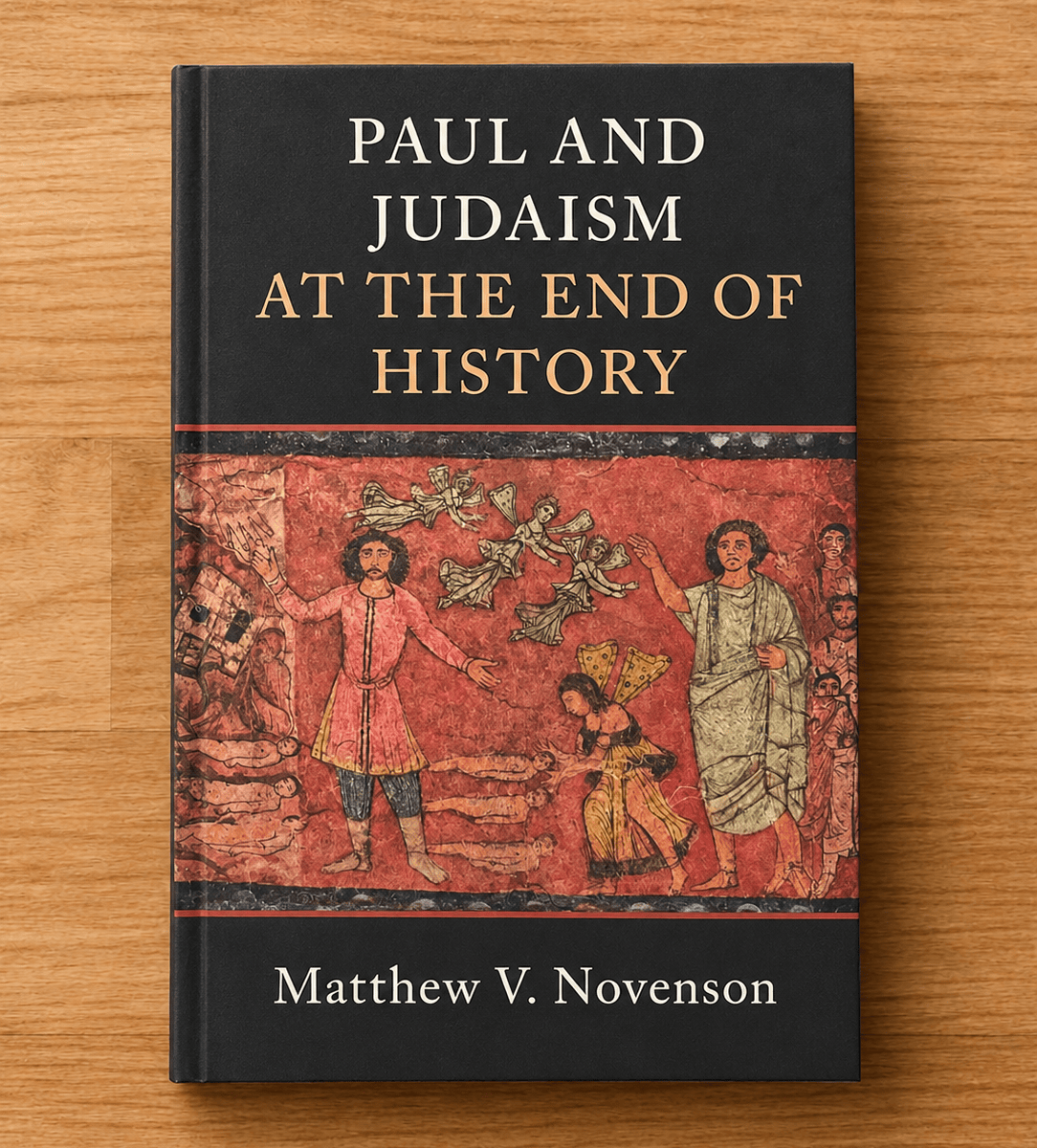

Who is Paul? What kind of Jew is he? Hellenistic? Apocalyptic? New Covenant? Anomalous? Is he still “within Judaism” or did he step outside of it?
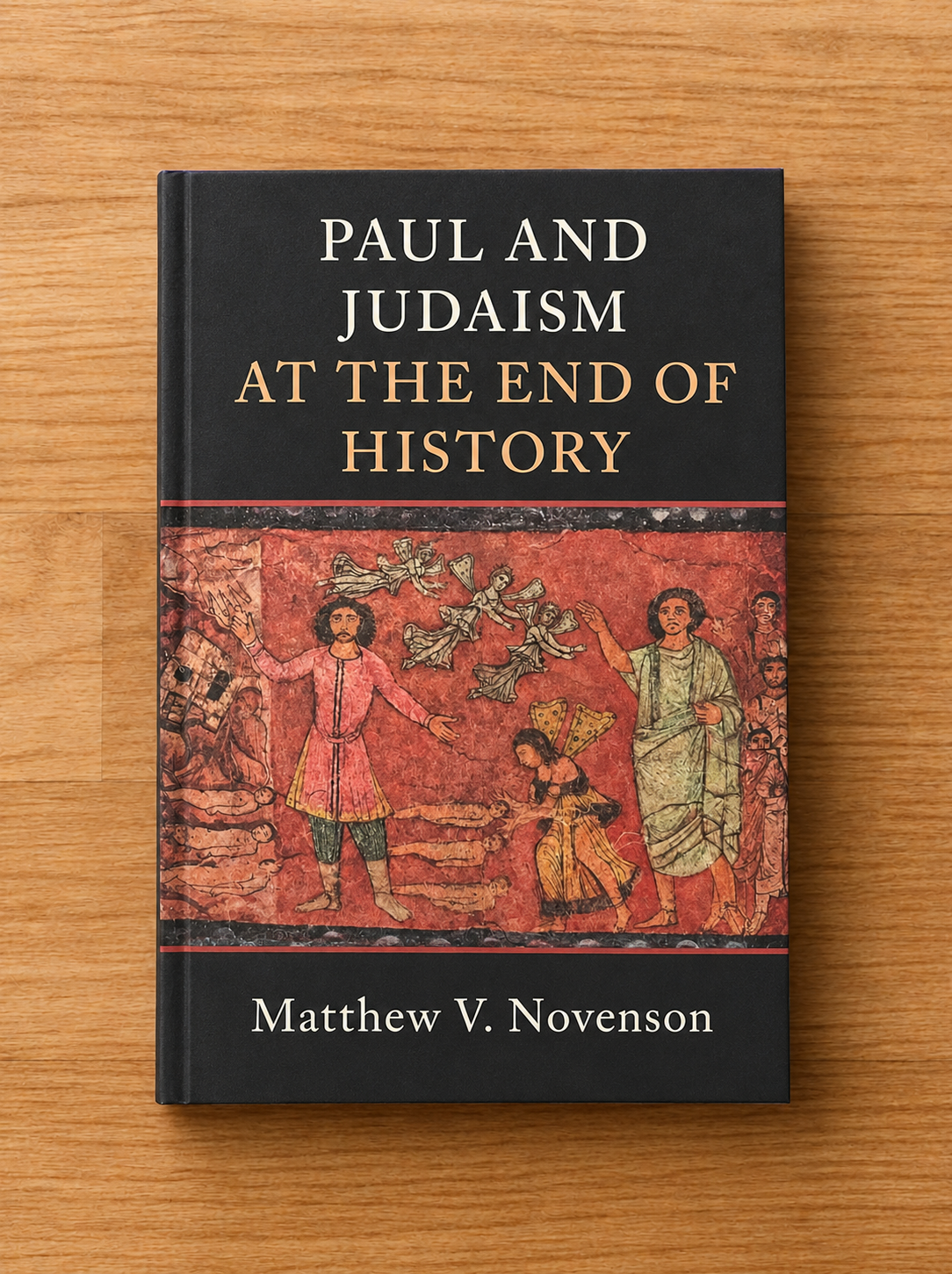
In his newest book, Paul and Judaism at the End of History, Matthew Novenson argues that Paul is simply a first-century Jew who believed the end of history had already broken into the present through the resurrection of Jesus the Messiah. This alone isn’t groundbreaking, as it’s the now-and-not-yet schema.
This was a fascinating book, one that is sometimes very technical, but Novenson—Professor of New Testament Studies at the University of Edinburgh—has a conversational style that keeps you from getting stuck in the mire of Greek grammar and rabbinical interpretation (something perhaps akin to N.T. Wright). The subject matter is dry, but Novenson manages to lead you along through it.
According to Novenson, Paul not just Jewish, but a certain kind of very Jewish. Paul thinks in categories of ethnicity and eschatology. Novenson aims to show us that Paul’s theology of ethnicity, Torah, and Gentile inclusion only makes sense when viewed through a thoroughly Jewish, restoration-eschatological framework.
The Main Points
Novenson dismantles common assumptions about the (seven) Pauline epistles across nine chapters.
I do not think Ioudaismos means what you think it means (Gal 1:13–14): After his first chapter talking about who Paul is (or isn’t) and how we can know what Paul wrote (or had someone write) but we can’t get into his mind, and basically telling us Paul is weird (because he probably was, at least compared to us today), Novenson goes on to argue (ch 2) that Ioudaismos does not mean “Judaism” as the general religion, but specifically the zealot-like Maccabean movement. Paul did not abandon Judaism for “Christianity”; he abandoned his extreme anti-Hellenistic, nationalist zeal.
“Justification by Works of the Law” is Paul’s Polemic: Novenson (ch 3) contends that no Jewish group taught a formal doctrine of “justification by works of the law.” Rather, this phrase was Paul’s own polemical summary of his own opponents’ position. It was shorthand for “not buying what Paul is selling” or “not smelling what he was stepping in” (2 Cor 2:16).
Judaizing Jews or Gentiles in Galatia: Novenson argues (ch 4) that Paul’s primary opponents in Galatia were not Jews but were actually Gentile proselytes trying to force other Gentiles to adopt circumcision. He argues that when Paul writes things like “we are the true circumcision,” he really means he is truly circumcised, unlike these Gentile fakers.
Law, Ethnicity, and the Last Man: Paul does not erase (ch 6) ethnic distinctions between Jews and Gentiles (contra Staples). Instead, Gentiles are granted eschatological blessings as Gentiles who are incorporated (or annexed, as Novenson writes) to Israel. Because the resurrection of Jesus (the “last Adam/man“) inaugurated the age to come (ch 9), the issue is not law versus no law, but law for mortals versus eternal life in the resurrected age. The function of the Torah shifted from a code for mortal humans to a reality reinterpreted in light of eternal, resurrected life.
The Chocolate Milks
Only Time: Novenson rightly forces us to ask what Paul thinks time itself has become because of Christ’s resurrection. Raeading Paul through the lens of inaugurated eschatology brings coherence to his statements on the Spirit, righteousness, and Gentile inclusion. But I already agree with inaugurated eschatology, but Novenson’s other arguements are new to me.
Gentile Cuts: Interpreting the agitators as Gentile proselytes gives a fresh look at Galatians (I had never even entertained the possibility). A Gentile getting circumcised as an adult would have failed to keep the covenant requirement of eighth-day circumcision (Gen 17:12). According to the LXX translation of Genesis 17:14 (pp. 90, 130), any circumcision not done on the eighth day after birth was essentially anathema.
Following this line, Paul would then have believed the only correct Jewish circumcision was that which was done on the eighth day (as Paul was, Phil 3:5).According to Novenson, this was one of many reasons why it was incorrect for Gentiles-in-Christ to receive circumcision, and it would make sense of Paul’s claim that “those who are circumcised do not themselves keep the law” (Gal 6:13).
Greek shapes: Finally, a book where the Greek text is not only translated into English (minus a few places) but it is left in its Greek form. There are no confusing transliterations making scholars suffer over words normal people won’t read anyway.
The Spoiled Milks
While entertaining (we’re talking about biblical studies here, folks), Novenson’s thesis and side quests run into a few snags.
Did Paul invent “justification by works of the law” out of thin air? Novenson is right to slow us down before assuming Paul was attacking a simplistic Jewish doctrine of “merit theology.” However, while his argument is intriguing, and he shows that what is found in the Qumran’s 4QMMT doesn’t match with what Paul is arguing, there were active Jewish debates regarding Torah, righteousness, final judgment, and covenant membership. Even Novenson argues that there was no unified doctrine X that everyone held equally. So, for example, Philo distinguished between those who recognized God’s blessings as gifts and those who believed themselves worthy of divine favor because of their own virtues.
Misacts in Acts: To maintain his argument regarding adult Gentile circumcision, Novenson has to address Timothy’s circumcision in Acts 16:1–3. He sidesteps the conflict by suggesting the author was incorrect. But is that not the tail wagging the dog? Is Acts wrong because it doesn’t fit “the evidence”? If Luke/Author were correct, what would this mean for Novenson’s argument?
A physical Casper? Novenson draws on Stoic philosophy to argue that Paul understood pneuma (Spirit) as a literal, indestructible material substance. But does Paul really need a Stoic physicalist pneumatology to affirm bodily resurrection? Scholars like James Ware offer a compelling canonical alternative: the Spirit is the divine agent who transforms and animates the resurrected body, not a physical substance infused into human flesh. Also, In Acts(!) 17, when Paul speaks at the Aeropagus, everyone, including Stoic philosophers, v18, listened intently until he spoke about the resurrection. If Paul’s idea of the pneuma was so similar to the Stoic idea, why did they mock Paul (Acts 17:32)?
Recommended?
Paul and Judaism at the End of History is an exceptional work that will make you rethink the contours of Pauline theology. While I don’t agree with every historical reconstruction Novenson offers, particularly his treatment of Acts and his material view of the Spirit, his insistence on reading Paul through an eschatological, resurrection-centered lens is correct. To what extent Paul was still “within Judaism” remains up for debate, but Novenson has made me think harder about the text, which is what I want books on Paul to do.
This volume is recommended for scholars, professors, and studious pastors tracking with the “Paul within Judaism” (PwJ) debate.
Buy it from Amazon or Cambridge University Press!
Buy it from Amazon or Cambridge University Press!
Lagniappe
- Author: Matthew V. Novenson
- Hardcover: 324 pages
- Publisher: Cambridge University Press (December 2024)
Review Disclosure: I received this book free from Cambridge University Press. The opinions I have expressed are my own, and I was not required to write a positive review. I am disclosing this in accordance with the Federal Trade Commission’s 16 CFR, Part 255 http://www.access.gpo.gov/nara/cfr/waisidx_03/16cfr255_03.html.
Amazon Affiliate Disclosure: As an Amazon Associate I earn from qualifying purchases.

