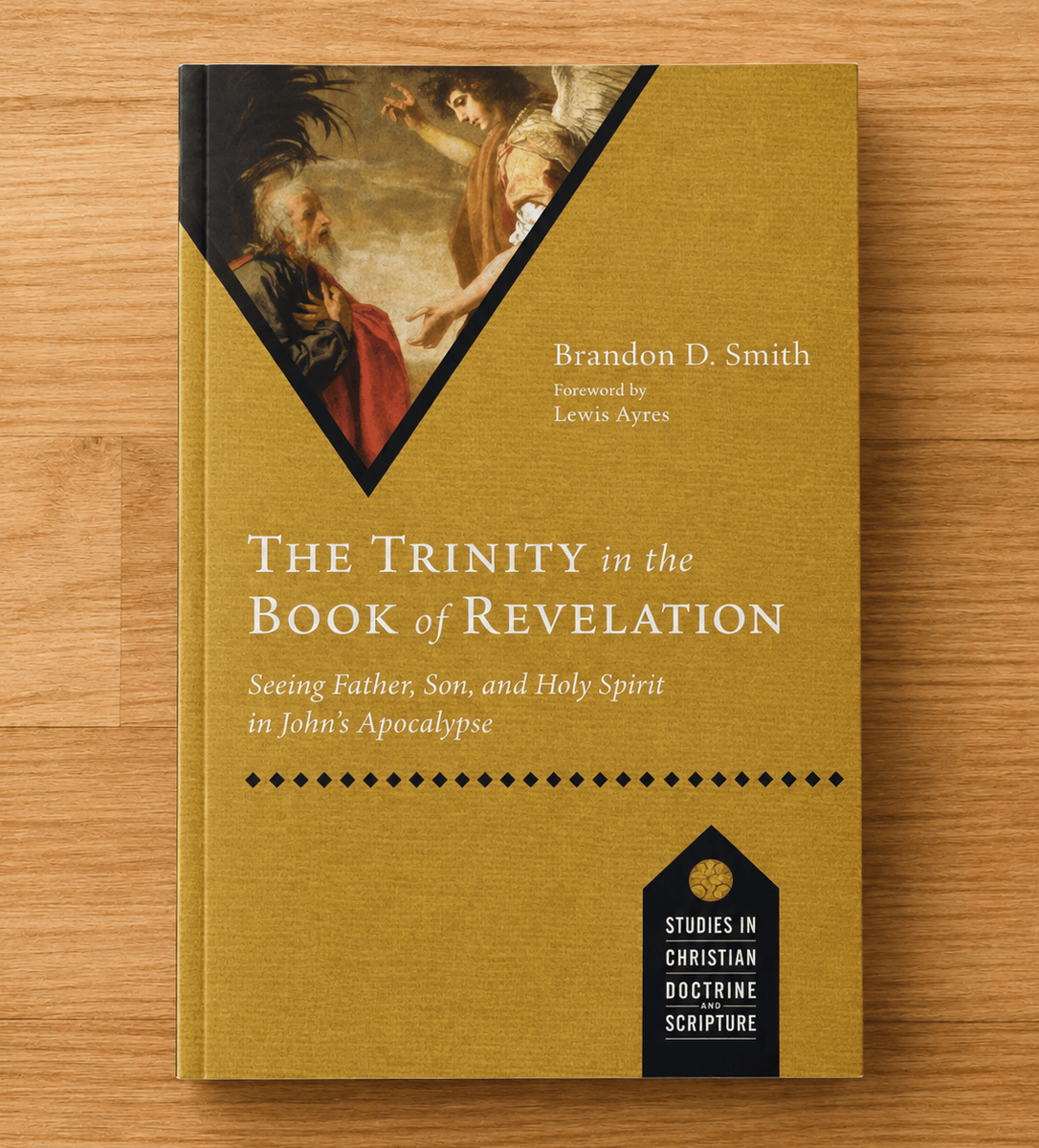

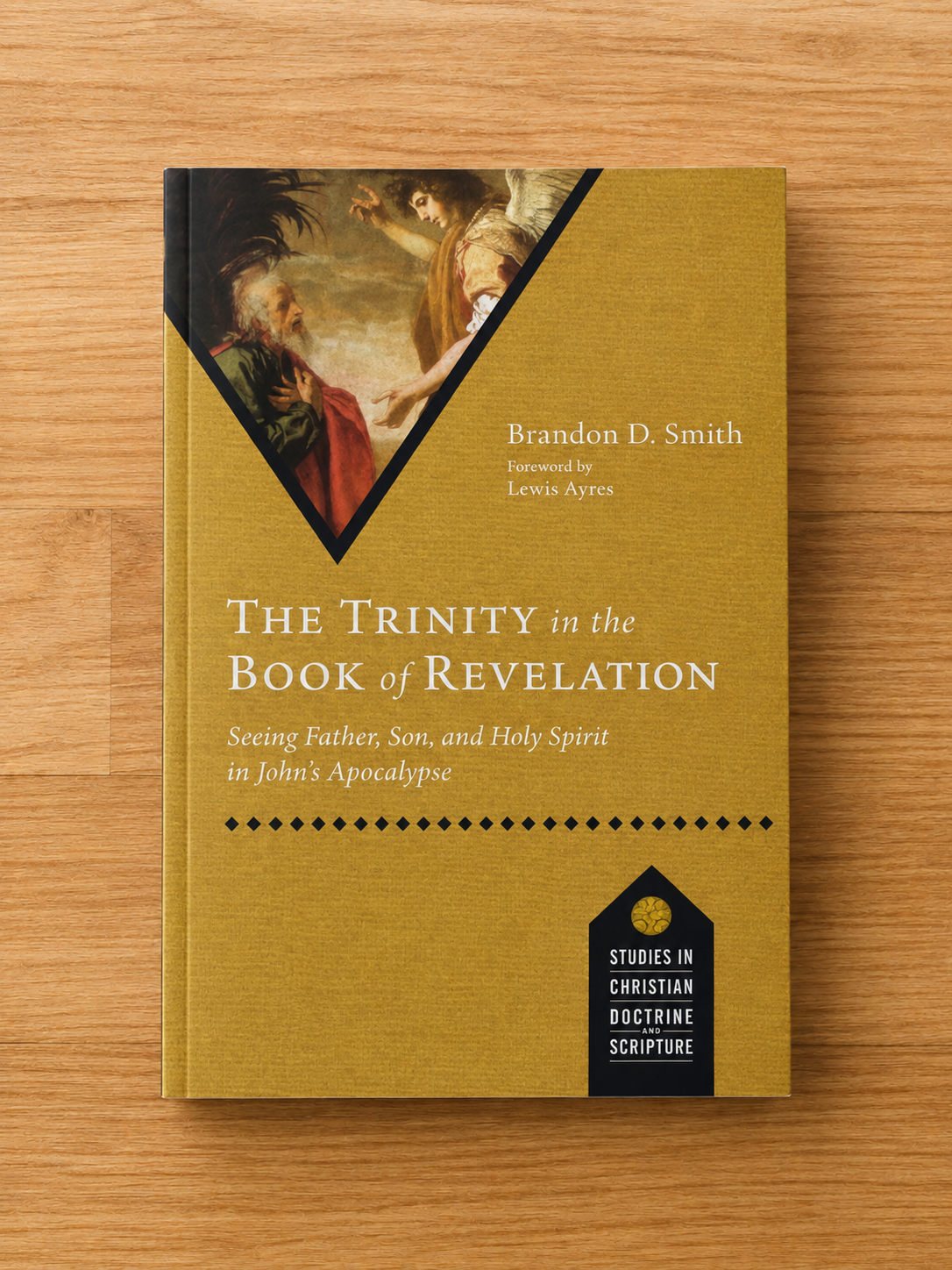
What does Revelation have to say about the Trinity? According to Brandon Smith in his book The Trinity in the Book of Revelation, quite a lot, actually. Smith’s basic argument is that Revelation presents the Father, Son, and Holy Spirit as distinct persons who share in the one divine identity, authority, and worship. John does not use the “standardized” theological vocabulary made later at Nicaea, and Smith does not pretend he did. Rather, he argues that Revelation creates “biblical pressure” toward the kind of Trinitarian conclusions the church would eventually articulate. We see this when he writes, “Revelation prompts the reader to consider the trinitarian dynamics of the book, so that even those above who disagree with a trinitarian reading ultimately feel pressured to respond to the narrative presence of the Father, Son, and Spirit” (11).
Brandon Smith is assistant professor of theology and New Testament at Cedarville University, is a cofounder of the Center for Baptist Renewal, and is host of the Church Grammar podcast.
Smith argues that, given this biblical pressure, later pro-Nicene theology can and does help us understand what John is doing. His approach combines close exegesis of Revelation with canonical interpretation, theological interpretation of Scripture (TIS), and extensive interaction with the church fathers.
After an introduction on doing theology with the Trinity, Smith Smith lays out his presuppositions, methodology, and the key terms he works with in chapter one. Instead of trying to place Jesus on the axis of high vs. low Christology, Smith agrees with Wesley Hill that the New Testament uses a “web of relations” between the Father, Son, and Spirit, placing them equal to each other. Smith explains his trinitarian reading, the lenses he puts on when he reads the New Testament books, lenses formed from both specific texts from the New Testament and the later-hammered-out-doctrines of fourth century Nicaea.
The next three chapters treat the Father, Son, and Spirit, respectively. The strongest part of the book is his treatment of Jesus, which, naturally, is the longest chapter. Smith builds a cumulative case from Revelation’s use of Old Testament imagery, Daniel 7, divine titles, authority over death and judgment, and especially worship, to show that Jesus is equal to the Father. Revelation 5 is particularly important by showing Jesus as distinct from the Father, yet he both participates in the divine rule and receives divine worship.
Smith spends a good deal of time arguing that the “seven spirits” in Revelation 1:4 are the Holy Spirit. The Holy Spirit is where the argument becomes more difficult. Smith notes that within Revelation’s own imagery one could (and has) come to the conclusion that the seven spirits are angelic beings. However, his observation that “In John’s vision, the seven spirits are not only around or proceeding from the throne; they appear to be acting distinctly from angels mentioned elsewhere in the vision by unreservedly receiving worship alongside the Father and Son” (171–172) is spot-on. No matter where you land on that interpretation, his argument about John being “in the Spirit” is much stronger. The Spirit reveals God’s purposes to John and speaks to the churches, so the Spirit is clearly not peripheral to Revelation’s theology.
Chapter 5 offers a constructive synthesis and discusses implications for theology, exegesis, preaching, teaching, and discipleship.
Smith shows that Revelation presents the Father, Son, and Spirit in patterns of distinction and divine participation that fit well with Nicene Trinitarian theology. His larger contribution is showing how Revelation contributes to our doctrine of the Trinity than is often thought. Which Smith points out in his book, “While Christians might be tempted to overlook the Trinity in Revelation rather than look for the Trinity first, we must remember that God most clearly reveals himself in his words and deeds,” which come from “the triune God who is bringing all of history to its culmination” (3).
Recommended?
I would especially recommend this to pastors, seminary students, and Bible teachers working through Revelation, Christology, or the Trinity. This is neither a simple introduction to the Trinity nor a commentary on Revelation. It is a theological reading of Revelation that brings biblical exegesis into conversation with the early church. Although at times this can be dense (this is a revision of Smith’s dissertation), this is a helpful combination.
Buy it on Amazon or from IVP Academic
Lagniappe
- Series: Studies in Christian Doctrine and Scripture
- Author: Brandon Smith
- Paperback: 248 pages
- Publisher: IVP Academic (December 2022)
Disclosure: I received this book free from IVP Academic. The opinions I have expressed are my own, and I was not required to write a positive review. I am disclosing this in accordance with the Federal Trade Commission’s 16 CFR, Part 255 http://www.access.gpo.gov/nara/cfr/waisidx_03/16cfr255_03.html.
Amazon Affiliate Disclosure: As an Amazon Associate I earn from qualifying purchases.

