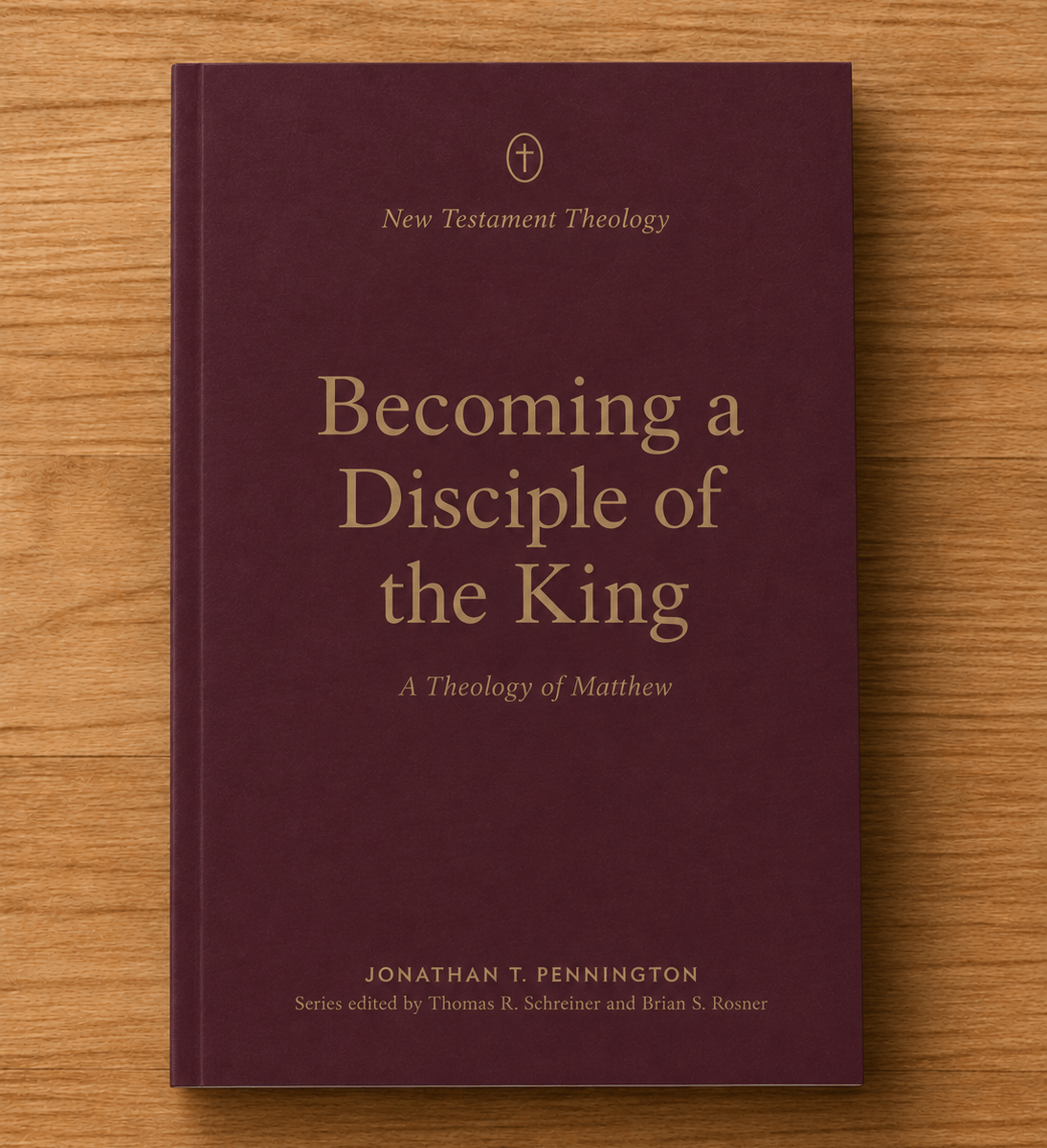

In his new book Becoming a Disciple of the King, Jonathan Pennington provides a concise theology of Matthew, bringing together the best of biblical theology, literary analysis, historical context, and theological interpretation.
Pennington guides us through the Gospel showing how Matthew presents Jesus as the fulfillment of Israel’s story: the Son of God, Davidic King, Son of Abraham, Savior, and Teacher, and how that vision of Christ is meant to produce (or drive us toward) discipleship. In this guide, Pennington is equally interested in what Matthew says about Jesus as he is in what Matthew thinks a disciple of Jesus should look like.
Jonathan Pennington serves as professor of New Testament interpretation at the Southern Baptist Theological Seminary and pastor of spiritual formation at Sojourn East church in Louisville, Kentucky.
What’s Matthew All About?
The book is separated into three parts. Part one orients us to Matthew’s overall perspective.
In the first chapter, Pennington explores Matthew’s use of the Old Testament. He argues that the term “fulfillment” does not merely mean the fulfillment of an earlier prediction. Rather, Matthew sees patterns and “figurations” in Israel’s story culminating in Christ (cf. Jer 31:15; Hos 11:1; and Matthew’s genealogy).
Chapter two argues that Matthew’s Gospel is an ancient biography, or bios. Pennington illustrates how Matthew’s literary form is part of his theology to form disciples by discussing the five major teaching sections, their relationship to the surrounding narrative, and Matthew’s use of contrasting characters.
Part two hones in on explaining who Jesus is.
In chapter three, Pennington synthesizes of Matthew’s Christology to show how Jesus is the divine Son who brings God’s saving presence to his people. Jesus is Immanuel (God with us), the one who receives worship, the greater Moses, the one with divine authority, the forgiver of sins, and the inaugurator of new creation.
Chapter four focuses on Jesus as the Son of David and Son of Abraham, and chapter five considers Jesus as Teacher (which Pennington has written a book about). Jesus does not merely give information; he calls people to take his yoke and learn his way of life.
Part three looks at how a disciple should live.
Chapter six looks at what these disciples should look like. Pennington emphasizes wholeness, righteousness, and integrity, particularly in the Sermon on the Mount (another of his books), and chapter seven moves from individual discipleship to life in the community. Mercy, forgiveness, reconciliation, and humility are essential marks of the people Jesus is forming.
The Chocolate Milk
Pennington’s seamlessly bridges together Matthew’s Christology and how it compels us to discipleship. Because of who Jesus is and all that he is, we must follow him as his new creation people.
He also shows how large a role Matthew’s five-discourse structure plays, as well as the way Matthew places people alongside one another for comparison and contrasts. When you add on how Jesus fulfills Israel’s story, it is easy to see why Matthew became the most popular Gospel. For the size of this book, Pennington gives us what is necessary to understand how we can become better disciples of Jesus through what Matthew wrote in his Gospel.
Recommended?
Yes, as with all of the other volumes in this series that I have read so far. The volumes on Mark and Luke are especially well-written, and this volume bolsters the Gospel section of this series.
This is perfect for pastors (another book), seminary students, Bible teachers, and any layperson who wants to understand Matthew. Pennington brings together so many aspects of Matthew’s Gospel and shows how it works together to form us into disciples.
Buy it from Amazon or Crossway!
Other Reviews in the NTT Series:
- Mark — Peter Orr
- Luke — Benjamin Gladd
- Romans — Brian Rosner
- 2 Corinthians — Dane Ortlund
- Ephesians — Benjamin Merkle
- Colossians & Philemon — Kevin McFadden
- Revelation — Tom Schreiner
Lagniappe
- Series: New Testament Theology
- Author: Jonathan T. Pennington
- Hardcover: 176 pages
- Publisher: Crossway (June 2026)
- Read: Chapter 1
Review Disclosure: I received this book free from Crossway. The opinions I have expressed are my own, and I was not required to write a positive review. I am disclosing this in accordance with the Federal Trade Commission’s 16 CFR, Part 255 http://www.access.gpo.gov/nara/cfr/waisidx_03/16cfr255_03.html.
Amazon Affiliate Disclosure: As an Amazon Associate I earn from qualifying purchases.

