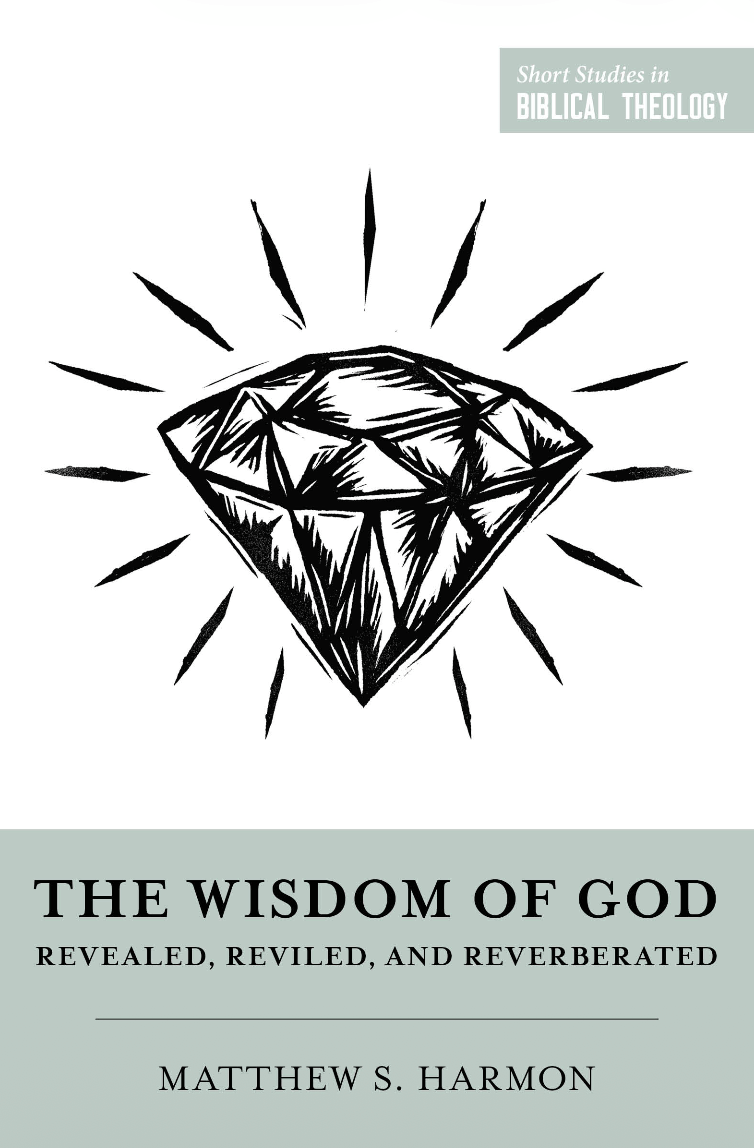

Summary: What does ‘wisdom’ mean across the whole Bible—not just in Proverbs, Job, or Ecclesiastes, but from creation to new creation? In The Wisdom of God, Matthew S. Harmon argues that wisdom is a central, unifying theme of Scripture, revealed by God, rejected by humanity, and ultimately fulfilled in Christ. This short volume in the Short Studies in Biblical Theology (SSBT) series traces that pattern across the entire biblical storyline.
The Short Studies in Biblical Theology (SSBT, which I have reviewed) series is a personal favorite of mine. While more concise than the New Studies in Biblical Theology (NSBT, also reviewed) volumes, it captures the sweep of a biblical theme without overwhelming detail. That makes it especially useful for pastors and busy readers.
Matthew S. Harmon is Professor of New Testament Studies at Grace College and Theological Seminary. He is a member of Christ’s Covenant Church, serving, preaching, and teaching regularly. He is the author of numerous books, including commentaries on Galatians, Philippians, 2 Peter, and Jude, and several books on biblical theology, such as sin and restoration and eschatology.
Matthew Harmon opens with the observation that we live in an age overflowing with knowledge, while, conversely, lacking in wisdom. The problem isn’t that we don’t know enough, but that we struggle to make sense of what we know. As he puts it, the “explosion of knowledge… makes it increasingly difficult to determine how different elements and forms of knowledge relate to one another” (1). This frames the entire book. Like Israel in Jeremiah’s day, constantly drawn to what was new and impressive, we too need to be called back to the “ancient paths” of God’s foundational wisdom.
Summary of the Book’s Argument
Harmon defines wisdom as the ability to discern good from evil and live rightly before God and others. Wisdom is moral, relational, and practical.
How do we live out this wisdom? Thankfully, Harmon avoids turning wisdom into moralistic self-help. Our problem is not simply that we fail to apply wisdom. Adam and Israel both received commands from God that they knowingly rejected. We lack the correct starting point altogether, and this problem is only resolved through faith in Christ.
Harmon proposes that Scripture reveals God through recurring patterns embedded in redemptive history. These patterns are are divinely intended to show us who God is, how the world works, and where history is heading.
According to Harmon, the theme of wisdom follows a consistent threefold pattern:
- God reveals his wisdom.
- Humanity reviles God’s wisdom.
- God reverberates his wisdom.
Each chapter follows this three-fold pattern, tracing it through key moments in the biblical narrative: Eden, Sinai, Solomon, exile, and ultimately to Christ, the church, and the new creation.
Harmon shows that God reveals his wisdom in creation, in his word, and, ultimately, in his Son. Humanity, however, consistently rejects that wisdom, redefining good and evil on their own terms. In response, God reverberates his wisdom, vindicating it through his judgment and mercy.
For example, one reads in Deuteronomy 4:6 how the law was meant to display Israel’s wisdom to the surrounding nations. Yet, this external law could not overcome Israel’s rebellious heart (neither did God’s external command to Adam and Eve keep them from choosing their own form of knowledge). The problem was neither with the knowledge nor the wisdom revealed, but with Israel’s heart.
Harmon includes eight tables throughout the book, highlighting parallels between figures like Adam, Israel, and Solomon. The connections between Adam and Solomon reveal how even Israel’s wisest king’s sin was nothing new. He merely repeated the same failure as Adam and Israel before him. While most of the parallels are good, the Adam–Israel parallels seemed to stretch beyond what the text shows.
For a book on wisdom, Harmon gives surprisingly limited attention to the traditional wisdom books (Proverbs, Ecclesiastes, Job), choosing instead to trace wisdom through the broader biblical narrative in order to show how wisdom is woven from creation to new creation.
Recommended?
This book is best suited for pastors, Bible teachers, and readers interested in biblical theology who want a concise, Christ-centered framework for understanding wisdom across Scripture. Harmon succeeds in taking a neglected theme and restoring it to its proper place within the biblical narrative. He reminds us that true wisdom is not found only in mastering useful information, but in rightly relating to the God of wisdom himself (Jas 3:13–18).
Buy it from Amazon or Crossway!
Other Reviews in the SSBT Series:
- Divine Blessing — William Osborne
- The New Creation and the Storyline of Scripture — Frank Thielman
- Return from Exile and the Renewal of God’s People — Nicholas Piotrowski
- The Royal Priesthood and the Glory of God — David Schrock
Lagniappe
- Series: Short Studies in Biblical Theology
- Author: Matthew S. Harmon
- Hardcover: 119 pages
- Publisher: Crossway (March 2026)
Review Disclosure: I received this book free from Crossway. The opinions I have expressed are my own, and I was not required to write a positive review. I am disclosing this in accordance with the Federal Trade Commission’s 16 CFR, Part 255 http://www.access.gpo.gov/nara/cfr/waisidx_03/16cfr255_03.html.
Amazon Affiliate Disclosure: As an Amazon Associate I earn from qualifying purchases.

