
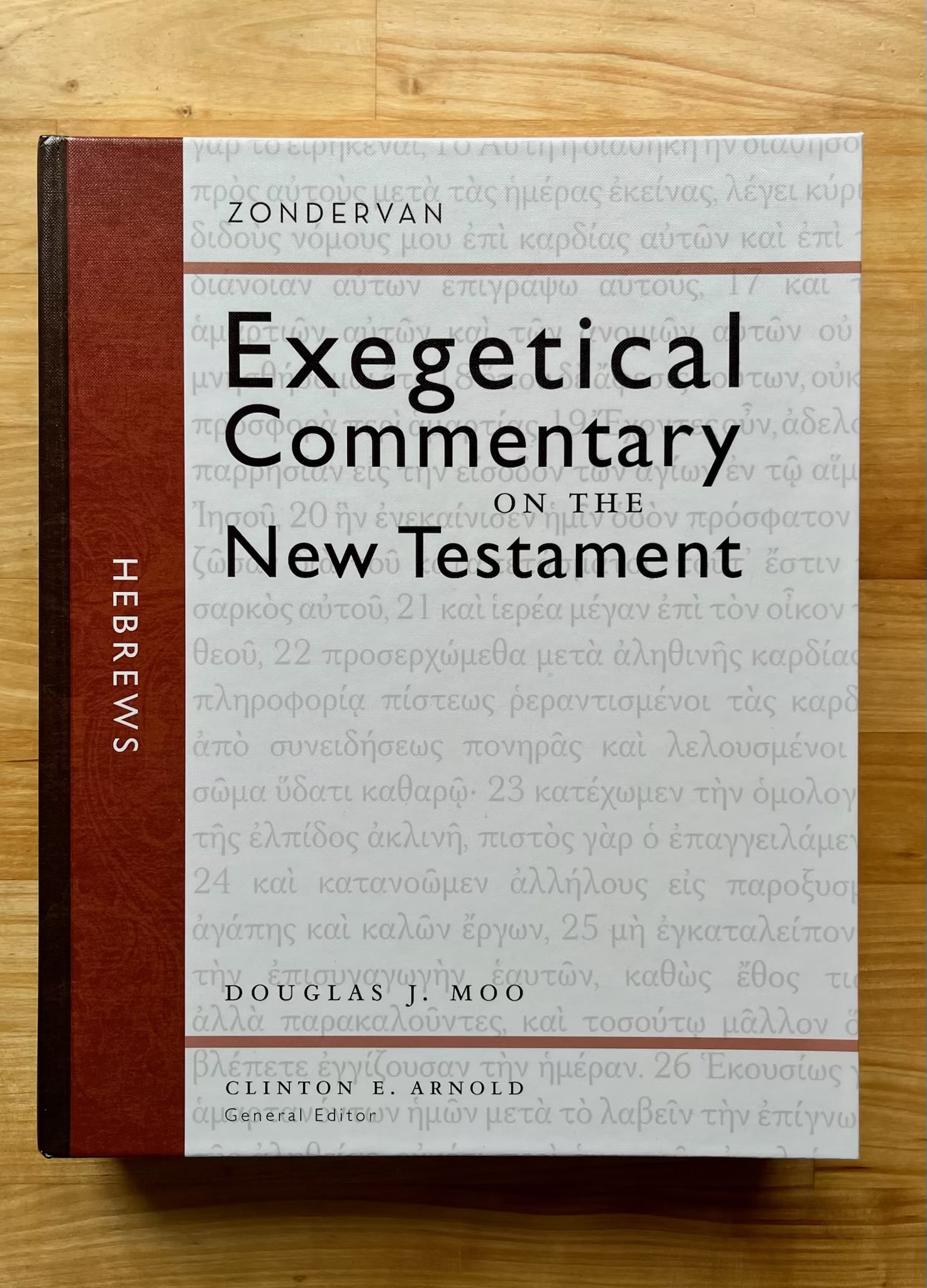
Hebrews is an incredibly difficult book, so I was glad to see Douglas J. Moo’s volume on Hebrews finally released. Douglas Moo is a veteran New Testament commentator, known for his careful exegesis and Reformed interpretations. Even though he wrote his dissertation on the Gospels’ use of the Old Testament, he is most known for his works on Pauline theology.
Douglas Moo is professor of New Testament emeritus at Wheaton College.
Because Hebrews gives us so little historical background, Moo adopts what he calls a kind of “historical minimalism.” This allows him to read the letter both on its own terms and in relation with the rest of the New Testament. His introduction is brief (only eighteen pages), but it clearly covers the key issues. Moo argues that the genre of Hebrews is best understood as a sermon put into written form. As for authorship, it was likely someone with excellent Greek, deep familiar with the Old Testament, and had some connection to the Pauline circle. Moo finds Apollos to be the most likely candidate, but, in the end, we will never know.
The date is placed before AD 70, since the readers have not yet shed blood, which suggest for Moo a time prior to Nero’s persecutions. As well, the argument of the letter would lose much of its force if the temple had already been destroyed. When it comes to audience and occasion, Moo avoids the common reconstruction that the readers were tempted to return to Judaism. Instead, he sees a more general spiritual sluggishness, which would be a failure to press forward to maturity combined with the danger of drifting backward.
Moo situates the author’s worldview primarily within Jewish apocalyptic thought, emphasizing a redemptive-historical framework centered on the “last days,” while allowing for some influence from Middle Platonism. Moo also does a good job maintaining a canonical balance. In the one hand, he holds Hebrews as unique, and he resists forcing it into a pre-existing theological system. On the other hand, he shows how Hebrews fits into and contributes to New Testament theology. The uniqueness of the letter shows up especially in Moo’s treatment of the warning passages and the timing and location of Christ’s atoning work.
Commentary Set-Up
The structure of the commentary is one of its strengths.
- Each passage begins with a discussion of the literary context, showing how the unit fits into the argument of the whole letter.
- A short “main idea” follows, summarizing the passage in a concise paragraph.
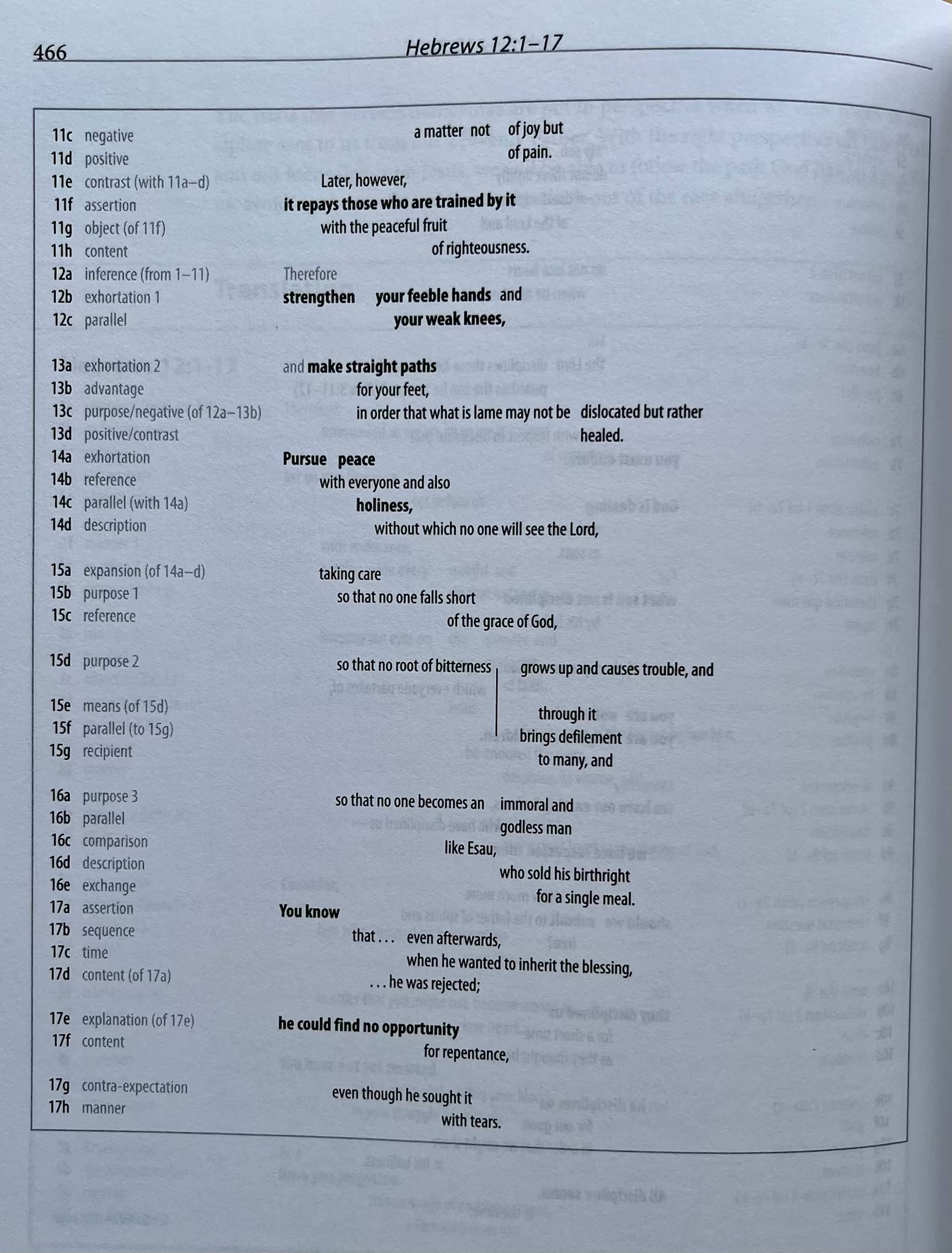
- Moo then provides his own translation with a graphical layout of the Greek text, displaying the relationships between clauses.
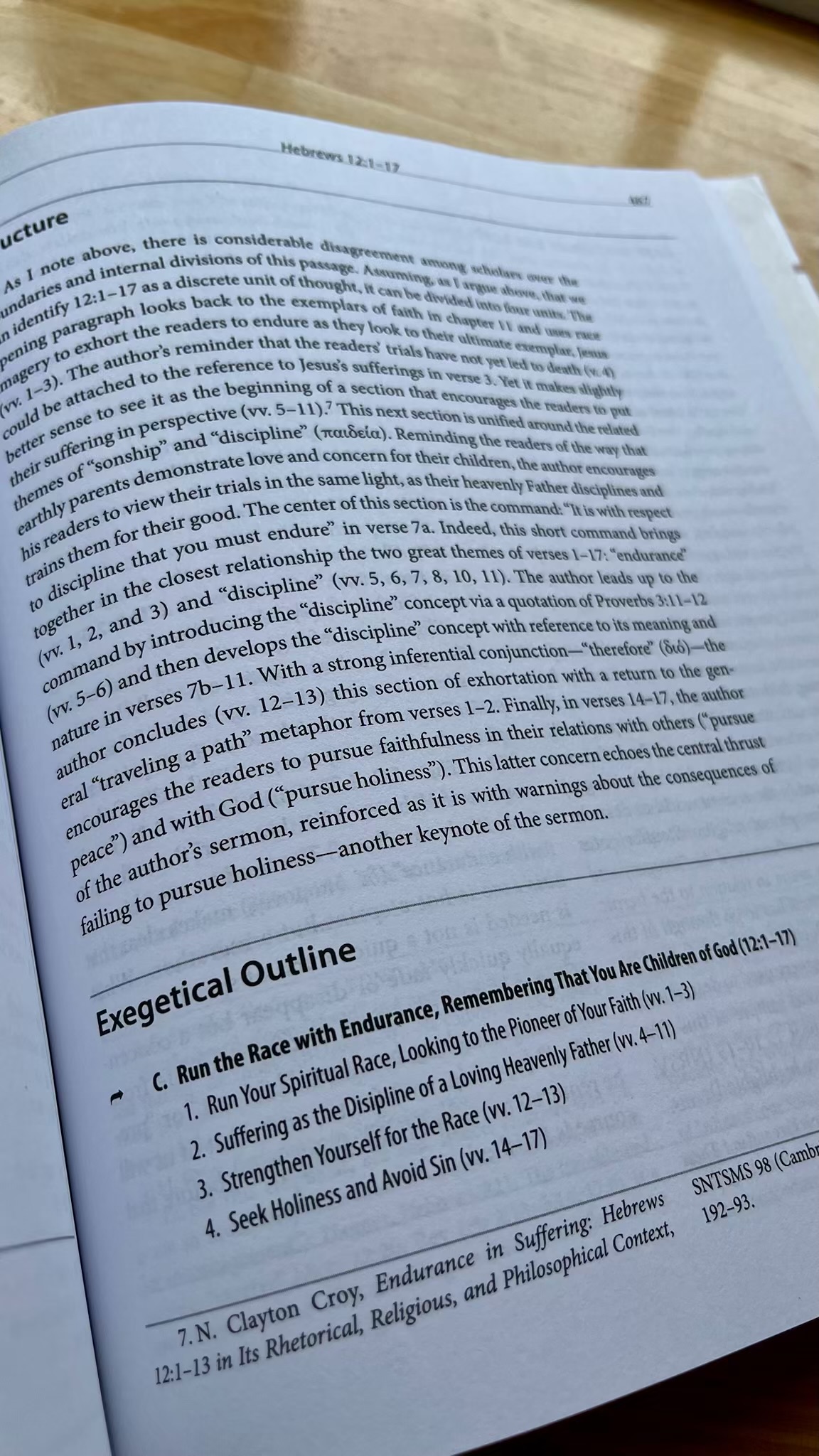
- From there, he walks through the structure before offering a detailed exegetical outline.
- The main body of the commentary is the the explanation of the text where Moo engages the Greek, syntax, key terms, rhetorical features, and biblical theological connections.
- Each section concludes with Theology in Application, which is especially helpful for pastors and teachers.
- The volume ends with a set of theological emphases on major themes in Hebrews, including salvation history, the unseen realm, the use of the Old Testament, and the person and work of Christ.
Rhetoric
Moo’s sensitivity to rhetoric is one of the more helpful features of the commentary. A good example is his treatment of the warning passages as speech-acts. Meaning, language does not merely communicate information; it also does something. Moo illustrates this with a simple example: if his wife says, “the kitchen garbage bin is full,” she is not merely informing him of a fact, she is prompting him to get up and act.
In the same way, the warnings in Hebrews are meant to move the audience toward perseverance. Here, Moo gives a nod to Schreiner and Caneday: the warnings function as means by which God preserves his people. However, Moo does not ultimately reduce the warnings to mere hypotheticals. Instead, he argues that the author pastorally employs hyperbole to press the urgency of perseverance. The familiar pastoral dynamic is at work: comfort the afflicted and afflict the comfortable.
That said, how do we know this is hyperbolic language? Is it because then these warnings fit better together with the rest of the New Testament’s emphasis on the perseverance of the saints? To say that one cannot be brought back to repentance is a sobering claim if true, one that would be difficult to justify treating it as mere hyperbole. As of now, I am still persuaded by Schreiner and Caneday‘s reading of the warning passages.
Mini-Stops
- In Hebrews 1:5, Moo understands “begotten” as referring to Jesus’ exaltation and enthronement, not his eternal generation. The Son is eternally the Son, but in the economy of redemption, he enters a new phase of royal status through resurrection and exaltation.
- In 2:12, the author places Psalm 22:22 on Jesus’ lips, showing Jesus willing to declare us his brothers and sisters in the midst of the assembly. Jesus himself quoted from Psalm 22:1 from the cross (Mark 15:34//Matt 27:46), and from that the evangelists applied other verses from Psalm 22 to Jesus’s passion. Moo observes that it is “only Hebrews [that] quotes from the second, ‘praise’ part of the psalm” (83).
- In 4:12, God’s word is not merely informative but penetrating. It exposes and discerns what even human beings themselves cannot separate.
- On 8:6, Moo makes an important theological point: atonement does not function in a vacuum. It requires a covenantal framework. Just as the old sacrifices were effective within the old covenant, so Christ’s sacrifice is effective within the new covenant, which is both “new” and “better.”
- In 8:7–13, regarding the new covenant, while Moo doesn’t exegete the passage from Jeremiah 31, he ends with writing about the continuity and discontinuity of the covenants. Moo affirms New Covenant Theology, a view very close to Progressive Covenantalism. He emphasizes discontinuity with the Mosaic covenant and the unity of Jews and Gentiles in one people of God. The church doesn’t “supersede” or “replace” Israel; it fulfills Israel. Both Jews and Gentiles are one body in Christ (Eph 2), “members of God’s household” (Eph 2:19), the church (3:10). Baptism is the sign of the new covenant, given to those who belong to it by faith.
- In 12:16–17, the imagery of Esau and the rejection of his birthright/blessing fits with the author’s emphasis throughout the letter on the serious nature of the readers’ decision against sluggishness. Moo writes, “Those who spurn God’s good gifts after experiencing them cannot be brought back again to repentance” (482).
New Covenant Tensions
One of the clearest tensions in Moo’s commentary emerges in his handling of perseverance. Moo is explicit: reading the New Testament as a whole, he affirms the perseverance of the saints. But when he focuses on Hebrews in isolation, he admits that the warning passages carry greater weight than the assurances. In fact, he suggests that Hebrews on its own could plausibly support an Arminian reading.
This is where the issue becomes more pointed. Hebrews is the one New Testament document that explicitly develops the theology of the new covenant. And that covenant, as promised in Jeremiah 31, includes transformed hearts, true knowledge of God, and definitive forgiveness of sins. To belong to the new covenant is, by definition, to be saved.
At the same time, Hebrews 7:25 tells us that Christ always lives to intercede for his people. Moo himself affirms the completeness of the salvation secured by Christ’s priestly work. Yet he stops short of drawing the full theological conclusion from these realities. Instead, he leaves the tension in place: strong warnings alongside real assurance, without a final synthesis.
Moo ultimately argues that the warnings are not merely hypothetical but rhetorically intensified. They function to press the audience toward perseverance. That is helpful as far as it goes. But the question remains whether the promises of the new covenant—and the ongoing intercession of Christ—should play a more determinative role in resolving that tension.
Recommended?
Moo has given us a very good commentary, one that is careful, text-driven, and attentive to both the Greek text and the flow of the argument of the letter. This is especially useful for pastors and readers who want to see how an author like Moo actually reaches his exegetical conclusions. That said, it is not light reading, and the level of detail will likely be overwhelming for many lay readers.
I would place Tom Schreiner’s commentary ahead of Moo’s in terms of biblical theological conclusions, particularly in how it handles the theology of the new covenant. But in comparison, Moo gives more exegetical detail. A necessary comentary in the Reformed field.
Lagniappe
- Series: Zondervan Exegetical Commentary on the New Testament
- Author: Douglas J. Moo
- Hardcover: 608 pages
- Publisher: Zondervan Academic (November 2024)
Buy it on Amazon or from Zondervan!
Disclosure: I received this book free from Zondervan Academic. The opinions I have expressed are my own, and I was not required to write a positive review. I am disclosing this in accordance with the Federal Trade Commission’s 16 CFR, Part 255 http://www.access.gpo.gov/nara/cfr/waisidx_03/16cfr255_03.html.
Amazon Affiliate Disclosure: As an Amazon Associate I earn from qualifying purchases.

