
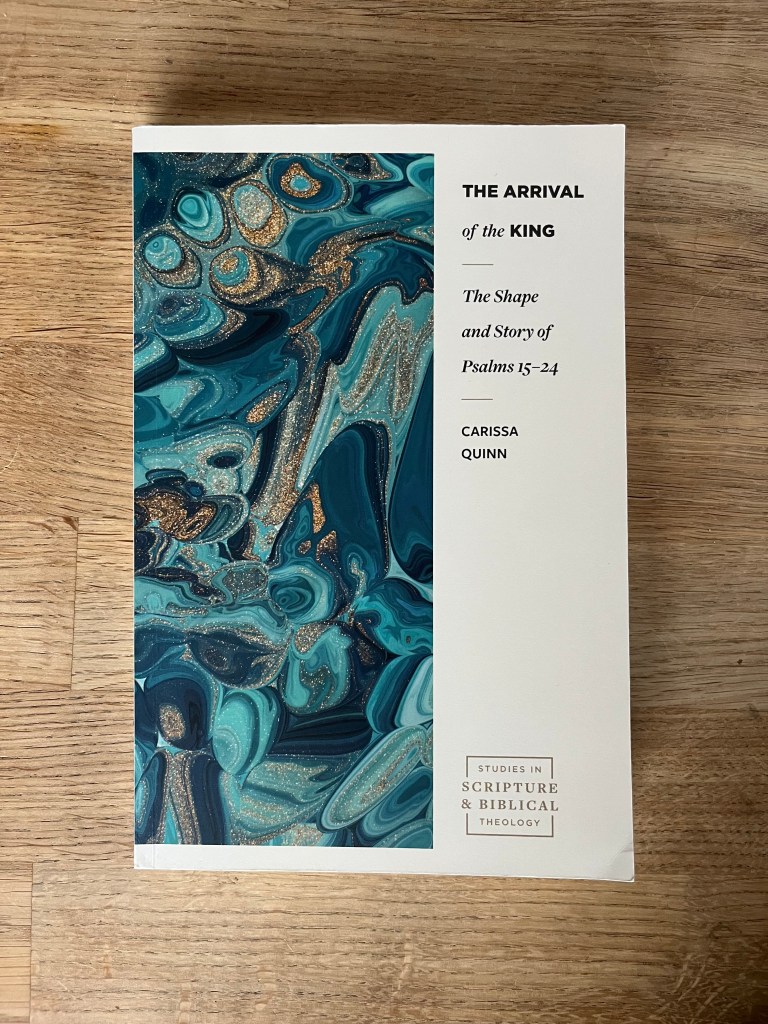
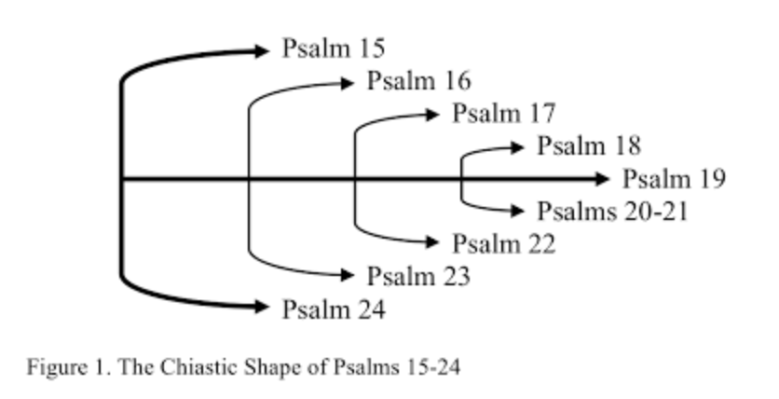
How should we read the Psalms? Are they Israel’s greatest hits? Perhaps the whole hymnal? Maybe they tell a story? Perhaps their arrangement is actually intentional. Carissa Quinn’s book was born out of her doctoral dissertation at Gateway Seminary. Through her methodology, she identifies links between Psalms 15–24 and “confirms that Psalms 15-24 form a chiastic collection of the following parallel psalms: 15 and 24; 16 and 23; 17 and 22; and 18, 20, and 21” (xv). Psalm 19 stands at the center of the frame and is closely linked with Psalms 15 and 24. The consistent differences found between the two halves of the chiasm “show a progression in the storyline… toward the fullness of Yhwh’s kingdom and his arrival as king. Psalms 18-21 at the center of the collection depict a central figure-the Torah-obedient king-through whose deliverance by Yhwh the kingdom comes about” (xv). These psalms alternate between the ideal vision of life in the kingdom and the reality of suffering in this life. Until YHWH comes, life is a journey involving suffering while remaining confident in YHWH’s kingship and faithful deliverance.
In chapter one, Quinn introduces her work and aim, gives insight into the design of the psalter, and reviews the history of Psalms study. Why make a big deal about these ten chapters? Reading the Psalter as one unified book intentionally arranged to tell a story has become increasingly popular over the last few decades, and Quinn’s work adds to the evidence that this is so. Quinn writes that examining these ten psalms “challenges the tendency to read psalms as isolated units by raising various questions” (1). There are “only two entrance liturgies in the entire Psalter,” and they kept close together, Psalms 15 and 24 (1–2). The phrase “I/he will not be shaken” occurs five times in Book I of the Psalter. Four of these appear within Psalms 15-24. “The correspondence between Psalms 20 and 21 is striking: in Psalm 20, “the community petitions Yhwh to give the king his heart’s desire,” and Psalm 21, “the community rejoices that Yhwh has given the king his heart’s desire” (2). Are these merely incidental occurrences, or are they intentional links that bind these psalms together? And if these psalms, why not the whole Psalter?
Chapter two covers Quinn’s methodology, how she identifies the relationships that exist between these specific Psalms. She wants to show that seeing an overall design to the Psalter is neither “impressionistic” nor does it “tend to draw unsupported conclusions” (17). In fact, in keeping with her three appendixes, Quinn has plenty of supported conclusions, showing that she does in fact put “forth a thorough methodology for discerning the shape and message of collections” (18). Quinn does this in three ways. She:
- includes other ANE editorial strategies;
- analyzes the strength of the repetitions between Psalms 15–24;
- Develops a method for interpreting the psalms that are most closely connected (18).
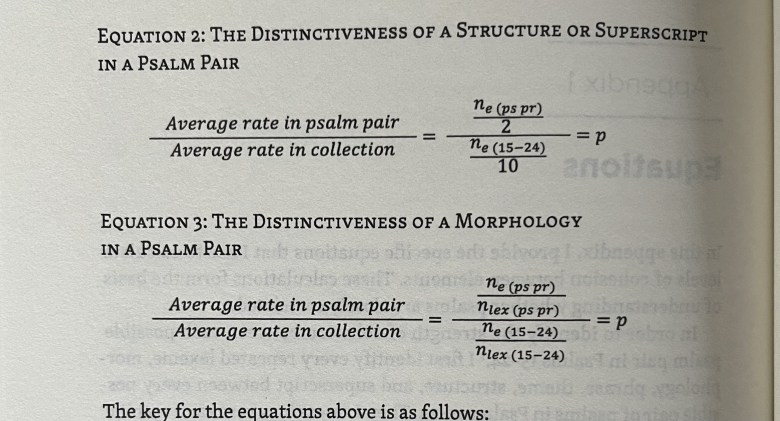
For example, she identifies every repeated element (word roots, lexemes, phrases, themes, the psalm’s structure, the superscript, and the Divine name. She compares how often a word occurs within the collection vs. within a psalm pair (when two psalms closely cohere to each other) to determine whether that psalm pair is intentionally linked.
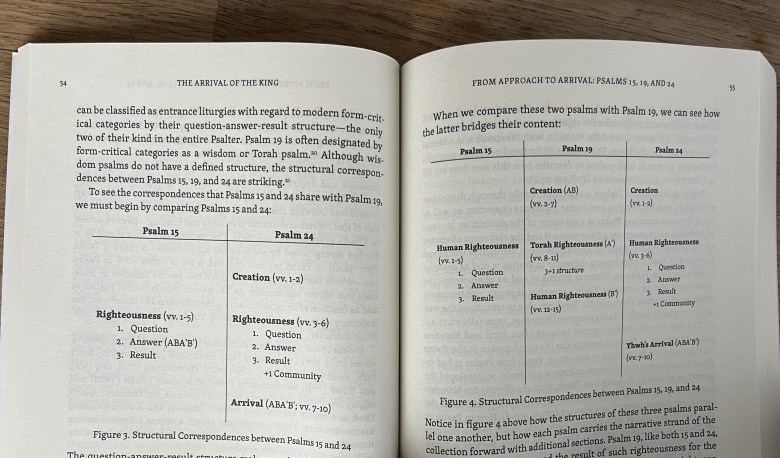
Chapters three to six cover the relationships of these psalms, their cohesion, and the story they tell. Within each chapter Quinn inserts tables with the strengths of cohesion these particular psalms share with the rest of the psalms in the collection (e.g., how Ps 15 coheres with Pss 16–24). These tables offer proof for why Quinn believes Psalm 15, 19, and 24 cohere; 16 and 23; 17 and 22; and 18 and 20–21.
Quinn then considers the shape of each Psalm, such as an ABA’B’ pattern, or a chiastic ABA’ form. She giver her own translation with her own divisions to help us see the relevant connections in her comments on the text. She looks at significant words used throughout the Psalm and then reused and developed in other psalms. For example, the lexeme tent is one distinctive link between Psalms 15 and 19 “that further elaborates on how relentless Yhwh is in his forgiveness and deliverance of his people” (46). The sun dwells in a tent (19:5c), a word used elsewhere in the psalm group only in Psalm 15:1 where it refers to God’s dwelling (Ps 15:1). While this might seem like a stretch, there is an analogy between God and the sun. However, we can unearth more information in Psalm 19. Within this Psalm, nothing is hidden from the sun’s heat (19:5–7). Just the same, YHWH “actively discerns all parts of a human heart, including the hidden errors (vv. 12-13). This analogy depicts Yhwh as relentless to deliver his people from sin to present them as blameless and innocent before him (v. 14)” (46).
Quinn offers a very brief exegetical/literary commentary on the chapters’ psalms to show how particular themes are handled within that psalm, as well as how it conforms to a particular “shape,” such as lament or praise. She looks at parallelism not merely between two neighboring lines (22:25a, 25b-c), but between sections and individual psalms. This parallelism is seen in her chasm, offering an understanding that within this collection there is “a general pattern of intensification and fulfillment” (153). If Psalm 15 poses the question of who may enter the house of the Lord, its parallel, Psalm 24, answers that question with the arrival of YHWH. The two themes of joy and trust are found in Psalm 16 and are intensified in its parallel, Psalm 23. When the pattern within the parallel psalms are understood, and when all the psalms within the collection are then read together, we gain a greater understanding of the message.
Chapter three examines the cohesion between Psalms 15, 19, and 24.
Chapter four examines the connections between Psalms 16 and 23 and how they move the story forward.
Chapter five examines the cohesion between Psalms 17 and 22 and how they offer a plot twist: suffering.
Chapter six focuses on the hinge: the King is delivered in Psalms 18, 20, and 21.
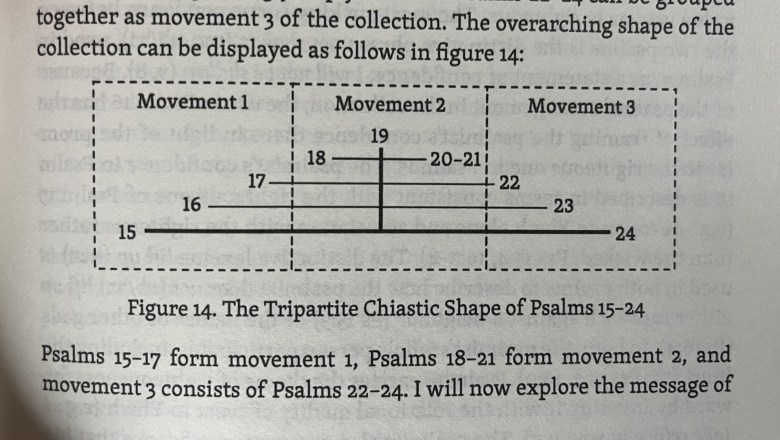
Chapter seven gives us the payoff with a look at the message of Psalms 15–24. Here Quinn covers some of the themes developed throughout the collection. YHWH’s presence is intensified, and he is identified as King over all. As well, from one half of the chasm to the next, YHWH’s kingdom is not limited to one particular location but is expanded to all people, places, and times. Quinn takes us through these ten psalms and shows how the storyline progresses and shows how one accesses YHWH’s presence through being faithful to the Torah. YHWH’s ideal king must undergo suffering and be delivered by YHWH in order for his kingdom to come about.
Math
This may very well be the first time I’ve encountered math, at least this much statistical math, within a theology book. And while I feel I’m swimming in deep water, this is also an excellent resource for scholars to use for their own research. How does one know if a word link between two books or sections within a book are actually significant? Quinn has performed some serious research, which isn’t exciting to read, but at least you know exactly what she did to get her answers. This is both a legitimate and an understandable issue with most biblical theologies. Scholars don’t provide their exegetical work, and for good reason. Their books would be immensely longer (think of Kingdom Through Covenant—KtC—by Gentry and Wellum). Yet because of the exegetical work in KtC people are able to understand both why and how Gentry (and Wellum) arrived at their conclusions. Quinn pulls back the curtain to reveal her work, allowing you to go further in your own exegetical pursuits.
Recommended?
If you are a scholar looking for more evidence on how the psalms cohere together as one book, Quinn’s book is highly recommended. She offers a careful methodology that shows how the psalms can be seen as grouping of literary units that, when put together as they are, create a holistic, unified story. I do hope that more psalms scholars will take her methodology, tweak it if necessary, and see how the book of Psalms is put together. If you are a pastor or layperson studying these Psalms, and you enjoy biblical “scuba diving,” this would also be a great work for you. Quinn dives deep into the textual and thematic connections within these ten psalms. The effort was clearly worth it as she finds plenty here, showing the Psalms were intended to be more than only individual psalms/songs/chants in the temple. They tell us of God’s salvation and kingdom that comes through his Davidic king.
Pair this with Jim Hamilton’s two volume commentary on Psalms and his new book on Psalms, Reading the Psalms as Scripture.
Buy it on Amazon or from Lexham Press!
Lagniappe
- Series: Studies in Scripture and Biblical Theology
- Author: Carissa Quinn
- Paperback: 280 pages
- Publisher: Lexham Academic (December 13, 2023)
Other SSBT Reviews
- Figuring Resurrection — Jeffrey Pulse
Review Disclosure: I received this book free from Lexham Press. The opinions I have expressed are my own, and I was not required to write a positive review. I am disclosing this in accordance with the Federal Trade Commission’s 16 CFR, Part 255 http://www.access.gpo.gov/nara/cfr/waisidx_03/16cfr255_03.html.
Amazon Affiliate Disclosure: As an Amazon Associate I earn from qualifying purchases.

