

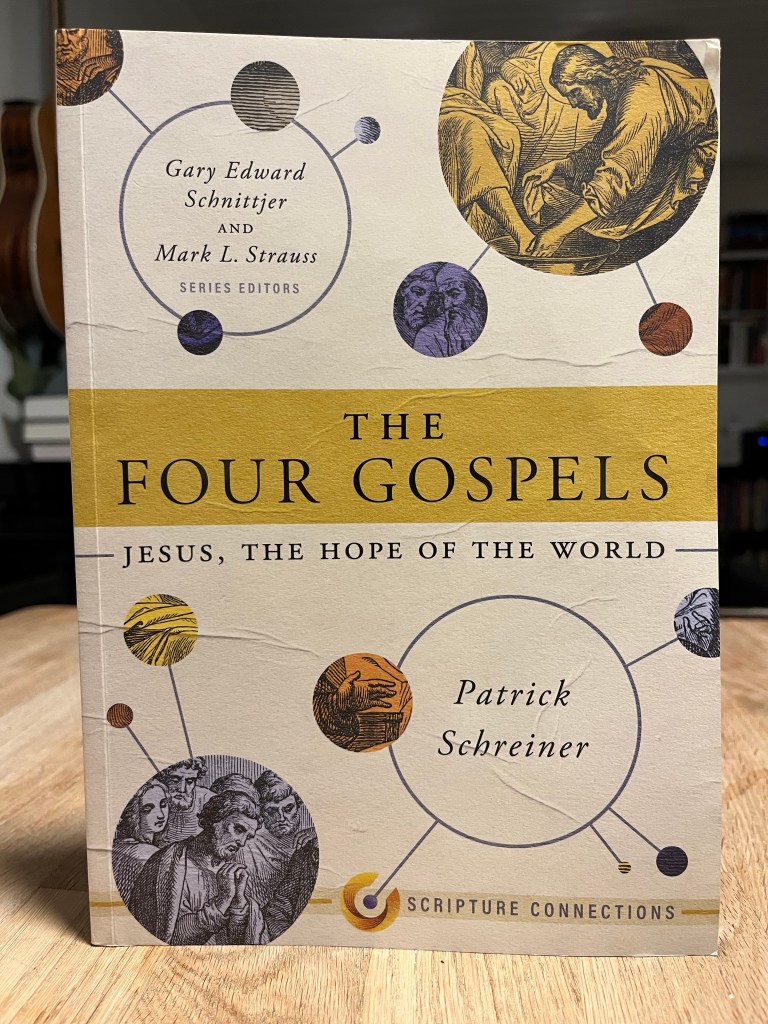
This is the third volume in the Scripture Connections series, edited by Gary Schnittjer and Mark Strauss. This volume covers The Four Gospels and is authored by the prolific Patrick Schreiner. Previously, in connection with the Gospels, Schreiner has written about Matthew, the ascension, and the transfiguration. He doesn’t elevate the Gospels over the rest of the Bible, where some understand them as a canon-within-a-canon, taking interpretive priority over the other 62 books of the Bible. However, as he writes, “The Gospels are the center of the Bible, the climax of the Scriptures” (1). We finally meet the King, the Messiah, the Savior, here! Schreiner continues, “The Gospels are where the rest of the story falls into place, the shadows depart, and the light shines. In the Gospels we finally see Jesus: the resolution, key, final movement, the light” (1).
The Gospels are important because they give us a “direct sense of the Bible’s great story line” (2). The Old Testament leans toward them, and the rest of the New Testament presupposes them. The best part of all is that we meet Jesus here. Schreiner quotes Erasmus who pointed out that if trust historical footprints made by Jesus’ feet were put on exhibit, how the world would clamor to see it, and how Christians would adore it. But how much more do we have in the Gospels themselves about Jesus—his very words, actions, his care for people, his obedient death on the cross?
Who chose the Gospels? Rather than being “chosen” by a committee, as the very word of God “the Gospels imposed themselves as canonical upon the church” (5). In fact, contrary to what many might think, “Neither the community nor history creates the Word; rather, the Word creates the community and directs history” (5).
Schreiner teaches us that it is important for us to wear three lenses when we read the Gospels:
- We need to read the Gospels according to their historical context.
- To give a few examples, houses usually included multiple generations of families, and it was from here where people would conduct business. As well, “Politics and religion were not distinguished. Rome ruled over Israel. Polytheism ruled the day. Slavery was ubiquitous” (7). We enter a different world when we come to the Gospels.
- We need to read the Gospels according to their literary context.
- Being Greco-Roman biographies, the Gospels are centered on one figure: Jesus. Every story is about him, and every character reveals something about Jesus. We need to pay careful attention to the Gospels’ structure, setting, point of view, characters, and plot.
- We need to read the Gospels in the context of the whole book.
- While there are many wonderful stories in each Gospel, each Gospel is its own book. Each author repeats words, themes, parallels throughout their Gospels to tie their theology of the Messiah together.
Schreiner gives a two-page summary that covers the end of the OT, the intertestamental period, and up to Jesus day. This is important for understanding Jesus’ main message and action, mainly, announcing the kingdom of God, which is “the King’s presence over the King’s people in the King’s place” (13). The Gospels show us the Jesus who transforms us. He is a Savior we can trust (faith), a King whose return we hope for (hope), and a wise teacher to emulate (love).
Next Schreiner introduces each Gospel with an outline, a section on its author, date, and message, and an interpretive overview (that is, a section-by-section summary). These overviews are neither dull nor repetitive. Schreiner is sensitive to each Gospel authors theological aims and themes. Boxes and tables are placed throughout these sections. Schreiner helps us understand Jesus and purity laws, the abomination of desolation, the parable of the prodigal son, or the temple cleansing in John. Tables include parallels between Jesus and Moses in Matthew, or how Jesus fulfills (or reenacts) Israel’s story in Matthew, the new exodus in Mark’s structure, or the Jewish festivals in John and their fulfillment in Jesus.
Schreiner ends each chapter with Old Testament Connections (perhaps how Jesus fulfills expectations or picks up loose threads from the OT), Gospel Connections (how this Gospel points us to Christ as our salvation), and Life Connections (application). He ends with a list of interactive questions and recommended resources with commentaries and monographs.
Recommended?
I am very happy to recommend this because Schreiner is enjoyable to read (and because I think he’s correct on so much!). In college I tried picking up some NT survey books, but they were so dry and boring. There was no pizzazz to them. It was just information cut-and-dry. But Schreiner clearly believes what he writes, and you can tell he enjoys this. This makes it enticing to read, not to mention it covers the Gospels themselves which point to our King. This volumes would be good survey texts for a Bible college, but it would serve you well just reading it at home trying to learn more about the four Gospels we have before us.
Buy it on Amazon or from B&H Academic!
Other reviews and posts in this series:
- The Pentateuch — J. Daniel Hays
- Old Testament Narrative Books — Gary Schnittjer
Lagniappe
- Series: Scripture Connections
- Author: Patrick Schreiner
- Paperback: 213 pages
- Publisher: B&H Academic (June 1, 2024)
Review Disclosure: I received this book free from B&H Academic. The opinions I have expressed are my own, and I was not required to write a positive review. I am disclosing this in accordance with the Federal Trade Commission’s 16 CFR, Part 255 http://www.access.gpo.gov/nara/cfr/waisidx_03/16cfr255_03.html.
Amazon Affiliate Disclosure: As an Amazon Associate I earn from qualifying purchases.

