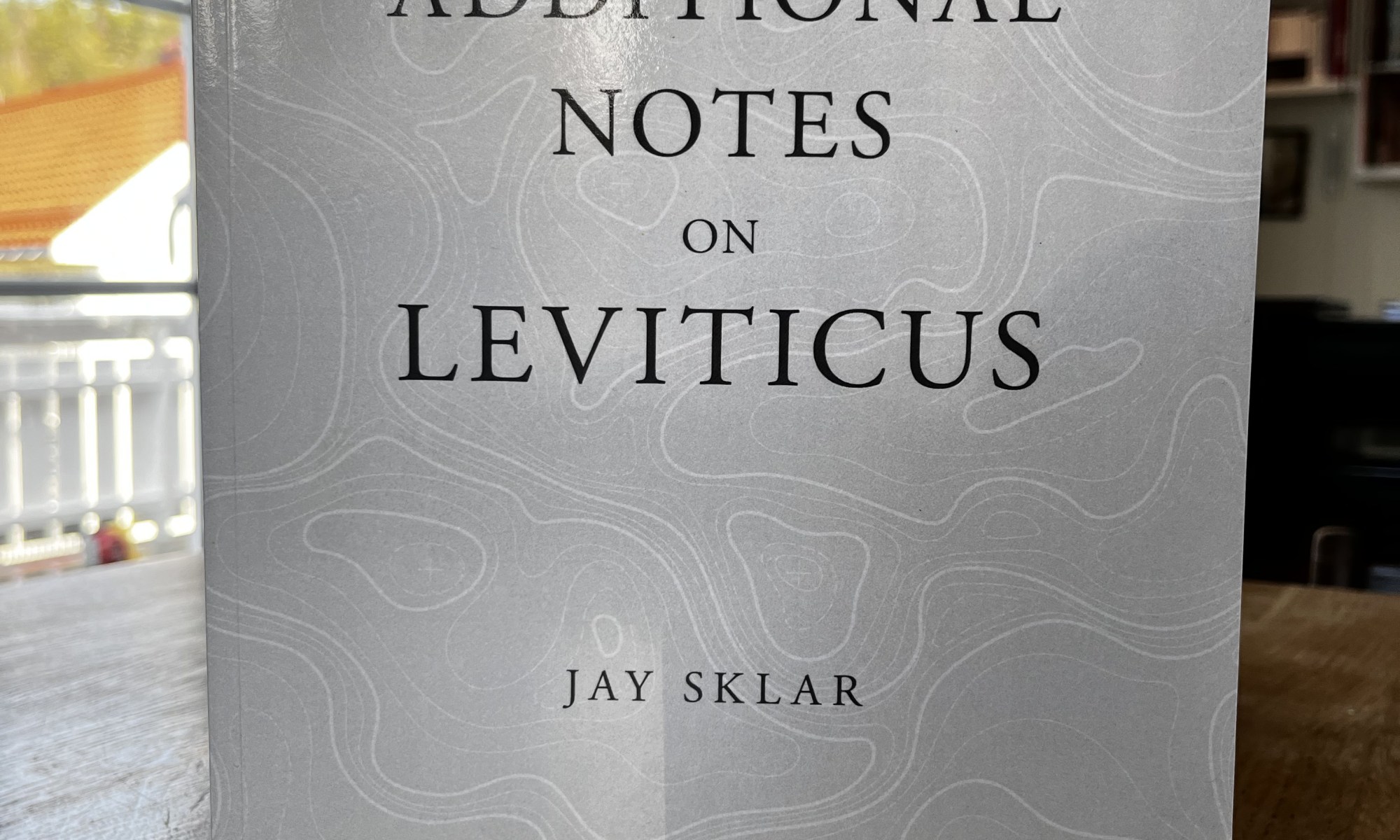

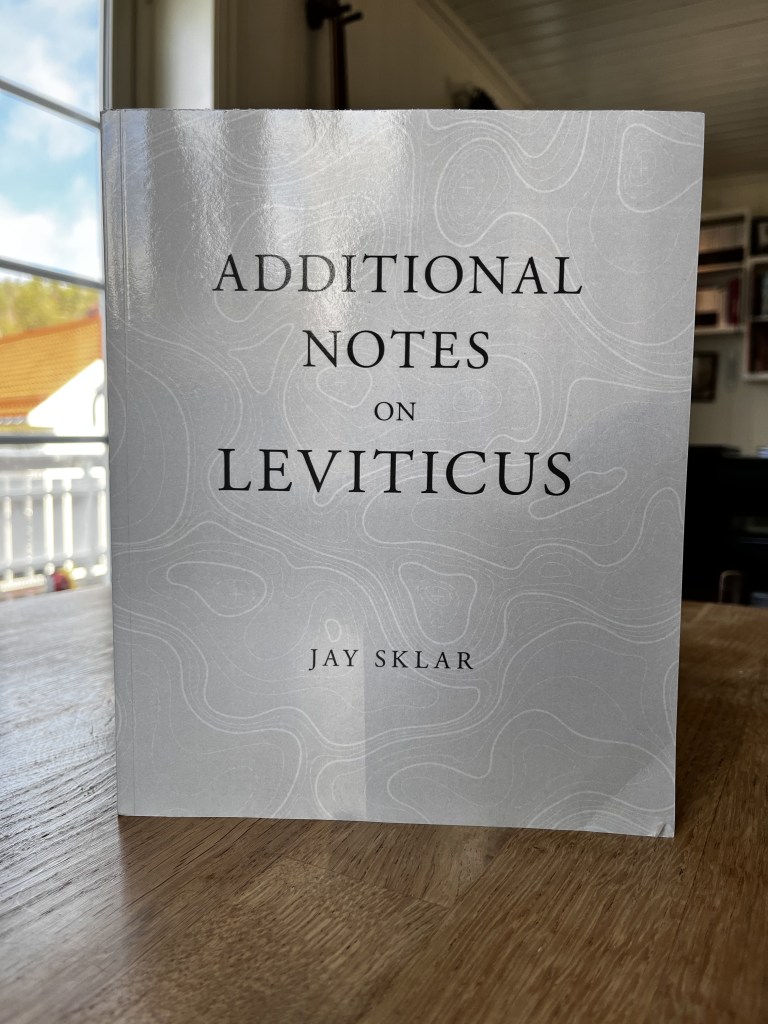
Earlier this year I reviewed Jay Sklar’s excellent commentary on Leviticus in the ZECOT commentary series. It was an extension of his TOTC commentary on Leviticus. While his ZECOT volume was long, Sklar still had to cut out 160,000 words! That was over one-third of his book. Some of those notes have managed to sneak themselves into this book, Additional Notes on Leviticus.
If Sklar’s ZECOT volume answered the question, “What do I need to know to teach or preach well on this passage?”, this book answers the question, “What else might I like to know if I am interacting with the secondary literature, or looking very in-depth at various aspects of the Hebrew?” Sklar offers three categories of notes. To showcase some of what this book does, I will present the examples Sklar cites in his categories below.
Sklar offers three kinds of notes:
- Notes interacting with secondary literature, usually when Sklar comes to a different conclusion (cf. the use of “when” in 1:2);
- In his commentary Leviticus 1–16, Jacob Milagros argues that the presence of the particle “when” (ki) in Leviticus 1:2 “implies this law is conditional and optional and therefore describes voluntary offerings” (1).
- However, Sklar notes that this law is a case law, and all case laws are conditional for they apply only when a certain condition exists.
- In this instance, Israel is to present a domesticated animal as a whole burnt offering. This doesn’t mean the law itself is optional, for there are texts where presenting a burnt offering is required.
- Leviticus 12:6, “And when the days of her purifying are completed, whether for a son or for a daughter, she shall bring to the priest at the entrance of the tent of meeting a lamb a year old for a burnt offering….”
- The “when” in Leviticus 1:2 means that when the conditions are such that you do bring a domesticated animal as a whole burnt offering, then you must follow the stated instructions. It does not mean that specific law is optional.
- Notes offering expanded thoughts on a passage without referring to secondary literature (cf. “belongs to Aaron and his sons,” 2:3);
- The rest of the offering belongs to Aaron and his sons to provide for their needs. Uncooked grain offerings would be shared by the priests (7:10), and it would provide “an ongoing store of flour to use for making bread” (9).
- Notes focusing on technical aspects of the Hebrew in the passage, but they are not central to understanding the main thrust of the text (cf. “herd,” 1:3).
- Sklar offers five Hebrew terms for animals of the herd. I won’t give all of the specifics Sklar wrote, but iIn English these animals are:
- an ox—a single member of the herd either male or female (22:21, 23),
- a bull—an adult male (23:18),
- a cow—an adult female (1 Sam 6:7),
- a male calf (Lev 9:3),
- and a female calf (Gen 15:9).
- More specifics are offered here as well.
- To give another example, in Lev 2:3 mentioned just above, the preposition L attached to “belongs to” is used often to indicate possession.
- These kinds of remarks are sprinkled throughout this book.
- Sklar offers five Hebrew terms for animals of the herd. I won’t give all of the specifics Sklar wrote, but iIn English these animals are:
Aza’el, a goat, and the Day of Atonement (Lev 16:8)
In Lev 16:8 and the goat sent to Aza’el, Sklar argues against the common interpretation that Aza’el is a demon. For one, while there is parallelism involved, does the verse require the tightest parallelism such that if one goat is for God (a living being), then the other must be sent to another living being (a demon?). Sklar instead understands the parallelism to be that both goats are for something: one goat is for the Lord, and one goat is for “the rough place” (or that it is the departure goat). One difficulty Sklar brings up is the question over why God would involve a demon in one of Israel’s ritual ceremonies.
Michael Heiser talked about this subject on his podcast (transcript). Heiser said that God gets the good stuff (the sacrificial goat to ritually cleanse the tabernacle) while the demon gets Israel’s refuse, the year’s worth of nastiness cleansed from the tabernacle. Yet if in the very next chapter God commands Israel no longer to more sacrifices to goat demons, why would he allow a demon to be a part of the biggest sacrificial ritual of the year: the Day of Atonement? I think Sklar makes a better case here.
Unlike his Additional Notes on Numbers, there are no appendices here (preaching stories, preaching/teaching through Numbers). Although you can find such notes at his website. This book should be read in conjunction with Sklar’s longer Leviticus ZECOT commentary. Since these notes were part of the original manuscript before they were excised, they will make the most sense read alongside that commentary.
Recommended?
This is a helpful book adding extra insights to Sklar’s superb Leviticus commentary. All the information in this book can be found on Sklar’s website, even this book as a PDF file. But if you want the physical copy, go over to Amazon. You might even want to take a look at the PDF first to see more of what you would get. You just might like what you see.
Lagniappe
- Author: Jay Sklar
- Paperback: 234 pages
- Publisher: Independently published (October 3, 2023)
Buy it on Amazon or from Sklar’s personal website (near the bottom)
Review Disclosure: I received this book free from Jay Sklar. The opinions I have expressed are my own, and I was not required to write a positive review. I am disclosing this in accordance with the Federal Trade Commission’s 16 CFR, Part 255 http://www.access.gpo.gov/nara/cfr/waisidx_03/16cfr255_03.html.
Amazon Affiliate Disclosure: As an Amazon Associate I earn from qualifying purchases.

