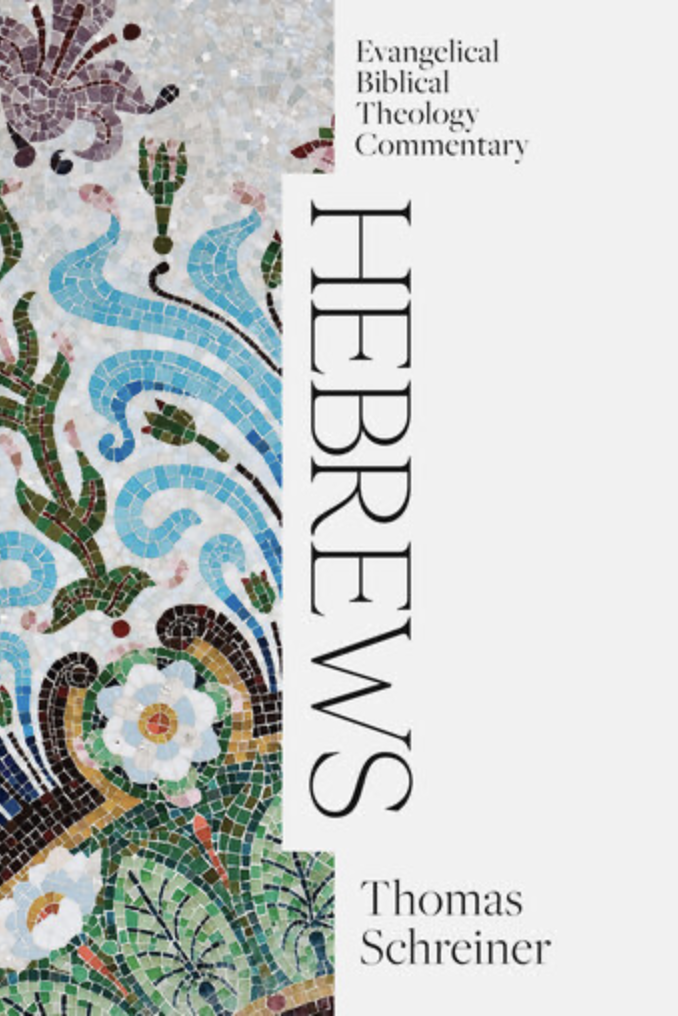

(This commentary was published originally under the Biblical Theology for Christian Proclamation series by B&H Academic, but it has been acquired and updated by Lexham Press under the Evangelical Biblical Theological Commentary (EBTC) series).
Hebrews is among one of the harder books of the NT to understand. I’ve always found it easy to read, but nonetheless confusing when it comes to OT quotations, warnings not to fall away, and that Melchizedek character. While one commentary can’t do everything, the EBTC series aims at showing how Hebrews fits into the biblical storyline.
Schreiner says his “introduction and the commentary are relatively brief and nontechnical,” and he hits his goal (1). His introduction is roughly the same length as O’Brien’s, and his exegesis is a little over 100 pages shorter than O’Brien’s (385 pages of exegesis, with the rest being the Introduction and Biblical Theological sections). If you’re familiar with the PNTC series, it’s not quite as technical as the BECNT or NIGTC. This is even less technical than the PNTC, which will appeal to many.
- Greek is always translated
- Footnotes rarely take up half a page
- Exposition on each verse is relatively brief (though sometimes too brief)
The commentary starts off with the Introduction which covers topics like Date, Authorship, Genre and Structure, Hebrews and the Storyline of the Bible, Biblical and Theological Structures [you can read my others posts about this section here], etc.
The commentary proper consists of:
- Section Heading: “Hebrews 2.10-18”
- Outline: While helpful, it’s also a bit much as it takes up a lot of space since every section has an outline, and they get longer as the book nears the end
- Scripture: the passage of Hebrews 2.10-18 is given in full
- Context: Explains how v10 picks up where v9 left off and how the argument continues through to v18
- Exegesis: Schreiner carefully works through the text. Each verse can have between one and seven paragraphs
- Bridge: This is the theology of the passage in a nutshell.
At the end of the commentary is the Biblical Theological section. Schreiner clearly and succinctly ties the letter together and reveals the unity of the letter under topics such as God, Jesus Christ (and his Divine Sonship, humanity, Priesthood, sacrifice, assurance, and resurrection and exaltation), the New Covenant, the Holy Spirit, Warnings, Assurance, and more.
Biblical theology is “the theology expressed by the respective writers of the various biblical books” and how it fits into the storyline of the Bible (pg. ix, emphasis original). Biblical theology is the theology of the Bible, and it is the attempt to understand and embrace the interpretive perspective of the biblical authors (ix). One of the greatest challenges that biblical theologians face is “how to handle the Bible’s manifest diversity and how to navigate the tension between its unity and diversity in a way that does justice to both” (ix). This series doesn’t aim at being a dense, academic work. It seeks to present Biblical theology to the lives of all who sit in the pew every Sunday morning.
Quick Glimpses of Schreiner’s Interpretations
- In Hebrews 1:5, the use of Psalm 2:7 should be interpreted within the context of Psalm 2, speaking of the Davidic king. It does not refer to Jesus’ eternal being nor to his virgin birth. “The author of Hebrews actually interprets the verse in light of the entire message of Psalm 2. In context, the verse refers to the reign of the messianic king, which Hebrews sees as commencing at Jesus’ resurrection and ascension. Jesus is greater than the angels because he now reigns as the messianic king” (65).
- In 2:12, the author quotes Psalm 22:22 to show that Jesus identifies believers as his brothers and sisters, emphasizing their shared family relationship. Schreiner deftly explains the context of the psalm and how the author of Hebrews uses it in light of Jesus’ work as Lord and Savior. Psalm 22 moves from suffering to deliverance, making it a fitting picture of Jesus’ death, resurrection, and exaltation. Hebrews cites the psalm at its turning point, where cries for help give way to praise and victory. Jesus’ triumph is shared with all who belong to him, who participate in his inheritance and reign. Schreiner argues that this fulfillment of Psalm 22 realizes God’s promises to David and Abraham, bringing blessing and God’s rule to all nations through Christ.
- Hebrews 4:12 “highlights the efficacy of God’s word. Nothing can withstand its power” (147). Because it represents God himself, his word “penetrates to the core of the human heart” (148).
- In 6:4–8, the reference to the impossibility of repentance means that there is no option for salvation outside of Christ: “It is impossible for true apostates to experience conversion anew” (92). While God’s grace can still reach those who lapse in their faith, Schreiner points out that it “will not serve the author’s purpose, however, to speak of the possibility of a return from apostasy. The readers must be made to see the seriousness of what they are contemplating” (92).
- Hebrews 12:16–17 looks back to 6:4–6 and 10:26–31. Esau sought repentance, but it “was not a possibility although he sought it with tears (Gen. 27:30–40)” (222). This reinforces the author’s warning “about the impossibility of repentance for those who abandon the faith” and think they can return to Christianity when circumstances become easier or more convenient (222). Esau, unlike Moses (11:25–27), traded the unseen future for immediate gratification.
Recommended?
What I really enjoy about Schreiner is how he can convey so much in few words, at least relative to the size of Moo (review) and especially Grindheim’s (review) commentaries. This makes Schreiner’s volume perfect for pastors, Sunday School teachers, and lay people. What also makes this book accessible is Schreiner’s rare use of Greek. He mentions important terms in parentheses and rarely brings in Greek grammar when it impacts how Hebrews structures its flow of thought (discourse). Explanations of the discourse are still in English.
Pair this with Bobby Jamieson’s book on Hebrews.
Previous Posts
- Promise-Fulfillment in Hebrews
- Already-But-Not-Yet Eschatology in Hebrews
- Typology in Hebrews
- The Spatial Orientation of Hebrews
Lagniappe
- Series: Evangelical Biblical Theology Commentary
- Hardcover: 560 pages
- Publisher: Baker Academic (January 13, 2021)
- PDF Sample
Interviews
- On the commentary
- On falling away
- On the function of the warnings
Other EBTC Reviews
- Joshua — David Firth
- Job — Barry Webb
- Psalms (vols. 1&2) — James Hamilton
- Romans — David Peterson
- Galatians — Matthew Harmon
- 1–2 Timothy and Titus — Andreas Köstenberger
Buy it on Amazon
Disclosure: I received this book free from Lexham Press. The opinions I have expressed are my own, and I was not required to write a positive review. I am disclosing this in accordance with the Federal Trade Commission’s 16 CFR, Part 255 http://www.access.gpo.gov/nara/cfr/waisidx_03/16cfr255_03.html.
Amazon Affiliate Disclosure: I receive a percentage of revenue if you buy from Amazon on my blog.


Reblogged this on Talmidimblogging.
LikeLike