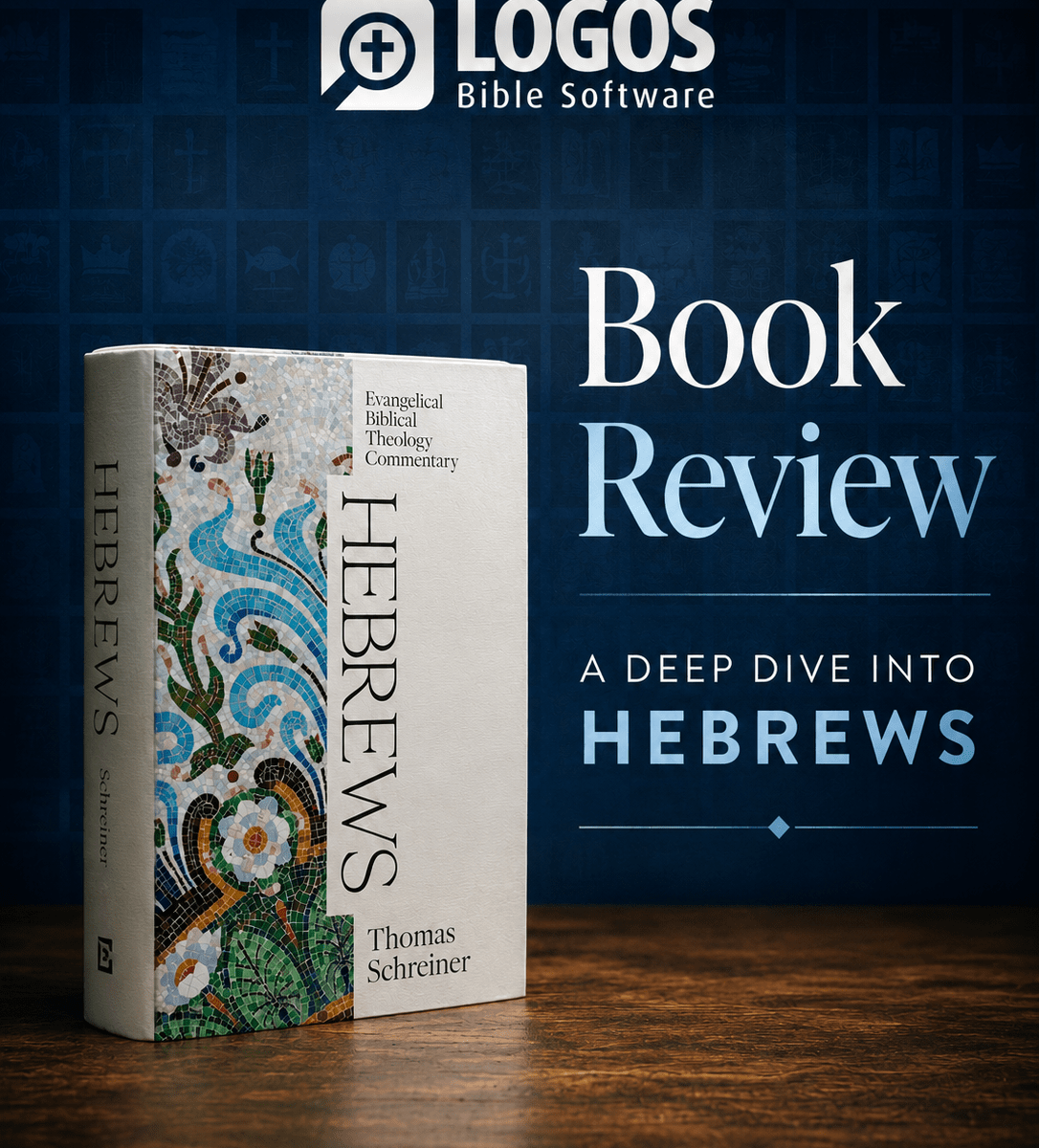


(This review is for the Hebrews volume written by Tom Schreiner in the Evangelical Biblical Theology Commentary (EBTC) series on Logos Bible Software. My original book review, which focuses on the book itself, can be found here. Faithlife has unlocked the whole series up to this point for me, so I will be doing many reviews on the individual volumes in the coming months.)
Hebrews is among one of the harder books of the NT to understand. It seems to quote the OT out of context, offers warnings of no repentance for those who fall away, and then there’s that Melchizedek character. While one commentary can’t do everything, the EBTC series aims at showing how Hebrews fits into the biblical storyline, and I think Schreiner does an admirable job at explaining the theology and flow of the book.
Schreiner says his “introduction and the commentary are relatively brief and nontechnical,” and he hits his goal (1). His introduction is roughly the same length as O’Brien’s now-discontinued volume in the Pillar series (revised by Sigurd Grindheim), and his exegesis is a around 100 pages shorter than O’Brien’s (385 pages of exegesis, with the rest being the Introduction and Biblical Theological sections). This volume is less technical than the volumes in the Pillar (PNTC) series, which will appeal to many.
- Greek is always translated
- Footnotes rarely take up half a page
- Exposition on each verse is relatively brief (though sometimes too brief)
The commentary proper consists of:
- Section Heading: “Hebrews 2.10-18”
- Outline: While helpful, it’s also a bit much as it takes up a lot of space since every section has an outline, and they get longer as the book nears the end
- Scripture: the passage of Hebrews 2.10-18 is given in full
- Context: Explains how v10 picks up where v9 left off and how the argument continues through to v18
- Exegesis: Schreiner carefully works through the text. Each verse can have between one and seven paragraphs (though seven is uncommon).
- Bridge: This is the theology of the passage in a nutshell.
At the end of the commentary is the Biblical Theological section. Schreiner clearly and succinctly ties the letter together and reveals the unity of the letter under topics such as God, Jesus Christ (and his Divine Sonship, humanity, Priesthood, sacrifice, assurance, and resurrection and exaltation), the New Covenant, the Holy Spirit, Warnings, Assurance, and more.
For a brief look at a few of Schreiner’s interpretations, see my review of his book.
Why Buy This on Logos?
Now comes the heavy truth: I think you should buy this on Logos. Look, I like thick theology books as much as the next Bible nerd, but many pastors who want to faithfully lead their congregation just don’t have the time to have five commentaries to flip through on their desk. But they can have it on their computers.
What does Logos have to offer?
If you have used Logos before, some of these may seem rather obvious, but the benefits need to be shown. (If you don’t have Logos, see my reviews of Logos 8, 8 features, L9, and the Logos Pro Subscription update to understand the sorts of features Logos offers).
Hover and Linking

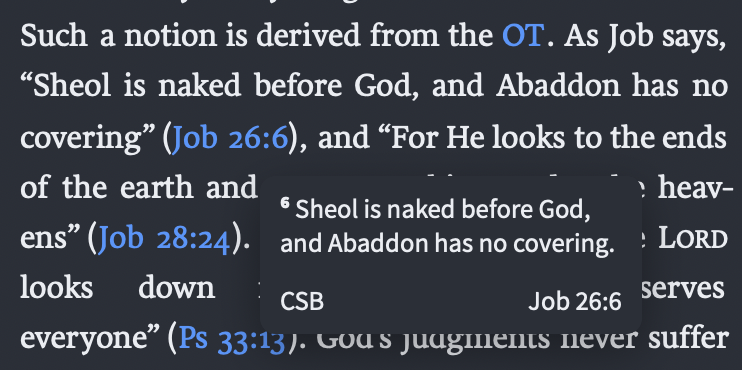

Schreiner cites hundreds of biblical passages. In Logos, you can:
- Hover over a link to another section of the commentary to instantly go there.
- Hover over a reference (Job 26:6 above) to instantly read the verse.
- Click it to open it up in your preferred Bible.
- Keep the Bible linked to the commentary so both scroll together.
Rather than constantly flipping between your commentary and Bible, Logos lets you read every cross-reference with a simple mouse hover/click.
Passage Guide

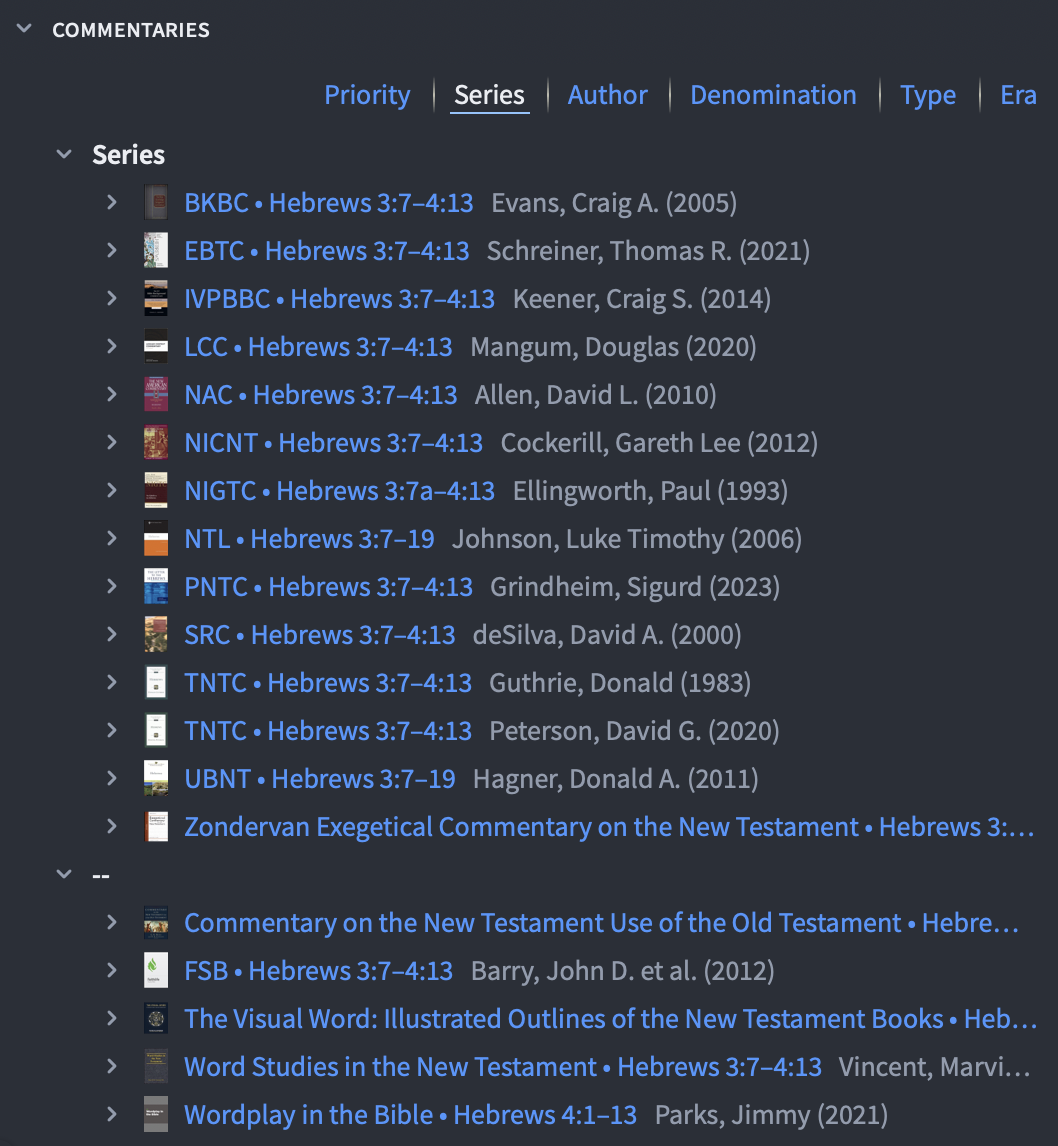
Pastors studying Hebrews can open the Passage Guide for Hebrews 3:7–4:13, a passage about God’s gift of rest fulfilled in in Christ, and Logos automatically gathers:
- All of your commentaries (including Schreiner’s)
- Cross references
- Journal articles
- Biblical theology resources
Now you have more than you need without having to go up to your attic to find your other books (like I do).
Simple Search and Find

This is an oddly satisfying feature. You click a word, any word, in the commentary, and every occurance of that word will be highlighted (until you click something else). Want to find every instance of the word “faith” in a particular section. Click any single occurrence of the word and all of them will be temporarily highlighted, allowing you to see everywhere Schreiner writes about it (and is quicker than doing a word search within the whole commentary).
Factbook

As well, when you click on faith, you can pull up the Factbook to dig into the meaning in the Lexham Bible Dictionary, as well as where it shows up in your other resources.
Word Search


When Schreiner offers his proposed translation of a Greek word, you can do a word search of its lemma (dictionary form) to see if you think he has offered an appropriate translation. You can also pull up the the Lexham Analytical Lexicon to the Greek New Testament for further studies. All right at your fingertips.
Notes

Every note can be attached to:
- a Bible verse
- a word
- a commentary paragraph
- an entire resource
- a selection of text
If you like something Schreiner wrote regarding Hebrews 11:1–3, you could copy it and place it as a sticky note in your Bible (it will show up in all of them).
Sermon Creation


Logos won’t write your sermon for you, but you can easily pull a quote from Schreiner’s commentary and place it in your sermon/Bible study/teaching and it will show up as a powerpoint. Also, When writing a Bible reference, Logos will fill in the verse for you (if you want). Super handy!
Recommended?
What I really enjoy about commentaries on Logos is the ease of use when it comes to highlighting, searching, and comparing it to other commentaries. Physical books are awesome, but I have five kids and I can barely keep one book on the table without it get drawn on (which is super sweet). Plus, for pastors, teachers, missionaries, etc., you can take your whole library with you wherever you bring your computer or your phone!
Schreiner’s volume is perfect for pastors, Sunday School teachers, and lay people. Schreiner mentions important terms in parentheses and rarely brings in Greek grammar when it impacts how Hebrews structures its flow of thought (discourse). Explanations of the discourse are still in English. Biblical theology and how Hebrews sits within the biblical canon flows from this volume.
Buy it on Logos!
Try a 60-day free trial of Logos
Lagniappe
- Series: Evangelical Biblical Theology Commentary
- Hardcover: 560 pages
- Publisher: Baker Academic (January 13, 2021)
- PDF Sample
Previous Posts
- Promise-Fulfillment in Hebrews
- Already-But-Not-Yet Eschatology in Hebrews
- Typology in Hebrews
- The Spatial Orientation of Hebrews
Disclosure: I received this book free from Baker Academic and Faithlife. The opinions I have expressed are my own, and I was not required to write a positive review. I am disclosing this in accordance with the Federal Trade Commission’s 16 CFR, Part 255 http://www.access.gpo.gov/nara/cfr/waisidx_03/16cfr255_03.html.
Logos Affiliate Disclosure: I receive a percentage of revenue if you buy from Logos on my blog.

