
“There is only one Gospel, and that’s the Gospel of Jesus Christ.”
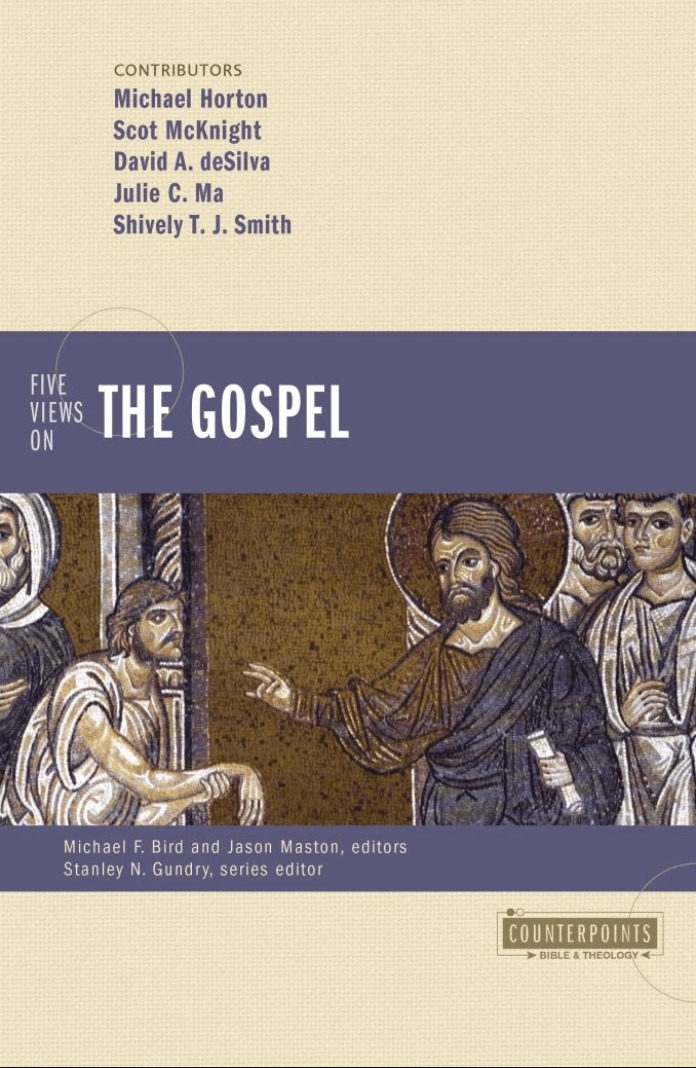
The New Testament tells us to spread the gospel, the good news, of Jesus Christ. Paul explains and defends the resurrection of Jesus in 1 Corinthians 15, part of the gospel that saves us (1 Cor 15:2). So why do we have a book that offers five views on the gospel? This should be simple enough, right? But the Bible is long, detailed, and complicated. While the gospel message is simple enough for a child to understand, it is also more than merely “Christ and him crucified” (2:2).
Another complication is how to preach the gospel in our present globalized age. As editors Michael Bird and Jason Maston write, “In order to share the gospel with anyone, the gospel must be contextualized” (17). One difficulty is that “there are some seven thousand languages in usage in the world today and a constant flux of cultures and contexts into which we have to speak the gospel. How do you speak the word of the gospel to a refugee family from Syria living in Idaho compared to speaking the gospel to a gay Gen-Z teenager with Pakistani parents working as a graphic artist in multicultural London? How does one live a life “worthy of the gospel” at the Waco Walmart, at a university in Nigeria, or in a retirement village in Swansea?” (17).
This book does not present five different gospels, but five angles on the one gospel.
The Five Views of the Gospels
- The King Jesus Gospel (Scot McKnight)
- The Reformation Gospel (Michael Horton)
- The Wesleyan Gospel (David A. deSilva)
- The Pentecostal Gospel (Julie C. Ma)
- A Liberation Gospel View (Shively T. J. Smith)
Summary of Each of the Five Views of the Gospel
Scot McKnight believes the gospel is fundamentally the story of Israel climaxing in Jesus the Messiah and King. The “King Jesus Gospel” stresses that the gospel is not merely about personal salvation but about the announcement of Jesus’s lordship and kingdom. Salvation means entering the story of God’s reign through faith, allegiance, and a life shaped by Christlike discipleship and cruciform living.
Michael Horton presents a classic Reformation and Calvinistic understanding centered on justification by faith. Humanity stands condemned under sin, but through Christ’s atoning work believers receive righteousness by faith alone. Horton strongly emphasizes the forensic dimensions of the gospel while still insisting that true faith produces holiness, obedience, and love.
From a Wesleyan perspective, David deSilva defines the gospel as God’s gracious work of freeing people not only from sin’s penalty but also from its power. His emphasis falls on new birth, sanctification, and Spirit-enabled holiness. The gospel calls believers into intentional discipleship, moral transformation, and participation in a holy community shaped by the Spirit.
Julie Ma approaches the gospel through a Pentecostal lens, stressing the liberating and empowering work of the Holy Spirit. Her presentation highlights deliverance from spiritual and social oppression, empowerment for mission, and the restoration of human flourishing. The gospel creates a holistic spirituality concerned with healing, blessing, and care for people in body, mind, and spirit.
Finally, Shively Smith argues that the gospel must be understood through the realities of suffering, marginalization, and oppression. Drawing from African-American religious experience and liberation theology, Smith sees the gospel as God’s work of spiritual and social liberation through the crucified Christ. The gospel therefore compels believers to pursue justice, human dignity, inclusion, and the dismantling of oppressive systems.
My Thoughts
I agreed most with the first three presentations, and while I initially thought I would not benefit much from Ma’s and Smith’s emphases, I admit I was wrong and appreciated their perspectives, even though they do not place the emphasis where I would.
I appreciated McKnight’s emphasis on the person of Jesus in the Gospels. This is important because, in my experience, the way many describe salvation focuses on what the rest of the New Testament says concerning Jesus’ death and resurrection and the resulting benefits. Many neglect showing how the gospel is seen in Jesus’ teachings, parables, and miraculous acts, generally speaking. McKnight brings into the salvation conversation the Jesus of the Gospels, not just justification.
McKnight contributes a strong essay, and his may be the only chapter that can truly be described as presenting his own distinctive view.
What I mean is the other contributors offer the Wesleyan/Pentecostal/Reformation perspective, and it is not always easy to parse (not that one has to) their personal view from the view they are presenting, which we see in the contributors’ comments about what deSilva writes on Wesley’s view.
As one would hope, the contributors both offer good feedback and substantive critique. That said, there are points where they commit the same fallacy as what they critique. This is seen in deSilva’s critique of Horton’s Reformation view.
Horton identifies several contexts that provide important background for understanding the gospel. These contexts include the Old Testament, Second Temple Judaism, and the Roman imperial cult, but not the Reformation.
“I was surprised by Horton’s claim that ‘the least likely candidate for a ‘context’ [for the Reformation gospel] is the Reformation’ (p. 70). It seems quite disingenuous to set aside the contextual role that Luther’s break from the Roman Catholic Church of the early sixteenth century played in the formulation of ‘the Reformation gospel’—and not a little ideological to claim this gospel to be purely a recovery of the ‘apostolic gospel’” (95).
However, in his chapter on the Wesleyan view, deSilva remarks that in promoting a ‘synergistic’ model of salvation, “Wesley had recovered a proper, contextual understanding of the inseparability of grace and grateful response that shaped all New Testament reflection on how God’s grace became effective for the transformation of its recipients” (123).
Yet deSilva’s comment appears to do the very thing he critiques Horton for doing. If it is ‘ideological’ for Horton to describe the Reformation understanding as a recovery of the apostolic gospel, then it is not immediately clear why Wesley may be said to have ‘recovered a proper, contextual understanding’ of grace without facing the same objection. Both Luther and Wesley were historically-situated theologians whose interpretations arose from theological controversies. What we are trying to figure out here is which theological system aligns best with the New Testament witness.
That said, deSilva is spot on in his critique of how Horton understands the rich young ruler pericope. Horton writes that the rich young ruler was “disillusioned by the law” when Jesus, so to speak, sharpened the knife of the law and showed the rich young ruler that he wasn’t good enough. He walked away (Lk 18:23) and missed hearing the gospel when Jesus predicted his death (18:31–33).
DeSilva points out that what Jesus said was not more law, but the “practical unpacking of the command to love one’s neighbor as oneself” (96). That is, “Jesus’s instructions to him were gospel” (96). The rich young ruler did not want a gospel that “made such demands upon him,” demands that “would lead him—and his poorer neighbors!—to a place of good news” (96).
There are no counter replies by the author. This was likely done to keep the volume from becoming significantly longer. Likely, the authors would only each repeat much of what they said in their chapters, making this section superfluous. The book ends with a conclusion by Jason Maston.
Recommended?
This is a fine volume that doesn’t try to give the only perspective on the gospel, but rather shows where the different perspectives put the most weight. Aside from possibly McKnight’s perspective, the other perspectives themselves show only one angle within their field. Many within the Reformed community will disagree with Horton’s emphasis on only two covenants or his strong law-gospel distinction. Hopefully, this volume will help readers, including those familiar with the McKnight-Gilbert debate, better understand and appreciate the strengths and concerns raised by the various perspectives.
What would have made this book more spicy would have been to include Catholic and Eastern Orthodox perspectives, possibly in place of Ma and Smith’s. But maybe that is another book for another time.
Lagniappe
- Series: Counterpoints: Bible & Theology
- Editors: Michael Bird & Jason Maston
- Paperback: 255 pages
- Publisher: Zondervan Academic (June 2025)
Buy it on Amazon or from Zondervan!
Disclosure: I received this book free from Zondervan Academic. The opinions I have expressed are my own, and I was not required to write a positive review. I am disclosing this in accordance with the Federal Trade Commission’s 16 CFR, Part 255 http://www.access.gpo.gov/nara/cfr/waisidx_03/16cfr255_03.html.
Amazon Affiliate Disclosure: As an Amazon Associate I earn from qualifying purchases.

