
“There is only one Gospel, and that’s the Gospel of Jesus Christ.”
The New Testament tells us to spread the gospel, the good news, of Jesus Christ. Paul explains and defends the resurrection of Jesus in 1 Corinthians 15, part of the gospel that saves us (1 Cor 15:2). So why do we have a book that offers five views on the gospel? This should be simple enough, right? But the Bible is long, detailed, and complicated. While the gospel message is simple enough for a child to understand, it is also more than merely “Christ and him crucified” (2:2).
Another complication is how to preach the gospel in our present globalized age. As editors Michael Bird and Jason Maston write, “In order to share the gospel with anyone, the gospel must be contextualized” (17). One difficulty is that “there are some seven thousand languages in usage in the world today and a constant flux of cultures and contexts into which we have to speak the gospel. How do you speak the word of the gospel to a refugee family from Syria living in Idaho compared to speaking the gospel to a gay Gen-Z teenager with Pakistani parents working as a graphic artist in multicultural London? How does one live a life “worthy of the gospel” at the Waco Walmart, at a university in Nigeria, or in a retirement village in Swansea?” (17).
This book does not present five different gospels, but five angles on the one gospel.
The Five Views of the Gospels
- The King Jesus Gospel (Scot McKnight)
- The Reformation Gospel (Michael Horton)
- The Wesleyan Gospel (David A. deSilva)
- The Pentecostal Gospel (Julie C. Ma)
- A Liberation Gospel View (Shively T. J. Smith)
Summary of Each of the Five Views of the Gospel
Scot McKnight believes the gospel is fundamentally the story of Israel climaxing in Jesus the Messiah and King. The “King Jesus Gospel” stresses that the gospel is not merely about personal salvation but about the announcement of Jesus’s lordship and kingdom. Salvation means entering the story of God’s reign through faith, allegiance, and a life shaped by Christlike discipleship and cruciform living.
Michael Horton presents a classic Reformation and Calvinistic understanding centered on justification by faith. Humanity stands condemned under sin, but through Christ’s atoning work believers receive righteousness by faith alone. Horton strongly emphasizes the forensic dimensions of the gospel while still insisting that true faith produces holiness, obedience, and love.
From a Wesleyan perspective, David deSilva defines the gospel as God’s gracious work of freeing people not only from sin’s penalty but also from its power. His emphasis falls on new birth, sanctification, and Spirit-enabled holiness. The gospel calls believers into intentional discipleship, moral transformation, and participation in a holy community shaped by the Spirit.
Julie Ma approaches the gospel through a Pentecostal lens, stressing the liberating and empowering work of the Holy Spirit. Her presentation highlights deliverance from spiritual and social oppression, empowerment for mission, and the restoration of human flourishing. The gospel creates a holistic spirituality concerned with healing, blessing, and care for people in body, mind, and spirit.
Finally, Shively Smith argues that the gospel must be understood through the realities of suffering, marginalization, and oppression. Drawing from African-American religious experience and liberation theology, Smith sees the gospel as God’s work of spiritual and social liberation through the crucified Christ. The gospel therefore compels believers to pursue justice, human dignity, inclusion, and the dismantling of oppressive systems.
My Thoughts
I agreed the most with the first three presentations, and while initially I thought I wouldn’t benefit much from Ma and Smith’s emphases, I admit I was wrong and appreciated their views, even if it isn’t where I would place the emphasis.
McKnight gave a strong essay for his view, and his may be the only one that we can say is “his” view. Meaning, the other contributors offer a Wesleyan/Pentecostal/Reformation, and it is not always easy to parse (not that one has to) their personal view from the view they are presenting (which we see in the contributor’s comments about what deSilva writes on Wesley’s view).
The contributors both offer good pushback and strong critique, as one would expect. Although there are points where they commit the same fallacy as the one they critique. This can be seen in deSilva’s critique of Horton’s Reformation view.
“I was surprised by Horton’s claim that ‘the least likely candidate for a ‘context’ [for the Reformation gospel] is the Reformation’ (p. 70). It seems quite disingenuous to set aside the contextual role that Luther’s break from the Roman Catholic Church of the early sixteenth century played in the formulation of ‘the Reformation gospel’—and not a little ideological to claim this gospel to be purely a recovery of the ‘apostolic gospel’” (95).
Whereas in his chapter on the Wesleyan view, deSilva remarks that in promoting of a ‘synergistic’ model of salvation, “Wesley had recovered a proper, contextual understanding of the inseparability of grace and grateful response that shaped all New Testament reflection on how God’s grace became effective for the transformation of its recipients” (123).
Recommended?
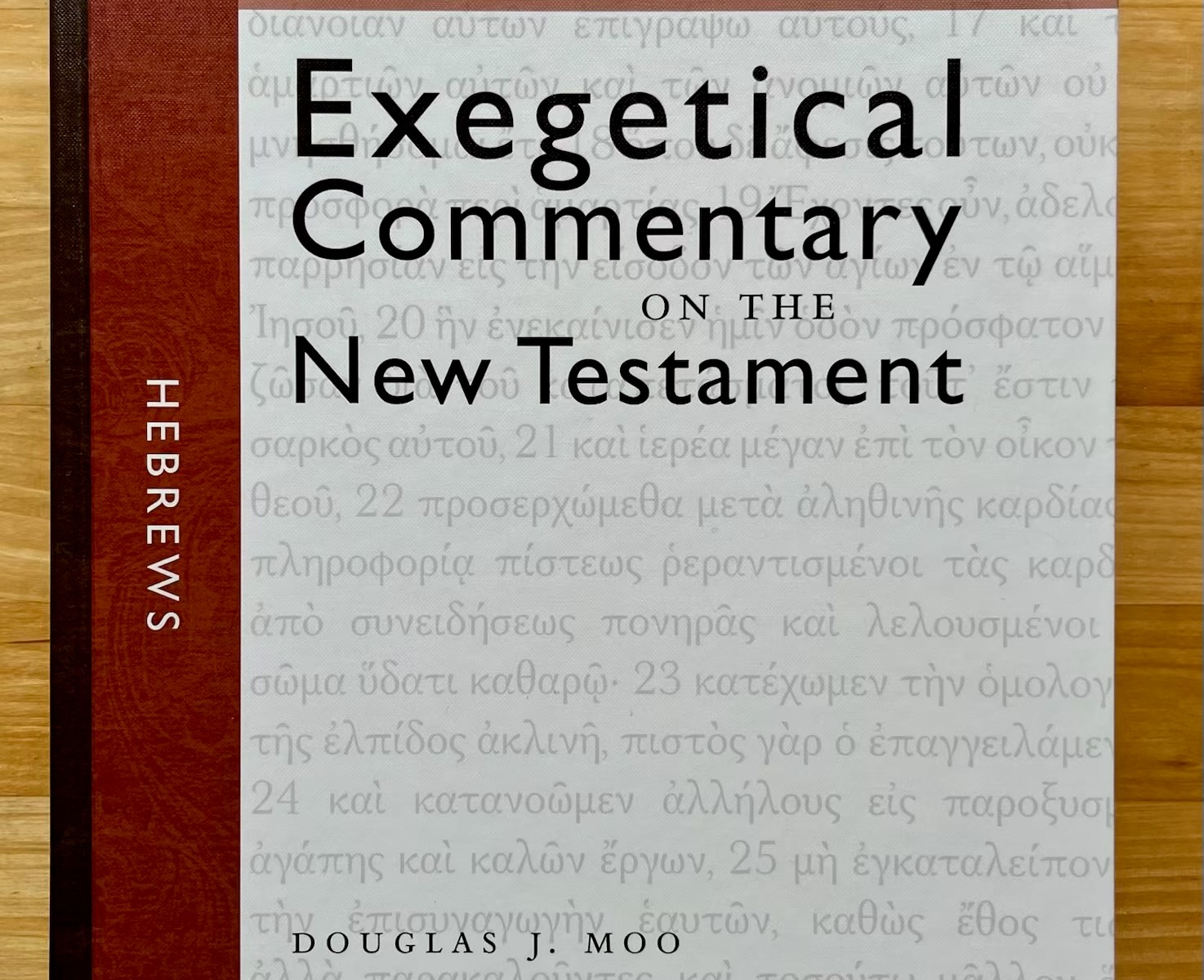
Moo has given us a very good commentary, one that is careful, text-driven, and attentive to both the Greek text and the flow of the argument of the letter. This is especially useful for pastors and readers who want to see how an author like Moo actually reaches his exegetical conclusions. That said, it is not light reading, and the level of detail will likely be overwhelming for many lay readers.
I would place Tom Schreiner’s commentary ahead of Moo’s in terms of biblical theological conclusions, particularly in how it handles the theology of the new covenant. But in comparison, Moo gives more exegetical detail. A necessary comentary in the Reformed field.
Lagniappe
- Series: Zondervan Exegetical Commentary on the New Testament
- Author: Douglas J. Moo
- Hardcover: 608 pages
- Publisher: Zondervan Academic (November 2024)
Buy it on Amazon or from Zondervan!
Disclosure: I received this book free from Zondervan Academic. The opinions I have expressed are my own, and I was not required to write a positive review. I am disclosing this in accordance with the Federal Trade Commission’s 16 CFR, Part 255 http://www.access.gpo.gov/nara/cfr/waisidx_03/16cfr255_03.html.
Amazon Affiliate Disclosure: As an Amazon Associate I earn from qualifying purchases.
 spoiledmilks