
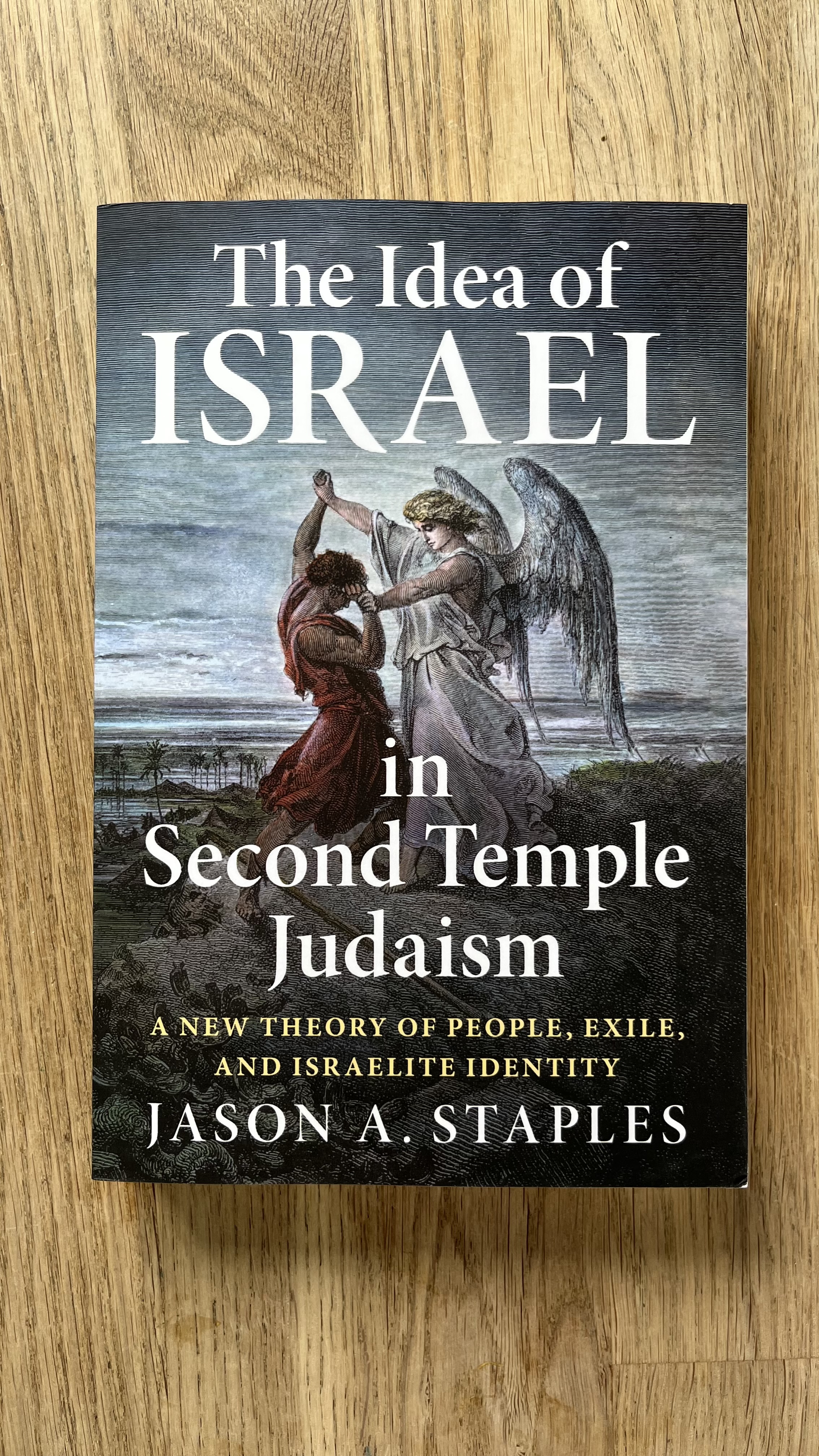
My favorite book of 2024 was Jason Staples’ Paul and the Resurrection of Israel. Just a few years before, he published the prequel, The Idea of Israel in Second Temple Judaism: A New Theory of People, Exile, and Israelite Identity, which lays the groundwork for his overall argument in a much more detailed way.
Jason Staples—assistant teaching professor in the Department of Philosophy and Religious Studies at North Carolina State University—places himself within the broad movement called “Paul within Judaism” (while also being critical of it too).
The famous new covenant passage in Jeremiah 31:31–34 (LXX 38:31–34) promises the restoration and reunification of “the house of Israel and the house of Judah.” As Staples points out, this language “specifically distinguishes the southern kingdom from the northern kingdom, the latter of which had not existed for over a century by the time Jeremiah began to prophesy” (xi). What is interesting is how this implies that the southern kingdom of Judah (and Benjamin and the Levites), the remnant of all of Israel, did not have an exclusive claim on this upcoming new covenant. The rest of the tribes were to be included too. So, later when Paul writes about “all Israel,” one must ask, “Who is ‘Israel’?” When Paul later discusses God’s relationship with Israel, he is pulling from this Second Temple language.
Staples has two aims with this book:
- to challenge the standard way scholars understand “Israel” (and how it relates to terms like “Jews” and “Hebrews”) and offer a better model for how those ideas functioned in the Second Temple period; and
- to argue that references to “Israel” are consistently tied to broader ideas about Israel’s future and end-times expectations found in many early Jewish writings.
This is to say, “Israel” refers to the full twelve-tribe people (whether in the past or in their future restoration), while Ioudaios is tied to the southern kingdom. Jews, then, are only part of Israel; they are not equivalent to it. To speak of “the Jews” is not the same thing as speaking of “Israel.”
Part I
Part I tackles terminology. Staples shows, with plenty of evidence from Josephus himself, that the Jews were a subset of Israel. Josephus is especially important here because, as a first-century Jewish historian, he offers evidence that this distinction was understood as such within Second Temple Jewish thought.1 Staples’ illustration: all Floridians are Americans, but not all Americans are Floridians.
Or, in his words, “Ioudaios is a term denoting a person descended from the southern kingdom of Judah or otherwise incorporated into that ethno-religious group” (52). The Jews (Judahites), along with Benjamin and some Levites, returned from exile, but the rest of Israel was scattered by the Assyrians. Israel as a full twelve-tribe entity ceased to exist.
Josephus himself uses the term Ioudaios when he writes about the remnant living in the Persian period. He reserves the use of Israel/Israelite for the northern kingdom or “the twelve-tribe people as a whole and thus using those terms only when referring to the past people or to the future time when ‘the two tribes’ … are reunited with the entire people of Israel” (52).
In chapter 2, Staples covers where the Samaritans fit in as well as the meaning of being a “Hebrew.”
Part II
Part II shifts to the bigger narrative: how Jews and others in the Second Temple period understood “Israel,” and how that understanding is tied to eschatology. Here Staples defines restoration eschatology as “a theology looking backward to biblical Israel and forward to a divinely orchestrated future restoration of Israel far exceeding the small return of Yehudim in the Persian period” (95). But included in that was the Jewish belief that Israel had fallen under the covenantal curses of the covenant, and they awaited “a time of glorious redemption and restoration” (95).
All of this anticipation stands in spite of judgment texts against the northern kingdom that we read in Hos 1:9b–2:1, Jer 9:16, and Jer 30:3. The text in Hosea gives you an idea:
You are not my people and I am not your God. Yet the number of the children of Israel will be like the sand of the sea, which cannot be measured or numbered. And in the place where it is said to them, “You are not my people,” it will be said to them, “You are the children of the living God.”
Staples notes that the statement “You are not my people” alludes to Deuteronomy 32:21 and may be rendered “my non-people.” Essentially, the northern kingdom of Israel was no longer Israel.
Which raises the obvious problem: if the ten tribes were decimated, what would it even mean that they should “return”? Chapters 3–5 take this head-on, tracing how the Prophets and later writings (Samuel, Kings, Chronicles, Isaiah, Jeremiah, the Twelve, Ezekiel, Ezra-Nehemiah, Daniel) held onto a real expectation of reunification. Staples brings these threads together while not missing the forest for the trees. In fact, he makes sure to go back and forthe between the trees and the forest to keep the whole argument in check.
Part III
Part III builds on and tests the theses of the first two parts across a broad corpus of early Jewish literature, paying particular attention to the correlation between eschatological perspectives within specific texts and how Israel is portrayed (or not) in these texts.
Staples works through 1–2 Maccabees, Josephus (ch 7), Philo (ch 8), the Dead Sea Scrolls (ch 9), narrative texts like Tobit, Judith, and Jubilees (ch 10), and apocalyptic material (ch 11). Along the way, he includes helpful tables comparing how often Israel appears in comparison to Ioudaios in these writings.
The Chocolate Milk
I was convinced of Staples’ thesis after reading Paul and the Resurrection of Israel, and this book only solidified that for me. I know I have often written about “clear writers,” but reading Staples is different. Staples is clear and coherent (and enjoyable) to read. He always knows exactly where the argument is going, and clarity like that comes from years of reflection (his dissertation was 600 pages long).
Recommended?
This is not for the layperson, but if you are a scholar who wants to check through Staples’ work and see the evidence of his findings throughout the OT and STJ literature, this is an excellent book. The main points Staples makes are found in PatRoI, but the evidence is here. A scintillating read.
Buy it from Amazon or Cambridge University Press!
Related Post:
- Staples’ article “Israelites or Jews?”
- My review of Paul and the Resurrection of Israel
- Galatians 3:11 and the Righteous One
Lagniappe
- Author: Jason A. Staples
- Hardcover: 452 pages
- Publisher: Cambridge University Press (September 2022)
Buy it from Amazon or Cambridge University Press!
Review Disclosure: I received this book free from Cambridge University Press. The opinions I have expressed are my own, and I was not required to write a positive review. I am disclosing this in accordance with the Federal Trade Commission’s 16 CFR, Part 255 http://www.access.gpo.gov/nara/cfr/waisidx_03/16cfr255_03.html.
Amazon Affiliate Disclosure: As an Amazon Associate I earn from qualifying purchases.
 spoiledmilks
Great review Spencer. I find myself drawn to his thesis and have listened to several interviews and podcast. I am very tempted to get his books. Which would you recommend reading first? BTW, the last two sentences in your final paragraph in part II needs editing.
LikeLiked by 1 person
I would recommend buying/reading Paul and the Resurrection of Israel first. He sums up this argument early on in that book. You can also find his PhD free online. If you want even deeper detail, buy this one then (or check it out at your library first).
What? You don’t like my dialect? 😉
LikeLike