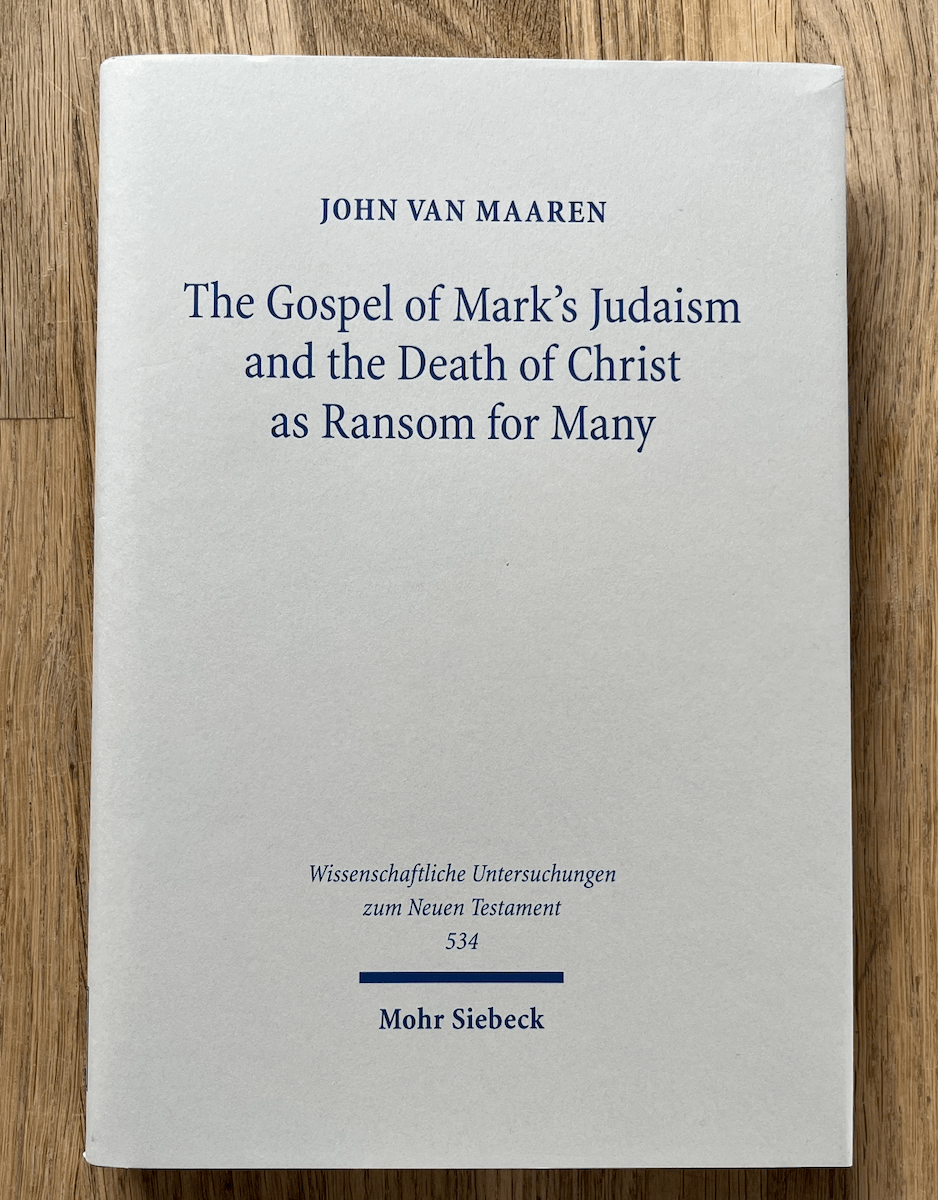

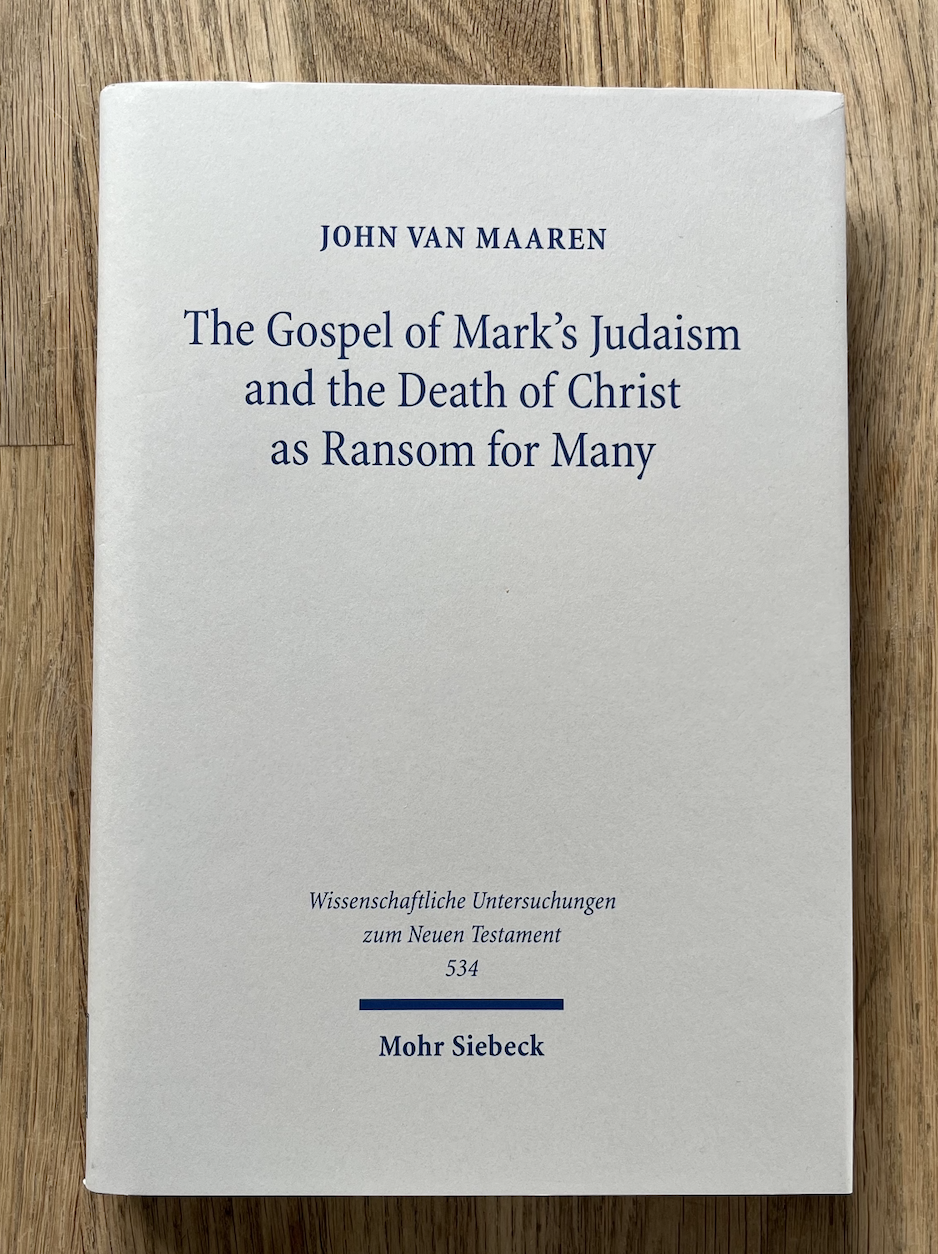
This is an incredibly compelling study on the Jewishness of Mark. I first became interested in the idea of Jewish restoration eschatology when I read Jason Staples’ Paul and the Resurrection of Israel (as well as his previous The Idea of Israel in Second Temple Judaism, review forthcoming). Overall, this is an incredible work that has really flipped some things around for me, forced me to question previously held beliefs, and hold the reins of even more interpretations as I figure out the possibilities of what Mark’s Gospel means. Below, I will summarize Van Maaren’s argument before I write some praises and critiques.
John Van Maaren earned his PhD from McMaster University, Hamilton, Ontario, Canada (2019), and is currently FWF ESPRIT postdoctoral fellow at the University of Vienna, Austria.
Summary
Chapter 1: Challenging the “Gentile Mark” Consensus
John Van Maaren argues that Mark is an authentic expression of first-century Judaism, not a “Gentile” text. He contends that scholars have been hindered by a false dichotomy between “Jewish” and “Christian” identities. He reads Mark in isolation, meaning he doesn’t allow Matthew or Paul fill in Mark’s difficult texts. Doing so allows Van Maaren to focus on whether the writer of the Gospel assumes continuity with Jewish customs and privileges ethnic Israel. Read within this framework, the kingdom of God is seen to be a restored Israel rather than a replacement of it.
Chapter 2: Deconstructing Fragile Foundations
Van Maaren researched 90 commentaries and monographs to show that the “Gentile Gospel” theory rests on weak evidence, such as how interpreters commonly cite Mark 7:3–4 (explaining Jewish handwashing) and 7:19 (interpreting Jesus as “cleansing all foods”) as evidence of a non-Jewish audience and the end of Torah law. He dismisses the idea that Jesus’s travels to the Decapolis constitute a “mission to the nations,” noting a scholarly shift toward situating Mark firmly within Second Temple Judaism.
Chapter 3: The Persistence of the Law
Van Maaren refutes the idea that Jesus abrogated Mosaic Law. In Mark 7:1–23, Jesus defends “God’s command” against “human tradition” (Mark 7:1–23). Whether addressing the Sabbath or ritual purity, Jesus maintains the Torah’s practical authority. He did not abolish the Law; he was the Law’s authoritative interpreter, driven by the urgency of the approaching Kingdom.
Chapter 4: The Mission to Scattered Israel
Van Maaren argues that Jesus focused on the New Exodus restoration of Israel rather than converting the nations. He critiques Kelly Iverson’s theory of “subtle signals” of a Gentile mission, noting this would require an “unrealistically perceptive reader” (96). Such interpretations introduce improbable narrative tensions; for example, if Jesus had already begun a Gentile healing mission in Mark 3:7–12 and 5:1-20, his initial refusal of the Syrophoenician woman (7:26–77) becomes incoherent. Geographic markers usually cited as Gentile areas actually point to the regathering of scattered Israel within their ancestral boundaries.
Chapter 5: The Imminent National Restoration
Van Maaren defines the Kingdom of God as a future, earthly, and national restoration of Israel. Analyzing “contextual echoes” from Isaiah, Zechariah, and the Psalms, Van Maaren demonstrates that Jesus’s baptism, miracles, and parables all signal the regathering of the twelve tribes and the subjugation of oppressive nations. In this framework, the kingdom remains a Jewish expectation centered on God’s return to Zion.
Chapter 6: Ransom for the Nation
Finally, Van Maaren examines Jesus’s death as a “ransom for many” (10:45). He deconstructs pistis (“trust”) as resilience in the face of the Kingdom rather than a Pauline alternative to the Law. Using the Septuagint, he shows that “ransom” language is historically tied to the New Exodus (Zech 13–14). The “many” are not a universal group, but the scattered tribes of Israel. Jesus’s death serves as the atoning price to resolve Israel’s corporate debt, enabling a purified, territorial Jewish kingdom.
Chapter 7: Conclusion
Chapter seven is Van Maaren’s conclusion where he synthesizes his argument. He has argued that this Marcan narrator is more consistent and more competent than the “Gentile Mark” theory, which, for example, depicts Jesus rejecting the Law (7:15) immediately after he scolds others for rejecting it (7:8). Van Maaren compellingly argues that the Gospel of Mark is a scripturalized narrative where the writer remains entirely within a Jewish worldview, writing with nationalist expectations, looking toward an earthly, territorial restoration of Israel ruled by Jesus.
The Chocolate Milk
A Lens Restored
Van Maaren exceptionally cleanses the interpretive lens for Markan scholarship. His most compelling contribution is the demonstration that a Gentile mission is often read into Mark via hindsight rather than found Mark’s explicit narrative statements. Assumptions about characters and geography are made from over-reading “subtle narrative clues” that Mark (likely) never intended.
Take the Gerasene demoniac (Mark 5:1–20) as one example: scholars often assume his ethnicity based on a herd of pigs, yet the text never identifies him as a Gentile. As Van Maaren notes, a Jewish presence in these regions was historically significant, and proximity to swine does not require Gentile identity (cf. Luke 15:15–16). See also my comments on Mark’s consistency regarding Jesus’s interactions with the Syrophoenician woman (7:26–27).
Van Maaren’s explanation of “and the gospel must first be proclaimed to all nations” (13:10) is compelling. The gospel will be brought to where all the nations are in order to re-gather Israel who was scattered to those nations. Van Maaren provides evidence from the LXX for his grammatical points.
A Jewish Framework
Furthermore, Van Maaren offers a robust defense of the Torah’s “practical authority” in Mark. Rather than depicting Jesus as subtley abolishing the Law’s authority, he shows Jesus rescuing the Law from the “human traditions” of a corrupt Temple leadership (Mark 7:13; 12:7). This fits with Jesus as the Son of God who perfectly obeyed the Law. In this new exodus framework, the ransom (Exod 6:6; 15:16 > Zech 10:8–10 > Mark 10:45) is the payment for the corporate debt to end Israel’s exile. This enables them to finally keep the Law properly in a restored Kingdom with new hearts.
While Van Maaren leaves some questions unanswered—specifically how this Law-keeping functions post-A.D. 70 without a Temple—his case for a “Jewish Mark” is formidable. He resists the urge to “flatten” Mark by harmonizing him with Paul and Matthew, and instead grounds the “ransom for the many” phrase (Isa 53; Zech 10:8–11) in specific prophetic hopes for Israel’s national regathering. If you chafe at the idea of Law-keeping, Van Maaren’s portrait aligns surprisingly well with Paul in Acts, who is wholly positive of the law (Acts 21:23–26; 25:8; 26:6–7).
The Spoiled Milks
I found many of Van Maaren’s arguments compelling, and he makes a strong case for taking Mark’s Jewish context seriously. While I agree with much of his analysis, I want to push back on three aspects of his overall thesis:
- Van Maaren’s argument against Jesus as “true Israel”;
- Kingdom Membership without Following Jesus;
- A Major Plot Hole
1. Jesus as “true Israel”
Van Maaren engages Rikk Watts’s argument that the heavenly voice at Jesus’s baptism (“You are my Son,” Mark 1:11) draws on Old Testament language that at times refers not only to the Davidic king (Ps 2:7) but also to corporate Israel (e.g., Exod 4:22). Watts argues that Mark presents Jesus as Israel’s representative, even as “true Israel,” through whom Israel’s vocation and promises are fulfilled.
Van Maaren rejects this conclusion, arguing that while Psalm 2:7 (and Isaiah 42:1–9) is in view, Mark does not provide sufficiently clear signals to warrant the “corporate” reading. But it is not clear why the baptismal declaration must be restricted to David alone. Van Maaren himself affirms the Old Testament’s use of itself throughout his book (cf. Malachi 3:1 conflates Exodus 23:20 and Isaiah 40:3).
Yet Psalm 2:7 (“You are my Son”) has its own referent. Its language of sonship presupposes the sonship language of Exodus 4:22, where Israel is identified as God’s firstborn son. As well, Psalm 89:27 applies the “firstborn” language to David. Following the flow of the canon, Davidic sonship does not replace Israel’s. The son-king was Israel’s representative head, embodying Israel’s calling, displaying covenant faithfulness and mediating God’s rule for the fulfillment of the Abrahamic promises—to Israel and to the nations (through Israel).
Following the logic, in Mark’s repeated use of sonship language (1:1, 11; 3:11; 5:7; 9:7; 12:6; 13:32; 14:61; 15:39), his hearers ought to think of David who takes on the sonship language of Israel as their representative. (They may even connect this with Adam, cf. Gen 1:26-27; 5:1-3; something Luke picks up on, Luke 3:38). Watts’s claim that Jesus functions as “true Israel” does not need to mean that Israel’s identity is replaced. Instead, Israel’s story as God’s “son” is fulfilled in Jesus, who came from them and obeyed God’s law as the perfect (and eternal) Son of God.
2. Does Kingdom Membership Not Require Following Jesus?
In his footnote in chapter six, Van Maaren states that salvation comes through entering the Kingdom via repentance and following the Law, not through following Jesus. He writes that the secrets of the kingdom “is not for those already in possession of kingdom membership, but rather functions as a ‘cheat-sheet’ for successfully ‘enduring until the end’ (13:30). Therefore, following Jesus is not equated with kingdom membership in Mark, but entails a sort of advantage through privileged knowledge” (208-209, fn. 105).
Yet the “follow me” motif pervades Mark’s Gospel. This doesn’t mean that all who followed Jesus were kingdom members, as many were like the rocky soil who fell away when they faced persecution or hardship. Yet, in a scene where Van Maaren argues for law-keeping, Jesus emphasizes that the rich man must “follow” him (10:21). Is Jesus saying he is the center of the law’s fulfillment? Or, if Van Maaren is right, is Jesus simply adding a “bonus step” to the rich man?
Blind Bartimaeus symbolizes true discipleship as he “followed him [Jesus] on the way” (10:52). Living as kingdom members requires following Jesus and enduring to the end (Mark 13:13). Jesus is not a mere prophet, but the prophet like Moses (Deut 18:15; Mark 9:7), the beloved Son (9:7), the son of the blessed (14:61), the Son of Man (14:62), the Son of God (1:1). If following Jesus is just an “advantageous cheat-sheet,” the dramatic call of the disciples (who “left everything,” 10:28) feels like a massive overkill.
3. Plot Hole? A Ransom, a Torn Veil, No Return and No Restoration.
[After corresponding with Van Maaren himself, this section is under revision.]
Van Maaren describes the torn veil (15:38) as a theodicy that “symbolizes the departure of the God of Israel from his temple and links it to the innocent death of Jesus” (215). Accordingly, due to the shed blood of the Innocent One, “the increased pollution of the land, prompts God to depart from his temple, indicated by the torn veil” (215). Van Maaren draws a parallel to Ezekiel 10–11, where God’s Spirit departs before the arrival of the Babylonian army to take Judah into exile. However, this creates a significant plot hole regarding the purpose of the cross and its ransoming effect.
In the Torah, murder is one of the few sins with no sacrificial expiation. It pollutes the land and requires the death or expulsion of the guilty (Num 35:33; Lev 20:2). This creates a conflict in Van Maaren’s framework: If Jesus’s death is the ransom (10:45) meant to resolve the sins of the first exile, how can it succeed if the act of payment itself is an unexpiable murder that triggers a second exile?
In Ezekiel 10–11, God departs from the temple due to the pollution of the land and so the people can be purged and eventually restored with a “new heart.” But first an invading army (Babylon) had to come in, wipe out Jerusalem, and take its inhabitants into exile. Following Van Maaren’s logic, Jesus’ ransom ends up polluting the land (due to the shedding of his innocent blood) and leads to a departure of God’s Spirit from this temple. The Jewish leadership, the temple, and Jerusalem would be wiped out by the Roman army in AD 70, suggesting the death of Jesus triggered a catastrophic judgment, not a restoration. Maaren effectively offers a narrative where Jesus provides both the “blood of the covenant” (14:24) meant to establish the kingdom and the “blood that pollutes the land” (15:38) and causes God’s Spirit to depart. Is the kingdom of God actually “at hand” (1:15)?
One could argue that the Roman invasion of AD 70 was the “death” required by Numbers 35:33 to cleanse the land of Jesus’s shed blood. However, this solution collapses the imminence emphasized in Mark’s Gospel. Van Maaren argues that Jesus’s ministry was driven by the “imminent arrival of the kingdom of God” (133), yet Jesus explicitly states that “this generation” would not pass away until “all these things,” including the national regathering, had occurred (13:30). If the destruction of Jerusalem was the necessary cleansing required before the ransom could take effect, then the restoration cannot happen within “this generation” (13:30). The Babylonian exile would be a blink (70 years) compared to the 2,000 years that have passed since the Roman invasion.
Van Maaren seems to skirt the issue when he states, “I have refrained from trying to understand how the double interplay between Jesus’s death and the impact of graves sins cohere for the writer” (217). One of Van Maaren’s goals has been to highlight how a Judaistic reading of Mark is more coherent than the Gentile reading.
Yet when faced with an interpretive crux that could unravel his interpretation, he writes, “It is just as plausible that the writer also does not have a fully coherent or integrated understanding of the significance of the death of Jesus, which was made sense of in different ways by his earliest followers” (218). But considering everything else that Van Maaren has shown throughout his book regarding the nuanced use of the Old Testament in the Gospel of Mark, how could “the writer” of Mark’s Gospel be amiss about this crucial matter?
By rejecting any spiritualized fulfillment of the temple (1 Cor 3:16), Van Maaren leaves the reader with a Good News (1:1) defined by irony: the first debt was paid, but the Temple was destroyed, the people remain scattered, and the Son of Man never returned as promised to collect the many he ransomed. Should a second death now be made for the new pollution?
[For a more consistent view of Mark 13 that takes the immanent language of “this generation” seriously, see Peter Bolt’s The Narrative Integrity of Mark 13:24–27.]
Recommended?
I will keep this brief. I really enjoyed this book. I wrestled long with it, and I find many, many aspects of Van Maaren’s arguments incredibly compelling. But the logical consequences of his main argument (at least, according to the title of his book) seem to make an even bigger plot hole than what the Gentile Markers do. I think Van Maaren makes a strong case for Jesus’s Israel-only focus, which we see in the other Gospels. His arguments about Jesus keeping the law are also very strong and make sense of what Jesus is actually doing in his ministry in Israel before his death and resurrection. I hope many scholars will pick up Van Maaren’s (expensive) book and really wrestle with his arguments. It will make future scholarship of Mark ‘s Gospel much sharper.
Buy it on Amazon or from Mohr Siebeck!
Lagniappe
- Series: Wissenschaftliche Untersuchungen zum Neuen Testament
- Author: John Van Maaren
- Paperback: 293 pages
- Publisher: Mohr Siebeck (February 2025)
- Read a sample of the book
Review Disclosure: I received this book free from Mohr Siebeck. The opinions I have expressed are my own, and I was not required to write a positive review. I am disclosing this in accordance with the Federal Trade Commission’s 16 CFR, Part 255 http://www.access.gpo.gov/nara/cfr/waisidx_03/16cfr255_03.html.
Amazon Affiliate Disclosure: As an Amazon Associate I earn from qualifying purchases.
 spoiledmilks