

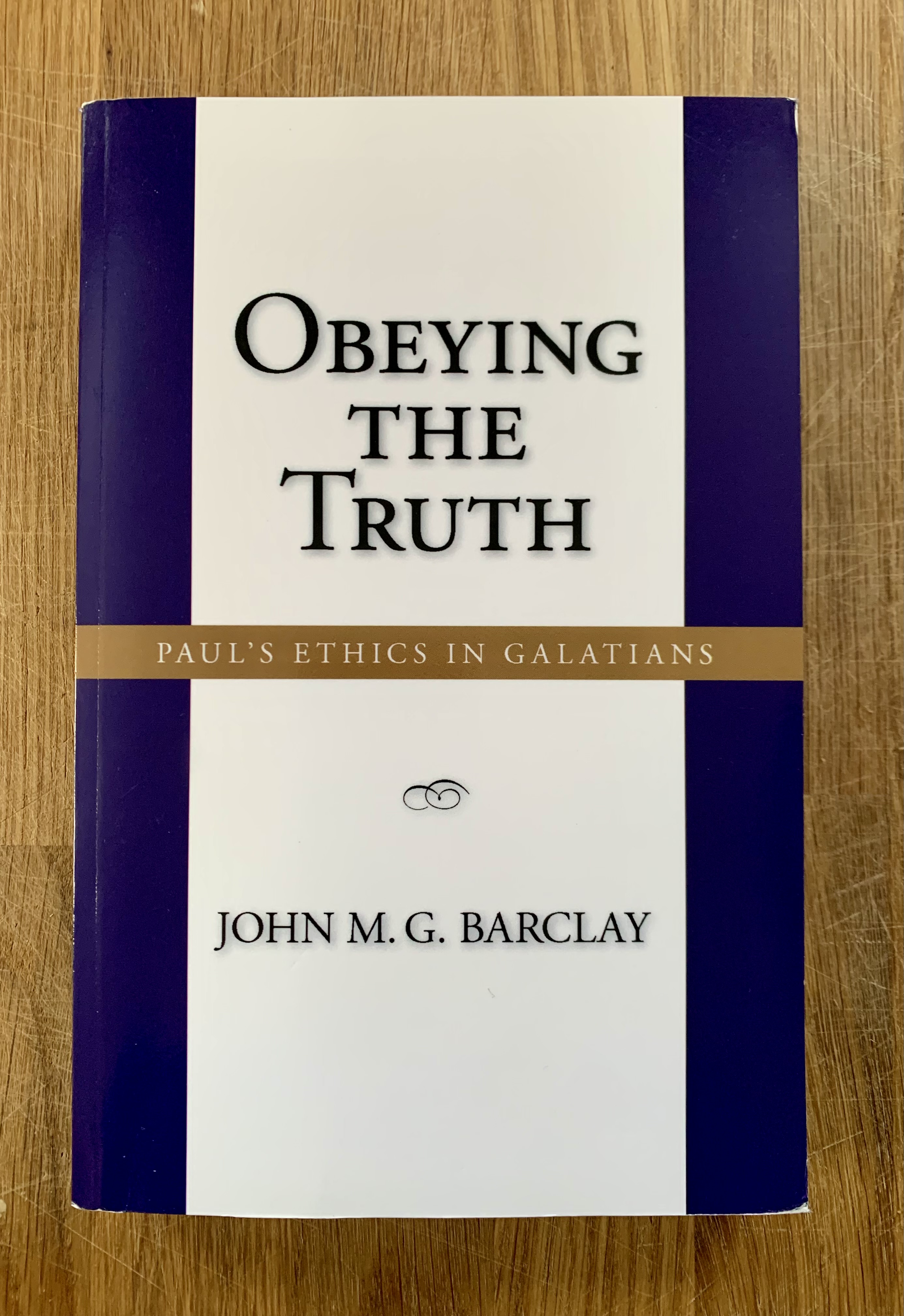
John Barclay is famous for his recent book Paul and the Gift (or the abridged Paul and the Power of Grace), which looks at how the word “grace” (charis) was understood in Greco-Roman culture and how to certain extents the gospel upended that understanding. Obeying the Truth is a revision of Barclay’s doctoral dissertation. Here he takes up the task of showing how Galatians 5:13–6:10 with Paul’s ethical commands is not an add on to Galatians 1:1–5:12 but an integral part to the letter. Today we have many commentaries that interpret the letter in such a fashion, but it wasn’t too long ago that form-criticism folks tried to split up Galatians (they still do this today with Philippians and 2 Corinthians).
How are Paul’s ethical commands related to matters of law and faith? Chapter one argues against the traditional view that the ethical section (paraenesis) is a disconnected appendix. Barclay asserts that Paul’s ethics are the conclusion of his theology, the solution to the specific problem in Galatia.
Chapter two reconstructs this historical context: the “Agitators” demanded that Gentile believers adopt Jewish identity markers, such as circumcision and law observance, to be fully part of God’s people. Barclay aligns himself with the New Perspective on Paul (NPP), and he views this as an ecclesiological problem focused on maintaining ethnic boundaries, not individual merit-earning. Paul’s response, therefore, is a refutation of these specific ethnic-social requirements.
Chapter three analyzes Paul’s direct theological response. The confrontation with Peter in Antioch (2:11–14) reveals the gospel’s social implications: requiring Jewish markers compromises the truth of justification by faith alone. Paul proves the Galatians’ acceptance by God by pointing to their reception of the Spirit, which validates his gospel apart from the Law. This allows Paul to redefine the Abrahamic family: true children of Abraham are identified by their faith in Christ, the singular “seed” of Abraham, creating a single, unified community of Jew and Gentile distinct from the covenant of the Mosaic Law.
Chapter four introduces the Holy Spirit as the sufficient power for the moral life, directly connecting theology and ethics. Christian freedom is not a license for the flesh, but a call to mutual slavery through love (5:13). The Spirit is presented as the adequate force to combat sinful tendencies where the Law failed. The Fruit of the Spirit is the authentic and spontaneous sign of Christ’s righteousness. The true moral requirement for the community is to fulfill the “Law of Christ” (the Old Testament Law redefined by Christ’s life and teaching) in 6:2. This renders the Mosaic Law irrelevant for Christian conduct.
Chapter five demonstrates the practical value of this ethic by examining the maxims in 5:25–6:10. Barclay contends these are not random, haphazard sayings, but they counteract the Agitators prideful, judgmental spirit of legalism. Specific exhortations, like bearing burdens (6:1) and gentle restoration (6:2), are concrete manifestations of the Law of Christ (that is, loving your neighbor), enabling the self-sacrificial life.
Chapter six offers a deep theological and lexical analysis of “flesh” (sarx) and “Spirit” (pneuma). Barclay argues that “flesh” is Paul’s term for legalism, ethnic pride, and spiritual failure—the ethics of the old age shaped by law and human striving. Conversely, “Spirit” is the divine empowerment and the new mode of existence in the new creation. The Christian life is the ongoing antithesis between these two ethical realities.
The final chapter concludes that Paul’s ethical exhortations flow directly from his doctrine. Barclay’s unified reading ultimately proves that Paul’s theology of justification by faith naturally issues in Spirit-empowered obedience and transformation, making the entire letter a coherent argument for the new life in Christ that overcomes cultural and social division.
What one can affirm is that Barclay argues that Paul’s theology of justification by faith is inseparable from Spirit-empowered obedience and transformation. The ethical calls at the end of Paul’s letters are not ad hoc add-ons but are the fruit of the gospel.
Barclay’s refuses to oversimplify Paul. In showing that Paul’s ethic is rooted in the “sufficiency of the Spirit,” he avoids both legalism and libertinism. Barclay critiques individualistic readings (like those of Bultmann) of the flesh (sarx) by interpreting the term within an apocalyptic framework. He defines the “flesh” as the entire human orientation bound to the old age. By doing this, Paul groups law, circumcision, and “works of the flesh” together.
Recommended?
Barclay makes a strong argument that Paul’s ethics flow out of his theology. Barclay stands within the New Perspective of Paul along with scholars like Sanders, Wright, and Watson, so if you want to read an older book from the earlier days of NPP, one that views Galatians as a whole letter with a logical progression (that is, it makes sense!), then pick this one up. However, this is not an easy book. I doubt most pastors would want to pick this one up, as there is little practical application for present-day readers, and, unless you’re a nerdy layperson with invested interest in Galatians, you’ll want to pass on this one. This is a book for scholars, and Barclay tackles important issues in Galatians quite well.
Yet, while this book was published in 2005, Barclay’s dissertation was originally published by T&T Clark in 1988. Canonical studies have made inroads in the last 37 years, and there are other monographs and commentaries I would recommend before this one. If you’ve read my blog long enough, you can probably guess that I side with the likes of Schreiner, Carson, Westerholm, etc. Commentaries from this ilk, e.g., Schreiner, Moo, Keener, and Harmon, would provide more updated insights than Barclay, at least in keeping with the Old Perspective on Paul.
Buy it from Amazon!
Lagniappe
- Author: John M. G. Barclay
- Hardcover: 208 pages
- Publisher: Regent College Publishing (June 2005)
Review Disclosure: I received this book free from Regent College Publishing. The opinions I have expressed are my own, and I was not required to write a positive review. I am disclosing this in accordance with the Federal Trade Commission’s 16 CFR, Part 255 http://www.access.gpo.gov/nara/cfr/waisidx_03/16cfr255_03.html.
Amazon Affiliate Disclosure: As an Amazon Associate I earn from qualifying purchases.
 spoiledmilks