


When you think of cultural Christianity, you might picture churchgoers who say they are Christians but live like the world. Ah, if only we could go back to the days of the early church. Things were better than, right? But in Cultural Christians, Nadya Williams shows that this problem is as old as the church itself. From Acts to the Roman Empire, Christians struggled with greed, sexuality, nationalism, and comfort. Some stood firm in the faith, but all too many looked more like Rome than like Christ.
Overview
Here I’ll highlight some of the chapters I really enjoyed, which was actually most of them.
Williams begins in chapter one by tracing how the early church wrestled with cultural pressures around wealth and sexuality. In Acts 4–5, Barnabas models costly generosity while Ananias and Sapphira seek cultural honor of giving (without the sacrifice of self). This reveals how greed easily corrodes authentic discipleship. Williams rounds this out with modern views on money, social care, and immigration. In chapter three, Williams shows how the Greco-Roman world’s sexual norms—where adultery, seduction, and abuse were common—stand in tension with the Christian vision of transformation. While Roman culture assumed character was fixed, Christianity proclaimed sanctification and transformation. Here, sinners become saints. She critiques modern evangelical legalism, calling for a gospel-rooted vision of sexuality and sanctification.

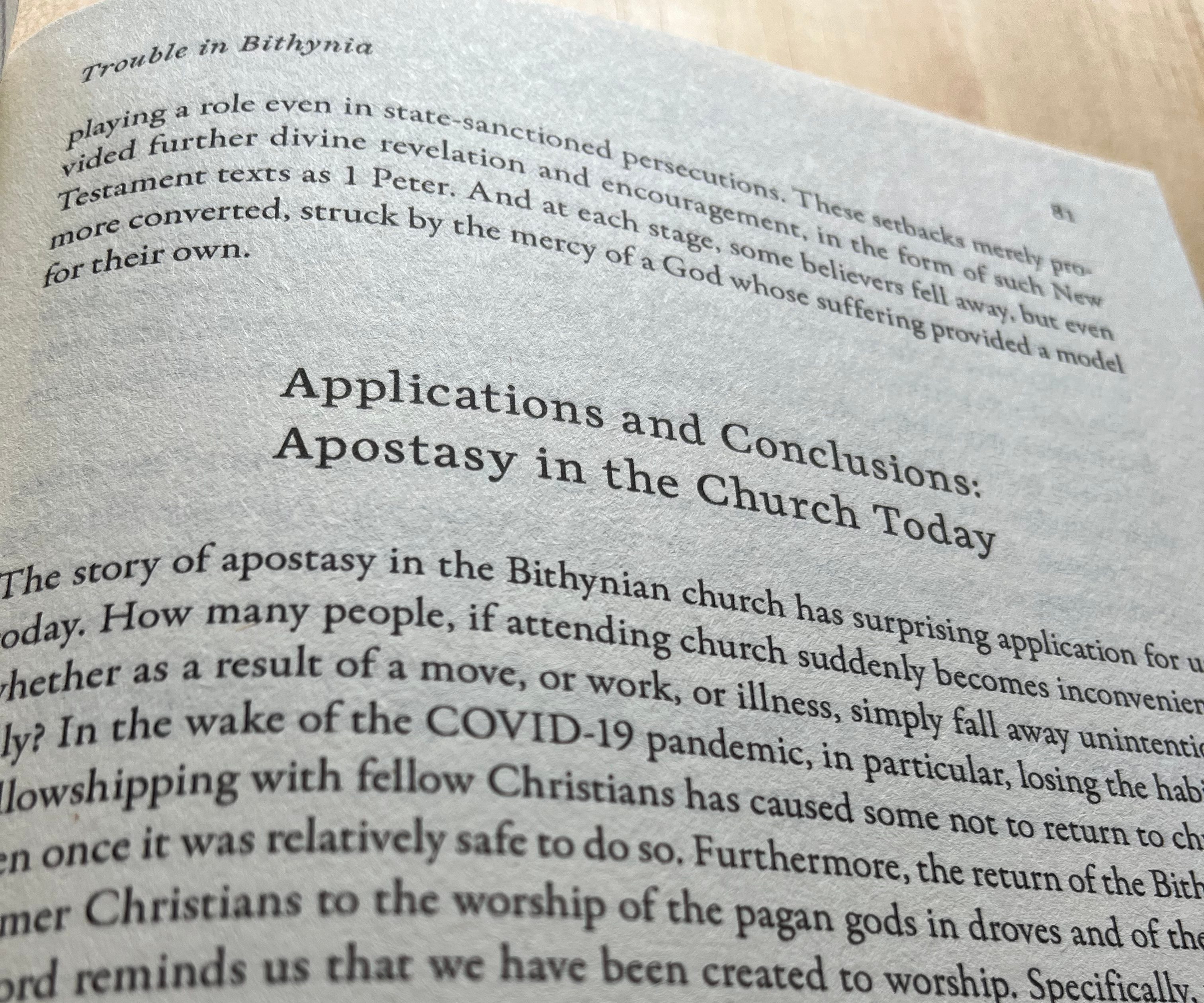
Chapter four focuses on apostasy. Williams shows how the church faced persecution and the temptation to apostatize when she compares Polycarp’s faithful martyrdom with two Egyptian women who, in order to live, complied with Roman edicts to sacrifice to pagan gods. Williams focuses on Hebrews and 1 Peter, which warn against turning away from Christ. In chapter six Williams critiques “self-care.” We see how during the plagues of the third century, some Christians abandoned the sick, while others embodied Christlike self-sacrifice. In chapter seven, Williams also highlights how factionalism and violence fractured the church when rival sects mimicked Rome’s violence rather than Christ’s humility (Phil 2:5–11). Cultural Christianity distorts the gospel by avoiding costly faithfulness, excusing selfishness, or replicating worldly values.
In chapter eight, Williams critiques Christian nationalism. After Constantine, Christianity became linked with the empire. Churches gained power, but cultural Christians confused loyalty to Christ with loyalty to Rome. Williams shows how this sort of union distorts the gospel into one of civil religion. Is one’s faith shown through one’s patriotism or through one’s holiness, love, and faithfulness to Christ? At the other extreme, in chapter nine, ascetics and monastics fled from a corrupt society, only to discover that sin cannot be left behind. Williams insists that genuine holiness is forged not in isolation but in community. True transformation flows from bearing with the church’s flaws, carrying one another’s burdens (Gal 6:1), and striving for holiness together
The Chocolate Milk
Williams excels at weaving together historical depth in an interesting way. While I personally struggle remembering details of ancient, oddly-named places and people, Williams knits together Scripture, Greco-Roman sources, early church writings, and archaeological evidence. She lays out for us biblical stories in their cultural world and shows how real people wrestled with temptation. I quickly understood (again) that the early church was not an “ideal” community, but, like us today, a body of very flawed people, albeit with some who truly showed the work of God’s Spirit in their lives. In doing so, Williams shows that these cultural sins are not bound to this time in history. They have reoccurred throughout history, and until our day too. Sins like greed, sexual immorality, and nationalism are not unique to us. There were no “good ol’ days.”
Recommended?
Cultural Christianity was not an exception but the norm throughout church history. Christians far too often mirrored their culture more than they did Christ. Yet amid their failures, the gospel always pointed to transformation, sanctification, and hope in Christ. Through looking at the early church’s history, Williams reminds us that discipleship has always required countercultural faith.
This book challenges the way we think about the “good old days” of the early church. It is a topic that is always relevant, and Williams does an excellent job at picking out some of the current trends within culture that seep into the church. If you’ve ever wondered how to resist cultural idols in your own life, or even what those cultural idols are, this is a book worth reading.
Buy it on Amazon or from Zondervan Academic!
Lagniappe
- Author: Nadya WIlliams
- Paperback: 256 pages
- Publisher: Zondervan Academic (November, 2023)
- Read the introduction + chapter one
Review Disclosure: I received this book free from Zondervan Academic. The opinions I have expressed are my own, and I was not required to write a positive review. I am disclosing this in accordance with the Federal Trade Commission’s 16 CFR, Part 255 http://www.access.gpo.gov/nara/cfr/waisidx_03/16cfr255_03.html.
Amazon Affiliate Disclosure: As an Amazon Associate I earn from qualifying purchases.
 spoiledmilks
Your review is better than mine! For whatever reasons, I struggled to pull my review together in a way that “satisfied” me. Finally, I gave up, and blogged it. This is definitely not the book’s or author’s fault, but mine. Thanks for your review, which I hope encourages others to read it!
LikeLike