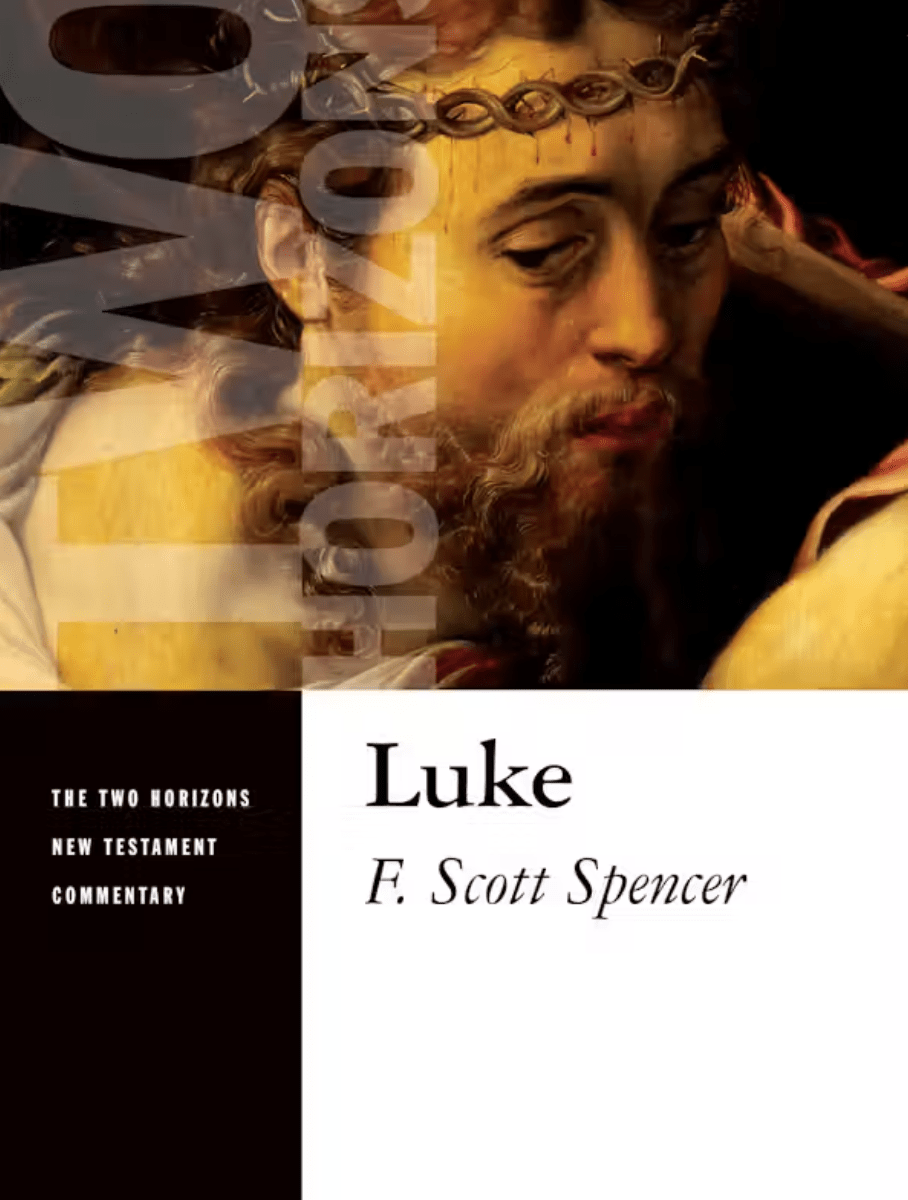

This volume is part of the “Two Horizons New Testament Commentary” (THNTC) series, which sought to “bridge the existing gap between biblical studies and systematic theology” via “section-by-section exegesis of the New Testament texts in close conversation with theological concerns,” in the vein of “theological interpretation of Scripture” (TIS).
Thankfully, instead of writing a tedious compendium of all the commentaries that have come before him, Spencer does something almost novel: he gives us his own interpretation gained through wrestling with the text (and others’ interpretations). He strives to understand the biblical text in its own first-century context before he brings it over into our world. He interacts with systematic theologians like Jürgen Moltmann, Paul Tillich, Miroslav Volf, and Nicholas Wolterstorff, and uses narrative criticism to understand Luke’s Gospel. Instead of using redaction criticism to make much about the small differences between Luke and Mark and Matthew (which would have been a burden to read), Spencer moves through Luke’s Gospel to understand it as Luke would have us do.
Following the THNTC series, after dividing Luke’s Gospel into five main sections (see below), this series gives a section-by-section approach to the biblical books. This serves to grasp the literary context of Luke’s smaller sections/paragraphs. Instead of atomizing the text with a verse-by-verse approach, a section-by-section approach helps the contributors focus on main themes and character development without those things getting lost in a sea of details. Spencer speaks to develop the text as it comes. Rather than reminding us immediately about Jesus’ death and resurrection (we all know it happens anyway), he strives for “a rigorously sequential, developmental, mindful interpretive journey that seeks to let the story unfold bit by bit, taking in the sights and sounds as they come, correlating (including questioning, wonder-ing, debating, revising) with what has come before, but avoiding as much as possible any peeking ahead and spoiling the adventure” (5).
Theologically Centered
Spencer’s volume is theologically centered: Luke’s Gospel is a narrative about God and his “dealings with the people of Israel and the entire world through God’s Son Jesus Messiah and God’s Spirit in dynamic, interpenetrating, theological union (trinitarian, as we would say)” (8). It is a real space-and-time story, a “theological-biographical history of God-in-Christ in the framework of first-century Palestine” (8);
- philosophically expanded: knowing that all the treasures of wisdom in knowledge are in Christ himself, Spencer includes the thoughts and ideas of philosophers, psychologists, anthropologists, and others to illuminate Luke in a slightly greater (and different) measure than what we might be used to reading;
- canonically connected: Luke engages in the “art of theological interpretation, a dynamic, creative, Spirit-infused process of thinking through, praying over, wrestling with, and writing out… of God’s coming into the world afresh in Jesus Messiah” (12). It is not just any God, but the God of all creation and covenant, over both Israel and the world, the God of the Bible;
- salvifically aimed: Luke shows us how God has acted in Christ to make broken lives and a broken world whole again;
- ecclesially located: Spencer writes as a moderate Baptist who engages with a wide spectrum of scholars, but who also understands that he is a “biased Bible reader,” for he cannot jump out of his own skin. Yet it is also our job as readers to read him rightly.
- emotionally invested: Spencer pays great attention to characters’ emotions, as it can show how they come to know the saving Lord, what matters most to them, or what concerns and drives them.
Reading Spencer (perhaps I too am a bit biased since we share the same name) is easy. No, this isn’t a 30-day devotionally styled book; it is an academic commentary. I will just give a few flavor-bites of Spencer’s thoughts.
Mary’s Song in 1:46–55
Spencer engages with Mary’s song on four levels: theological, emotional, temporal, and social. I won’t look at all four here, but I appreciated the specific themes I could hang on to rather than bare exegesis. Mary’s speaking of her inner depths are set in synonymous parallelism and traditionally translated as “soul” and “spirit.” However, readers don’t always quite know how to relate to this. We don’t usually talk about our spirit (unless we speak of our inner emotional being). Even if we read Mary as referring to her inner being, it still may seem like disembodied spiritual language. Spencer points us to the CEB translation, “With all my heart I glorify the Lord! In the depths of who I am I rejoice” (Luke 1:46-47) to help us see that Mary praises God with her entire being, with “heart” reflecting her inner being of thoughts, intentions, will, and emotions (48).
Mary speaks twice of God’s mercy (Luke 1:50, 54), which refers not to his “tender feelings but on the mega-acts… of mercy God ‘has done’ (1:49) in ‘helping’ or ‘coming to the aid of’… God’s long-suffering people” as seen in Luke 1:54 (cf. Acts 20:35; especially Ps 136; p. 50). Here God’s mercy is seen as a response not so much toward sin. While Mary isn’t perfect, this just isn’t what she is talking about here.
She and Israel “merit God’s mercy purely on the basis of their need and suffering” (52). The sin that causes them to suffer comes from the “ruling powers who squeeze the poor, neglect the needy, and thus fail to ‘do judgment and to love mercy… and….. to walk with the Lord your God’” (Mic 6:8; p. 52).
Mary’s Feelings in 2:19
In 2:19, Spencer sets aside sentimental thoughts on Mary’s gushing feelings of maternal pride over her precious baby. Just as Mary “thinks through” Gabriel’s announcement (1:29), she is, like a wrestler, grappling with what the shepherds have just said about her baby son. She, like the scribes of old, is delving into deep analysis, using both her mind and heart, to discern what God is doing in and through her son.
Liberation in Luke 4
Jesus’ liberation-redemptive mission in Luke 4 includes both material and spiritual realities. People were in various states of “physical, psychological, social, economic, and political distress” (111). They were poor, blind, and imprisoned, sometimes physically and other times through “demonization, debt, and domination” (112). Spiritually, people are freed from and forgiven of their sin-debts to God and other people (7:39–49; 11:4).
He brings in the important OT references here, noting that often commentators show that the phrase “let the oppressed go free” comes from Isaiah 58:6 without looking at the wider context. Isaiah observes that the people have three problems: spiritual (‘sins’), an epistemological blind spot (wrongly believing and claiming ‘to know God’s ways’), which shows up in their ethical failure to know God and practice his righteousness.
Pharisee and tax collector in 18:9–14
Spencer offers a thought-provoking interpretation of the parable of the Pharisee and the tax collector in Luke 18, suggesting that both men are justified before God. His view hinges on the interpretation of the Greek words translated “rather than” in 18:14, which possibly could instead be translated that the tax collector, alongside of the Pharisee, goes home justified.
However, in Luke 18:9 Jesus addresses those who are confident in their own righteousness and show disdain to others. This context suggests that the Pharisee represents self-righteousness, while the repentant tax collector embodies true righteousness. Diane Chen observes that Luke repeatedly highlights the Pharisees’ criticism of Jesus for associating with tax collectors, leading readers to view the parabled Pharisee with suspicion and to be inclined to see the tax collector in a favorable light.
Spencer also doesn’t mentioned the latter part of 18:14, for not addressing the last half of 18:14b, “For all those who exalt themselves will be humbled, and those who humble themselves will be exalted.” This, framed with 18:9, imply that the Pharisee exalts himself in the parable.
Theological Reflection
Spencer ends with just over 90 pages of theological reflection on Luke. He examines knowledge, progressively growing in knowledge about Christ, participating in Christ through knowledge, knowledge of Christ available to anyone, and ultimately knowledge about Jesus as the Christ transforms us into being like him to participate in his steps as we teach others knowledge of him. In the “social theology” section, Spencer tackles the topic of how social justice fits with the gospel (does it run alongside, is it the same thing?). We Christians ought to both pray and act. If people will have their injustices rectified quickly, it will be by God acting through us (706). Spencer, having written on Christ’s passions, ends with a discussion on emotions. He offers a summary-yet-still-robust understanding of emotion theory, argues for a holistic understanding of body-mind-emotions, and delves into what it means for God and Christ to have passions, both throughout the Bible but specifically in those particular passages where they appear in Luke.
Recommended?
This is an awesome commentary. Spencer is sensitive to the literary design of Luke’s Gospel (inclusio, parallelism, and characterization and their emotions) and the history and cultural setting. He draws together canonical and theological application so that we wonder in awe at the saving mercy of our God in Christ and so that we will carry that on to those we meet through justice, mercy, and social ethics. God wants us to be whole people. We are not only spiritually saved, but our bodies are and will be saved. We will be made whole, and we ought to pursue people’s wholeness now. Spencer does not offer a detailed analysis of the Greek. For that you will have to look elsewhere (see Alan Thompson’s guide). As a result, his commentary is much clearer for that reason. Overall this is a superb commentary for scholars, students, and preachers alike. Highly recommended.
Pair this with Joel Green’s volume on Luke (NICNT) and Ben Gladd’s insight into the OT in his From the Manger to the Throne.
Buy it on Amazon or from Eerdmans!
Lagniappe
- Series: Two Horizons New Testament Commentary
- Author: F. Scott Spencer
- Paperback: 860 pages
- Publisher: Eerdmans (April 30, 2019)
Review Disclosure: I received this book free from Eerdmans. The opinions I have expressed are my own, and I was not required to write a positive review. I am disclosing this in accordance with the Federal Trade Commission’s 16 CFR, Part 255 http://www.access.gpo.gov/nara/cfr/waisidx_03/16cfr255_03.html.
Amazon Affiliate Disclosure: As an Amazon Associate I earn from qualifying purchases.
 spoiledmilks
Thanks for this review. Loved this: “She, like the scribes of old, is delving into deep analysis, using both her mind and heart, to discern what God is doing in and through her son.”
LikeLiked by 1 person
Thanks, Laura. i’ve long wondered what Luke meant when he wrote that Mary “hid these things in her heart.” He comes up at least twice in his Gospel, so I figured it had significance. Spencer was really helpful here.
LikeLike