


Daniel Treier—Professor of Theology at Wheaton College—has written a new book that combines Biblical and dogmatic Christology. Treier defines dogmatic theology as being “[r]enewed by biblical exegesis, informed by the church’s history, stimulated by philosophy and other intellectual disciplines, and challenged by praxis” (35). But it is not only any one of these tasks alone. Treier adds, “It engages their contributions while prayerfully expounding the Christian faith” (35). In this book, Treier approaches dogmatic theology “as an exercise of faith seeking understanding, written primarily as an expository argument” (35). He connects dogmatic arguments with biblical texts, expositing those texts before moving on to christological concepts.
The New Studies in Dogmatics aims to offer concise treatments on major topics in dogmatic theology that fill the gap between introductory theology textbooks and advanced theological monographs.Dogmatic theology, as understood by editors and contributors to the series, is a conceptual representation of scriptural teaching about God and all things in relation to God. It has a source, stop, setting, and end:
- Source: Holy Scripture;
- Scope: the summing up of all things in Jesus Christ;
- Setting: the communion of the saints;
- End: the conversion, consolation, and instruction of creaturely wayfarers in the knowledge and love of the triune God until that knowledge and love is consummated in the beatific vision.
The authors of these volumes aim for theological renewal by retrieval from the church’s most trusted teachers (ancient, medieval, and modern). The authors, such as Daniel Treier, who have sought to fathom Christ’s unsearchable riches. In keeping with this belief, authors from a broad evangelical constituency will seek in this series to retrieve the riches of Scripture and tradition for constructive dogmatics. The purpose of retrieval is neither simple repetition of past theologians nor repristination of an earlier phase in church history; Christianity, at any rate, has no golden age east of Eden and short of the kingdom of God. Properly (19)
The way Treier structures his book is by viewing each doctrine against the eternal communion of the Triune God at the beginning of creation through to the consummation of redemptive history. Treier threads these lines through exegeting key texts associated with Christ’s biblical names. Each chapter begins with a biblical text. In chapter 4, Treier looks at Isaiah 7:14, Jesus as “Immanuel,” his incarnation through the virgin birth. He begins by exegeting Isaiah 7:14, looking at the historical and canonical contexts, what the sign likely was (a maiden, and later the virgin Mary), and how it was fulfilled (Jesus born of the virgin Mary, signaling “that the judgment involved in Isaiah 7:14 was ending and the promised light of God’s saving presence was dawning anew,” p.140).
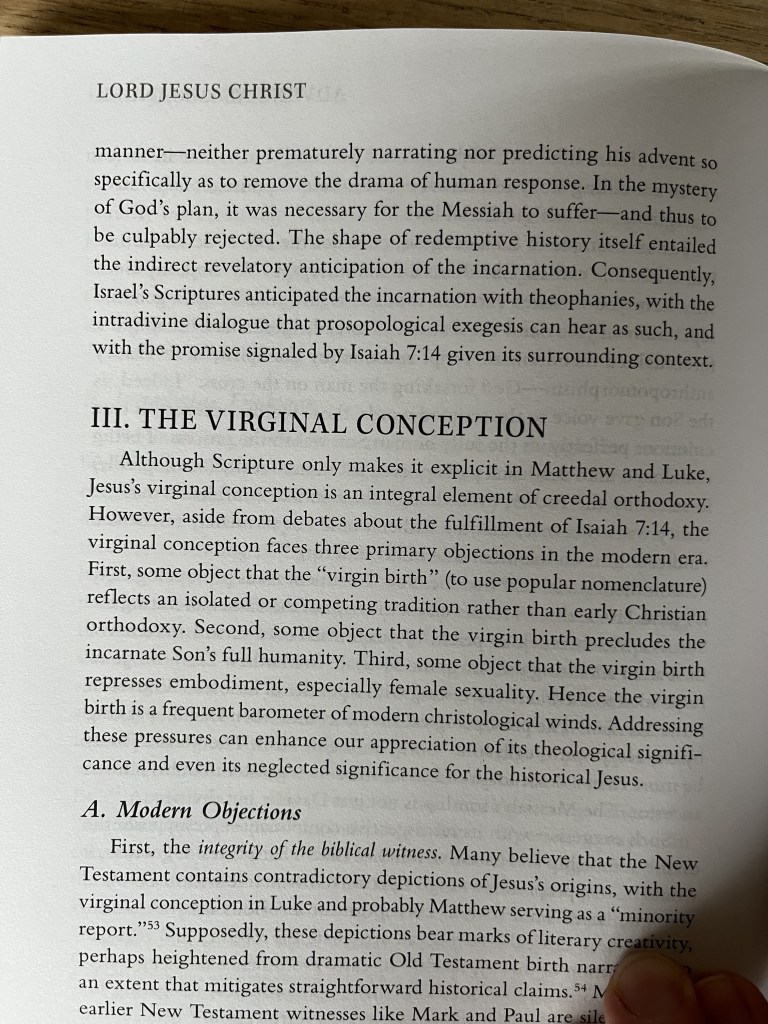
Treier looks at how the incarnation was anticipated in Israel’s scriptures, through theophanies and intradivine dialogue (seen in Ps 110). Then he moves to the dogmatic doctrine of the virgin birth, covering objections against it and the Christological significance of such a birth. Understanding that his mother was a virgin when he was born, in fulfillment of Isaiah 7:14, Jesus’ self-understanding as the promised Servant of YHWH in Isaiah 40–66 would naturally follow. Treier then offers a view on why Christ’s assumption of full humanity is so important to our salvation.
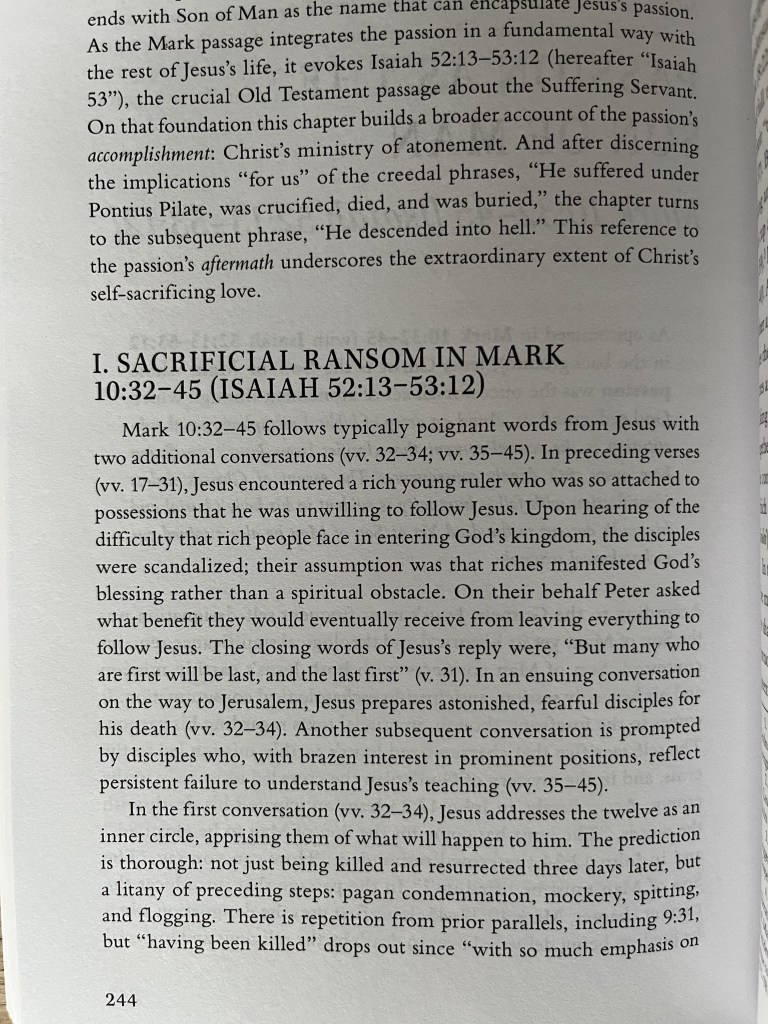
Some of the various Christological doctrines Treier surveys are the communion of the Son (Eph 1:3–14); covenant as the Messiah (Luke 24:13–35); the Lord’s humiliation as Servant (Phil 2:5–11); his exaltation as Mediator (Heb 7:22–8:6); and consummation as the Bridegroom (Rev 21:2–22:5). There are ten chapters in all, full of careful nuance.
Treier includes a varied set of voices: church fathers, biblical scholars and theologians, feminist and liberation scholars, as well as the global South and marginalized communities. He includes these voices to discover angles we don’t easily see, while also not agreeing with everything wholesale.
For example, in his chapter on the man Jesus the Savior, Treier begins with Luke 4 and Jesus proclamation that he has come in the name of the Lord to forgive, heal, and liberate (219). But what does this liberation look like? Is it only spiritual, or is it more? Treier notes how earthly kings and bureaucracies focus on status, systems, and their own pursuits rather than the people they are meant to care for. Jesus, on the other hand, emphasized his lowly status and serving others (235). Jesus’s ministry focused not only on the coming forgiveness that we receive through the atonement, but “the full range of human needs” like “healing and liberation that restore justice” (236). When Jesus healed the sick and possessed, he “did not treat the sick as mere passive recipients… [but] made their experience part of their relationship with God. Healings signaled the inauguration of God’s kingdom in person” (236). After announcing how Isaiah 58 and 61 were being fulfilled in that day (Lk 4:21), Jesus cast an unclean spirit out of a man and healed many from their physical ailments (4:31–44). By eating with tax collectors and sinners, Jesus liberated them from social rejection (5:27-32). He honored women as well, with them being the first to announce his resurrection (1:46-56; 24:1-12).
Treier observes that “Christ’s ministry of reconciliation” addressed “social structures and systemic evil as well as personal sin” (236). Jesus endured a mob “lynching” that relied on “the tacit support and overt misuse of government power,” one which “substituted prejudice for truth in a frenzy of scapegoating” (236). Christ’s experience with the cross reflected God’s solidarity with the oppressed and the sexually humiliated. These liberation-focused approaches may not always affirm conciliar Christology, and they may not always account for the fullness of Christ’s atoning work, but, as Treier writes, “they highlight integral aspects of Christ’s redemptive suffering that are frequently neglected. They underscore that Jesus was crucified because of how he lived” (237).
Recommended?
This book is aimed at scholars and pastors, but also to anyone preparing for ministry. By connecting dogmatics with biblical exegesis, Treier has sought how to tackle current debates in a way that is accessible to pastors as they preach through the Bible. Pair this with Brandon Crowe’s The Lord Jesus Christ In Lexham Press’s “We Believe” series. That said, I found this volume both more interesting than Crowe’s volume and, at times, more difficult to pin down Treier’s thoughts. It is hard to describe what I mean besides that sometimes I found Treier vague and it was hard to put my finger on his precise meaning. Regardless, I appreciated how he connected doctrinal concepts with the biblical text itself, and I enjoy his exegesis. He promotes the text as a unified whole, making sense of God’s overall plan as shown to us through his word. We need more theologians all over the world who believe this.
Buy it on Amazon or from Zondervan Academic! .
Lagniappe
-
- Series: New Studies in Dogmatics
- Author: Daniel J. Treier
- Hardcover: 384 pages
- Publisher: Zondervan Academic (October 31, 2023)
Disclosure: I received this book free from Zondervan Academic. The opinions I have expressed are my own, and I was not required to write a positive review. I am disclosing this in accordance with the Federal Trade Commission’s 16 CFR, Part 255 http://www.access.gpo.gov/nara/cfr/waisidx_03/16cfr255_03.html.
Amazon Affiliate Disclosure: As an Amazon Associate I earn from qualifying purchases.
 spoiledmilks