
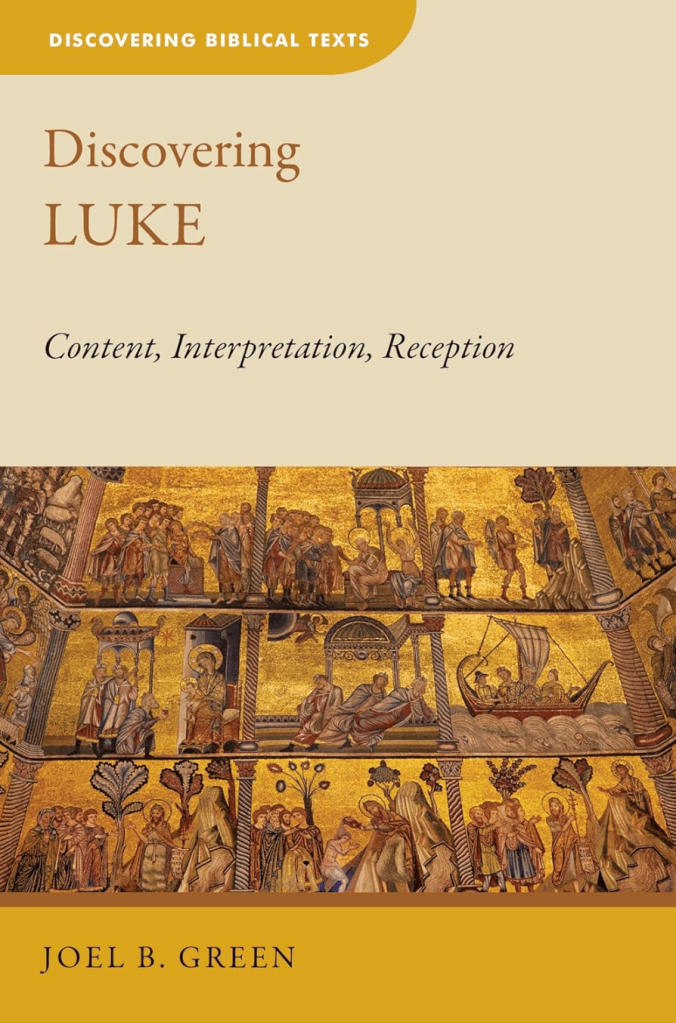
Joel Green is well known for his work on Luke. He is the author of the highly recommended commentary on Luke in the NICNT series. Anytime I’ve had to preach or teach on Luke, Green’s commentary is the first I turn to. Now he has authored Discovering Luke, focusing on the content, interpretation, and reception of Luke’s Gospel.
The first two chapters survey the contexts, or historical locations, of how the early, medieval, Reformation, and post-Reformation churches and those within the modern and post-modern eras understood Luke. Through these two chapters Green shows how this range of interpreters interpreted one text: Mary’s Magnificat (Luke 1).
For the past 19 centuries, theologians, pastors, and artists have read Luke’s Gospel piece by piece instead of keeping the whole narrative in mind. Think of the two famous parables the Prodigal Son and the Good Samaritan. These parables, along with Jesus’ encounter with Zacchaeus and his statement of forgiveness from the cross, are renowned texts. However, they are remembered apart from Luke’s overall meaning. How do these pieces fit with Luke’s theological and ethical interests? Most people couldn’t tell you.
According to Green, Luke hasn’t been studied as a literary whole until the early twentieth century by Cadbury, then later by Conzelmann, Fitzmyer, and Marshall who showed how Luke was a theologian on par with the other Gospel writers. To explain some of the reason for this, the early church focused on authorial-intent—only the author here is God, the divine Author. The central aim is that ”interpreting the Scripture is Scripture-empowered contemplation of Christ” (4). In the Middle Ages came up with Scripture’s multiple senses (the quadriga). They looked for deeper meanings that pointed to spiritual truths. The Reformation interpreters focused on grammar….
While postmodern readings focus more on perspectives than a certain “method” where texts were interpreted according to someone’s biases. Reformational readings located the text within the church and the church’s life, while the modern period located serious study of the Bible into the university.
Chapter three surveys introductory matters of Luke’s Gospel, such as authorship and when and why it was written. For the early church though, their concern was that people came to the Bible “with the right sensibilities, taking seriously its scriptural status” (60). Luke’s aim in his Gospel is “order and aim” (). He wants Theophilus to have confidence in the teaching he has received. This confidence “isn’t grounded in modern notions of historical veracity,” but deals with persuasion and invitation (66). It served the purpose of answering questions like, What does this all really mean and “what does this call us to be and do”? (66).
The “most honorable” Theophilus was most likely a real person, a literary patron, assisting Luke with being able to circulate copies of his Gospel to a broader audience. This would mean that Luke wrote for the purposes of something larger than a hypothetical “Lukan community.” The genre of Luke’s Gospel is closer to historiography than a biography. Luke writes about “events” more than he does “lives.”
Chapter four looks at how Luke reveals his meaning through geography and spatial metaphors. Green looks at the “alien character of Luke’s Gospel,” the gulf between Luke and his original audience and us today (80). We are worlds apart from his “social, political, psychological and religious” scene (80).
Green’s book helps us see the need for intercultural conversation with Luke’s Gospel and to be able to engage in that conversation. He writes, “We need to acquaint ourselves with the social patterns, behavioural scripts and institutional contexts of Luke’s world” (81). We will see both our own assumptions compared with what we read on the pages of Luke’s Gospel. This Gospel speaks to us as “other;” we stand outside of Luke’s cultural and social world.
In reading Luke, we can’t just obtain as much information as we can about the Roman world and think that we will understand perfectly everything Luke wrote. We also have to ask ourselves why Luke writes what he does in the way he does. What is counterworldly? What points to a “new world order”? Even though Rome was a dominating power (85–86), Luke’s Gospel doesn’t call for believers to revolt against Rome. Luke’s call is more implicit, “an invitation to reinterpret the world from the critical perspective of God’s redemptive purpose, to share in the counterworldly community of the faithful, and to embody patterns of thinking, feeling, believing and behaving congruent with Jesus’ directive to his followers, that they ‘say no to themselves, take up their cross daily, and follow me’ (9.23)” (88).
To give an example, Luke begins and ends with the temple. The temple shows up a lot in Luke’s Gospel, some times positively and sometimes negatively. Which is it? The temple is where people should go for “prayer, revelation, and instruction” (98). But it is full of abuses instead. Jesus aims to restore the Temple through his teachings, but doing so casts aspersions on the authorities “who use the temple system to abuse society’s marginal and vulnerable” (98). Since they reject him, he pronounces destruction on the Temple. Green also looks at the wilderness and synagogues and homes. Space is more than just a place on the map. “Geography, topography, architectural spaces – all receive sometimes-complex meaning within the narrative Luke provides” (102). (For more on this idea, see my review of Gathered Around Jesus).
Other social metaphors include “Luke’s verticality schema,” his pattern of up-down relations, as well as in-out (or close-distant) relations. This chapter adds a lot more depth to how we would usually think of Luke, depth that “may push us off balance,” positively speaking (122).
Chapter five shows the architecture and framing of Luke’s Gospel and narrative. Green doesn’t just summarize Luke’s Gospel. The anatomy of Luke’s Gospel is a broad stroke survey that connects the broader strands of Luke’s narrative thinking. How does Jesus’ ministry fulfill what Simeon prophesied in Lk 2:34?
Chapters six through eight highlight the themes of God and his purposes (ch 6), Jesus and his mission (ch 7), and disciples and discipleship (ch 8). Each chapter begins with Mary’s Song and how it teaches us about God, the politics of his kingdom, and our terms of allegiance. Rather than being a song that calls for “human social and political action,” Mary’s Song has God and his actions at its center (135).
There is no introduction explaining the thought behind the book’s structure (its own architecture) nor a preface by the editors explaining the series itself.
Recommended?
Green is the perfect person to write an introductory work on Luke. He is sensitive to Luke’s overall context and to the different methods we should use to understand his meaning. He does this all in less than 200 pages. Green writes clearly and has clearly mastered (or close to it) Luke’s Gospel. If you need a book to help you begin studying Luke, be sure to pick up this one.
Buy it on Amazon or from Eerdmans!
Lagniappe
- Series: Discovering biblical Texts
- Author: Joel B. Green
- Paperback: 259 pages
- Publisher: Eerdmans (September 16, 2021)
Review Disclosure: I received this book free from Eerdmans. The opinions I have expressed are my own, and I was not required to write a positive review. I am disclosing this in accordance with the Federal Trade Commission’s 16 CFR, Part 255 http://www.access.gpo.gov/nara/cfr/waisidx_03/16cfr255_03.html.
Amazon Affiliate Disclosure: As an Amazon Associate I earn from qualifying purchases.
 spoiledmilks