
A few months ago I reviewed Jay Sklar’s commentary on Numbers. Purchasing a commentary on Numbers doesn’t rank high on most laypeople’s lists of books to buy to understand the Bible well, but Sklar’s volume is a must. For the academic (or academically-hungry layperson), L. Michael Morales’ has come out with two volumes on the book of Numbers that are must-haves. But how many commentaries on Numbers does the world really need? Aren’t the few major ones we have enough? Michael Morales disagrees (and I agree with him). This review covers volume 1: Numbers 1–19. Later I will review volume 2: Numbers 20–36.
The literary structure is key in understanding any book of the Bible, and here Numbers’ structure is debated. Many have believed that Number’s theology and importance are elusive. Morales, on the other hand, believes that “the actual point of transition for Israel’s generations, having deep interpretative significance,” has largely been interpreted wrongly. As well, he includes neglected Jewish scholarship from all periods of time. Their neglect is unfortunate because they provide “satisfying solutions to these [literary an theological] conundrums” (xiii).
One reason Jewish scholarship, at least older scholarship, has probably been neglected is because it can seem like they are making textual connections out of thin air (the same is believed for the church fathers). But Morales points out, “The Jewish sages were not engaged in manufacturing correspondences, but in making them explicit; rather than fabricating bridges, they fill in gaps intuitively” (29).
Even still, somehow Morales believes that Numbers should be preached and taught within the walls of the church. Believe it or not, he is now in greater awe of the Lord and his mercy than ever before, and his views of what make up true spirituality in this world have been reshaped. This is not how most people think of the book of Numbers, yet, coming from someone like Morales who has labored through this book for ten years, Numbers is essential to the spiritual life of the church. According to Morales, “Numbers is both compass and map for the journey” to our destination, dwelling in the house of the Lord forever (Psalm 23:6), “revealing both the glory of YHWH and the nature of humanity” (1).
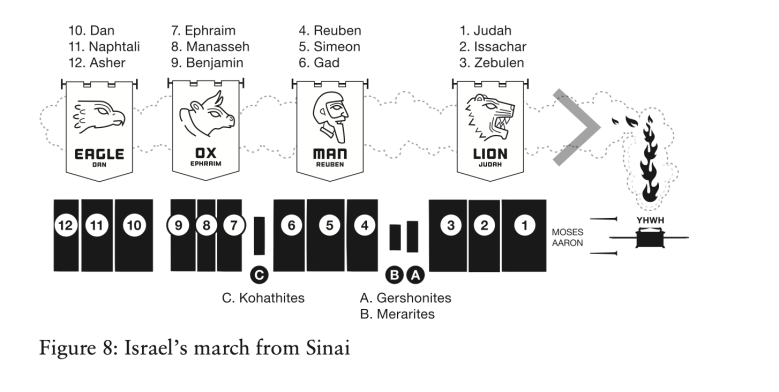
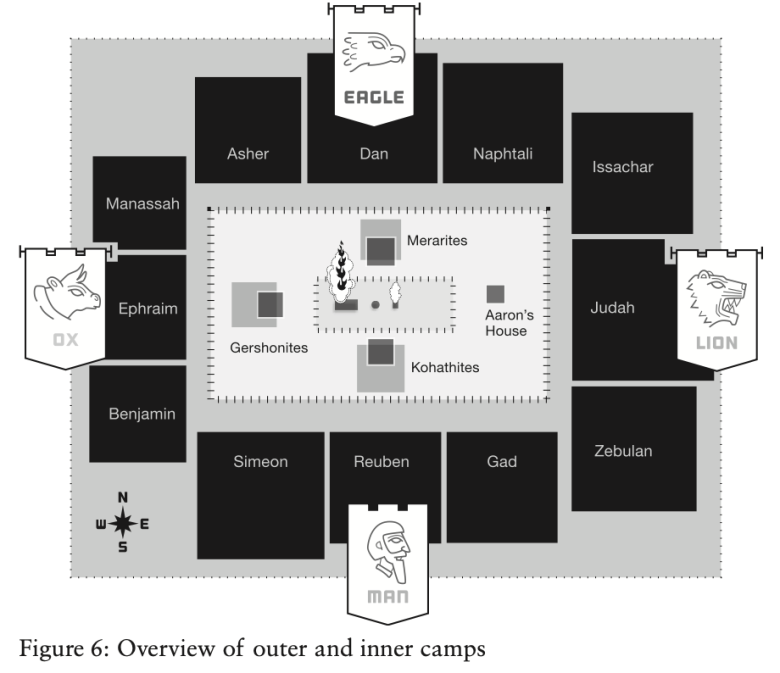
Israel’s second generation who wandered the wilderness “serves as a paradigm for God’s people in every generation, for Numbers is chiefly an analysis of Israel as the covenant community formed at Sinai, structurally expressed as the Camp of Israel” (2). Life “in the wilderness” (bĕmidbar) characterizes “the life of all God’s people in every age” (3).
Morales’ introduction (73 pages) covers how the “soul” of Numbers is leadership of the covenant community. In fact, Numbers is concerned with ecclesiology, so much so that it is the ecclesiology of the Torah (4). Both the nation of Israel and its leaders are regularly in view in Numbers. Morales writes that “nearly every character mentioned holds some status among the people, affirming that Numbers—to an uncanny degree—lays stress on the role of leadership” (10). In fact, “Contrary to common perceptions… the wilderness rebellions in Numbers are seldom generic sins of grumbling, but focused uprisings led by particular leaders with a designated role in the community; nor do they derive from tests on the part of God (as in Exod. 16), but are impulsive and wilful revolts.” (11). That covenant community, the camp of Israel, is the glue that binds the story (or literary integrity) of Numbers. He covers the Israel camp’s sojourn in Num. 11–25, how their purity laws are the spiritual nature of the camp, as well as how Numbers is structured and who composed it.
The Chocolate Milk
There are numerous figures (12) and tables (33!) that help us moderns visualize what all of these details meant for the ancient Israelite. Figures cover topics like the commands for expulsion (p50) and restoration (51) concerning purity laws, Levi’s genealogy (125), the chronological flashback seen in Numbers 7 (183), the distribution of YHWH’s Spirit (280), and more. A few of the tables included are the tabernacle’s three roles (8), census totals (87) by encampments (93), the references to cherubim (34), the role of the Spirit (267), temporal dimensions of corpse defilement (493), and many more.
Morales’ commentary is also very detailed, more technical commentary (though not like the critical kinds that believe multiple sources lie under the book as we have it). Morales interprets the book of Numbers as we have it today. Regarding Numbers 9 and the law stating that some who had missed observing Passover could observe it in the next month, Morales writes, “Some propose the second observance law first existed independently of its narrative frame… or that it reflects Hezekiah’s delayed Passover in 2 Chronicles 30” (210). There is always a handful of scholars somewhere who want to take laws and through them into the future as if Moses didn’t really speak with the Lord about it. Morales notes, “The simplest approach remains that of taking the text at face value and then assessing its theological role within Numbers” (210). Rather than take up wild theories of the text, Morales stays with the text as we have received it and shows how it makes sense for this law to be here.
Morales shows framing techniques such as inclusios and repetition within a passage and then elsewhere in Numbers to draw together theological connections. For example, Morales writes, “In the summary statement (v. 35), ‘evil community’ forms an inclusio with the same phrase in the opening line of verse 27, and ‘come to an end’ or ‘completion’ (tāmam) picks up the same term from verse 33. This evil community is further defined by YHWH as those ‘who are gathered together against me’, the same congregational conspiring against YHWH that will take place through Korah (16:11; 27:3). Rather than their being ‘the community’ (hā‘ēdāh) who approach YHWH through the Tent of ‘Meeting’, Israel has become ‘this evil community’ who ‘meets together’ against him” (358).
Regarding how Numbers 13 and 14 hang together, “While there are real textual matters with which to grapple, the ancient mind did not likely perceive the level of incongruity ascribed to the text by later scholarship – and features once thought problematic, such as doublets, are now understood as ancient literary artistry (cf. Miles 1981: 28). For interpreting the text as it stands, moreover, source criticism, which seeks to discern the history and politics behind a given text (e.g. Jeon 2020), is of little help. The narrative progresses by use of motifs and wordplays, especially by use of ‘ascend’ (‘ālāh), ‘see’ (rā’āh) and ‘possess’ (yāraš)” (321). As well, the literary motifs between Numbers 11–15 and the sin of Adam and Eve in Genesis 3 was simply brilliant.
The Spoiled Milk
I really loved reading this commentary. It’s dense, but Morales draws out the gold spread throughout Numbers 1–19. One editorial bit that confuses me (because the whole series is this way) is, honestly, the Table of contents. The Introduction is very detailed, listing each each main- and subheading with their respective page numbers. However, when it comes to the text and commentary, beginning on page 75, we aren’t given any more information. Obviously, you just flip through the book to find what section you want, but it’s unfortunate that the Table of Contents are skewed in this way.
Understandably, but unfortunately, the Hebrew is transliterated, which I think is neither helpful to the layperson nor the scholar. In my opinion, having the Hebrew in addition to the transliteration is preferable.
Otherwise this is a superb commentary.
Recommended?
Morales’ commentary is an example of Proverbs 2:4–5, “if you seek it like silver and search for it like hidden treasure, then you will understand the fear of the Lord and discover the knowledge of God.” In all of his digging, Morales finds gold everywhere. This is the California Gold Rush.
Pair this with Wenham (TOTC), Sklar (SGBC), Ashley (NICOT), and the eventual Collins (ZECOT).
Buy it on Amazon or from IVP Books!
Lagniappe
- Series: Apollos Old Testament Commentary
- Author: L. Michael Morales
- Paperback: 560 pages
- Publisher: Apollos/IVP Books (June 18, 2024)
Other Apollos Reviews
- Exodus — T. Desmond Alexander
- Numbers 20–36 — L. Michael Morales
- Deuteronomy — Gordon McConville
- Proverbs — Paul Overland
- Hosea — Joshua Moon
- Obadiah, Jonah, Micah — Elaine Philips
- Haggai, Zechariah, Malachi — Anthony Petterson
Disclosure: I received this book free from IVP Books/Apollos. The opinions I have expressed are my own, and I was not required to write a positive review. I am disclosing this in accordance with the Federal Trade Commission’s 16 CFR, Part 255 http://www.access.gpo.gov/nara/cfr/waisidx_03/16cfr255_03.html.
Amazon Affiliate Disclosure: As an Amazon Associate I earn from qualifying purchases.
 spoiledmilks