

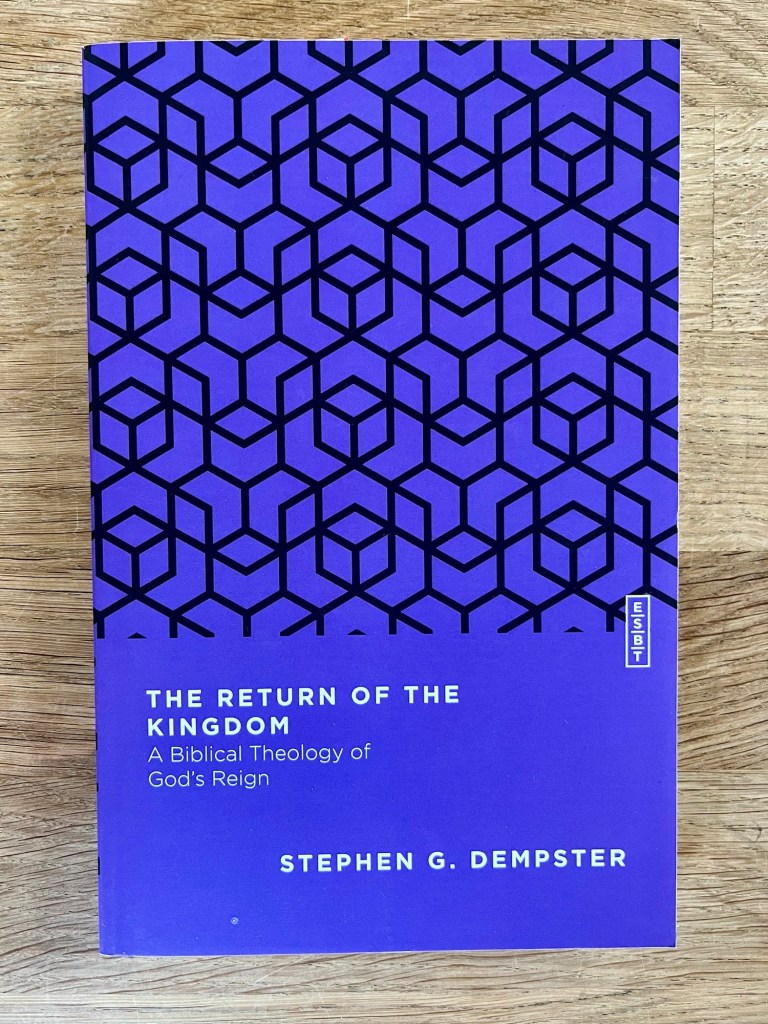
The Return of the Kingdom, the ninth entry in the Essential Studies in Biblical Theology series, comes from Stephen Dempster. I reviewed Dempster’s earlier work Dominion and Dynasty in the NSBT series, a work full of insight and biblical connections. D&D is one of my favorites from the NSBT series (one the ESBT series is patterned after.) Dempster’s The Return of the Kingdom doesn’t disappoint.
The volume, as the title suggests, is focused on the kingdom: how it began, what went wrong, and what God did and is doing to bring it back again. This is an essential biblical theme. When they hear the word salvation, many people think of going to heaven forever. Perhaps they think of the new creation of Revelation 21–22. But do they think of God’s kingdom? What did Jesus mean when he said, “Repent, for the kingdom of heaven is at hand”? How much of that kingdom is here today?
Chapters 1–4 look at creation, Adam and Eve in the Garden, and the fall. Chapter 5 guides us from Adam to the flood, the Tower of Babel, and up to Abraham. Chapters 6–9 cover the Pentateuch, chapters 10 and 11 the former and latter prophets (so the historical books and the Major and Minor prophets), and chapters 12 and 13 cover the books of poetry and the Writings like Daniel, Esther, Ezra-Nehemiah, and Chronicles.
If this order seems strange, this is because Dempster follows the Old Testament order of books: The Torah, the Neviim, and the Keteviim (often abbreviated as the TaNaK). To be more specific, Dempster follows the order of Baba Bathra 18, the oldest extant list of OT books. (For more on that, read my review of Dominion and Dynasty).
Moving into the New Testament, Dempster gives one chapter (14) to Matthew’s Gospel and one chapter (15) to Mark, Luke, and John. Chapter 16 covers Acts, Paul’s letters, and the general epistles, and Dempster concludes with Revelation (17). With Jesus’ birth and life we see that the kingship of God has returned to Zion, bringing in the kingdom of God. But this kingdom comes through suffering, death, and exaltation. In Matthew Jesus is presented as a new Moses with a new Torah (five speeches matching the five books of Torah), the first speech given from a mountain (Mt 5–7). Mountains feature throughout Matthew’s Gospel. Jesus reveals his divine nature on the Mount of Transfiguration (17:1–8), his impending time of suffering is prayed about on the Mount of Olives (26:30–56), and his great authority over the whole world as he tasks his disciples with teaching, baptizing, and making disciples as he ascends from a mountain (28:16–20). Jesus’ teachings, actions, parables, and healings are proof that the kingdom has invaded the world (4:23; 9:35). While his miracles show his compassion to the helpless and needy, ultimately “they are signs of the in breaking of the kingdom” (163).
Some stories (like David and Goliath) are summarized to show how God’s kingdom work was advancing, but because it is such a familiar story it is easy to skip most of it. Yet other narratives (Gen 1–3) are dripping with insights. Dempster ably summarizes narratives while keeping their kingdom focus in view. He summarizes the Abraham narrative without looking at every point. After surveying the promises in Genesis 12:1–3, Dempster focuses on key moments in these chapters:
- when God cut a covenant with Abraham (Gen 15);
- when God cut a covenant sign (Gen 17);
- and when Isaac, the chief bearer of the promise, was almost cut off (Gen 22). Through Abraham’s obedience, the divine promise was guaranteed through an explicit divine oath.
These texts have “important kingdom ramifications, since the covenant, its sign, and the explicit divine oath, guarantee the promise that will bring about worldwide blessing” (59). Because Abraham believed God’s promise, God considers him righteous (15:6).
God cut a covenant with Abraham so Abraham would know for certain that this land would be given to his offspring. Years later, God comes to Abraham and gives him an obligation. He is to walk blamelessly with God, connecting him to Enoch and Noah before him. Dempster observes, “He has been declared righteous but now he must embody that righteousness in his life” (60).
Then, just as Abraham is about to sacrifice his son Isaac, God tells him to stop and emphatically declares that these promises shall come to pass. Abraham’s obedience has becomes “integrated as a fulfilled condition of the promise, now sworn with a divine oath” (62). Here we see both Abraham’s commitment to God and God’s absolute commitment to Abraham. The greatest command we have is to place God above all things and people, “but God is committed to no less a love for the citizens of the kingdom” (62). While God provided a ram for Abraham, one day he will provide a Lamb, and he will experience the cutting of the covenant (Gen 15:10, 17; Jer 34:8–20).
Recommended?
If you haven’t yet read Dempster’s Dominion and Dynasty, this is a great book on the kingdom of God. Dempster covers the whole Bible with a focus on God’s kingdom work in both Testaments. If you have already read D&D, there are still many insights in this book that weren’t in D&D. At the same time, Dempster is summarizing the entire Bible, and a lot of this will be very familiar. For those who haven’t been introduced to the Bible’s overall context and how these stories are connected this will be a great book for them to read. These are people who may know the Bible’s stories but who don’t know how they connect together through the Son, the Lord and King, who brought his kingdom through his life, death, and resurrection.
Buy it on Amazon or from IVP Academic
Lagniappe
- Series: Essential Studies in Biblical Theology (Book 9)
- Author: Stephen G. Dempster
- Paperback: 232 pages
- Publisher: IVP Academic (March 19, 2024)
- Read Chapter One
Other works on the Kingdom of God:
- The Majesty on High — Stephen Baugh
- Living in the Kingdom of God — Sigurd Grindheim
- The Kingdom of God — Nicholas Perrin
- The Kingdom of God and the Glory of the Cross — Patrick Schreiner
Disclosure: I received this book free from IVP Academic. The opinions I have expressed are my own, and I was not required to write a positive review. I am disclosing this in accordance with the Federal Trade Commission’s 16 CFR, Part 255 http://www.access.gpo.gov/nara/cfr/waisidx_03/16cfr255_03.html.
Amazon Affiliate Disclosure: As an Amazon Associate I earn from qualifying purchases.
 spoiledmilks