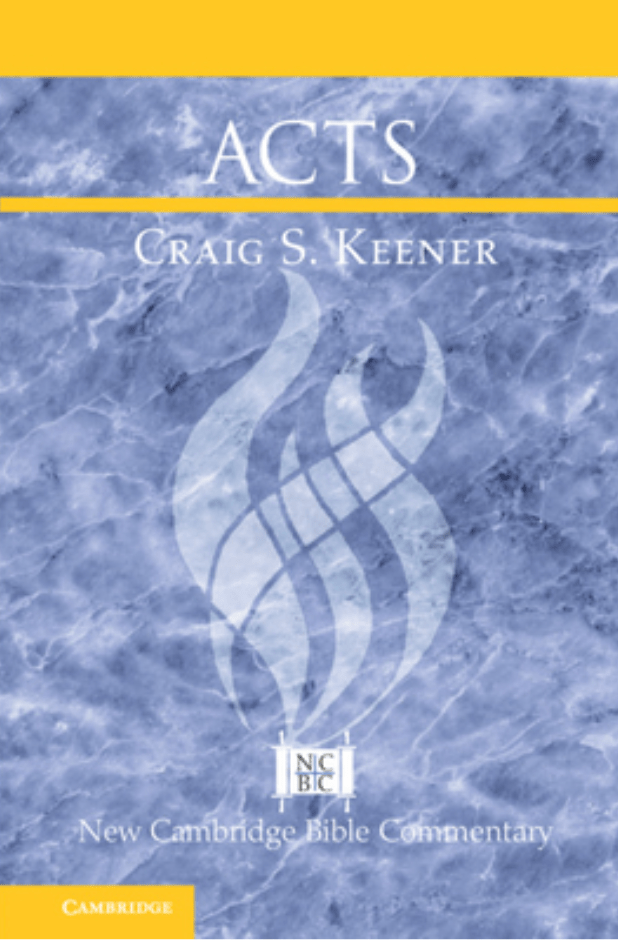

From 2012–2015, New Testament scholar Craig Keener came out with his four-volume commentary on Acts spanning 4,500 pages. That longer commentary has been abridged by about 91% into this shorter 700-page volume in the New Cambridge Bible Commentary series. Most people spend a few years just to write a 700-page commentary. Keener condenses his books into 700 pages.
Craig Keener—the F. M. and Ada Thompson Professor of Biblical Studies at Asbury Theological Seminary—is a prolific author and has written commentaries on Matthew, John, Romans, 1–2 Corinthians, Galatians, and Revelation, along with numerous other books (28 total!).
Keener is an excellent guide to the historical backgrounds of the New Testament (seen in this Bible). His four volumes contained 45,000 extra-biblical ancient references and more than 10,000 secondary sources. In order to make this present commentary more wieldy, most discussions, surveys of differing views and positions, major outlines, the vast majority of documentation, and scholarly arguments from silence needed to be omitted. The English translation (NRSV) was also, in the end, omitted due to spacial restraints (it made up 10% of the volume’s original length).
First Things First
Here are a “few” blurbs from Keener’s introduction.
- Author: Based on the internal evidence of Luke–Acts, Keener concludes that the author is either “a biblically informed Gentile Christian… or a (Diaspora) Jewish Christian who was part of the hellenist mission to the gentiles” (49). Luke the physician is the most likely candidate.
- Date: Keener holds the centrist position that Acts was written between AD 70–80. Keener writes, “Abrupt endings were, however, fairly common in ancient literature, and did not mean that the writer did not know some events that followed” (46). This can be compared to Mark’s (shorter) ending where he ends his Gospel with the women running away from the angel and the tomb in fear. Did Jesus actually rise again? It would be incorrect to conclude that because Mark didn’t write about Jesus’ resurrection that he did not know it happened.
- Purpose: Acts was written to:
- equip believers in their responses (cf. Luke 21:12–15; 1 Pet 3:15) and to confirm their faith (Lk 1:4).
- provide models to continue the Diaspora mission and on how to respond to persecutors (like the Roman government when one is on trial).
- The Spirit is given to all subsequent generations of believers. Since Acts’ ending is open-ended, “Luke thus encourages is audience to expect continuing preaching, church planting, signs and wonders, persecution, and the growth of the Way in the face of opposition” (53).
- Genre: Biographic history.
- Keener notes that historians wrote to “provide moral and political instruction,” and that they did so “by using what they understood as the genuine past” (9–10).
- While historians used rhetorical embellishments, they defined their works as factual. Historians would critique or even harshly criticize other historians who promoted falsehood, mixing truth with factual error, especially when done to promote themselves.
- Nonhistorians expected history to be truthful. Aristotle differentiated between “history” and “poetry” based on its truthfulness: “history recounts what actually happened whereas poetry… recounts what might happen” (11).
- Luke and History: A “broad middle range” of scholarship finds Luke’s story “largely reliable,” and certainly when evaluated by “the standards used to evaluate hellenistic historiography generally” (14). So just how accurate is Luke?
- Historical Accuracy: A few ways we can tell are:
-
- The information Luke takes for granted (12:12, 17);
- When Luke seems to condense a source (taking for granted Blasts’ role in 12:20);
- The criterion of embarrassment (6:1; 15:37–39; 21:4; 25:10);
- Essential but incidental information (the Hellenists’ mission in Antioch, 11:19);
- Date: if Acts was written late, Luke wrote within living memory of Paul’s ministry; if early then he witnessed some of the events.
- Local color: Luke knows local details and is “usually accurate even in obscure cases that few would have cared about” (20).
- Luke gets correct the titles of local officials of various places (Acts 12:1; 13:1; 16:20; 17:6, 8).
- See pages 20–22 for more examples.
- Keener concludes, “By the standards of ancient historiography, Luke should be considered an excellent source” (16).
Regarding the correspondences between Acts and Paul’s letters, after listing many of them, Keener writes, “No novel known to us in antiquity betrays such detailed correspondences with external, incidental information. Moreover, no ancient author would have worked so hard to extract such information from occasional documents, then failed to cite them” (27). Luke was clearly a painstakingly careful historian.
Keener also covers how to understand Luke’s use of speeches, miracles and healings, and the historical authenticity of them both.
The Theological Message of Acts
This section is brief not because it isn’t important but because “it is less controversial and because it emerges naturally for readers as they work through Acts itself” (59). This includes Israel’s story, the gospel, the Diaspora/Gentile mission, eschatology, the Spirit, and signs.
Tables and Structure
Keener offers many tables throughout his commentary. These include:
- parallels between Jesus in Luke with his disciples in Acts;
- parallels between Peter and Paul in Acts;
- a comparison between Jesus, Elijah, and Elisha;
- “tongues” in Acts 2:4 vs. 1 Cor 12–14;
- parallels between Joseph and Moses;
- Jesus in Luke 24 with Philip in Acts 8;
- and more.
Keener offers three different outlines for Acts, ranging from more symmetric and simplistic to more asymmetrical and a bit more detailed. He doesn’t state which one he prefers.
Closer Looks and Bridging Horizons
Keener gives us a closer look at many topics:
- the ascension narratives;
- tongues;
- the peoples of Acts 2:9–11;
- alcohol in Mediterranean antiquity;
- the revival of prophecy;
- synagogues;
- precedents and narrative typology;
- Stephen’s burial;
- Samaritans;
- narrative patterns in Acts 8:26-40;
- Africa;
- conversion and/or call;
- “Christians”;
- house churches;
- circumcision;
- pythoness spirits;
- Paul and riots;
- trials of Jesus and Paul;
- rejecting Israel?;
- and many more.
Keener also offers many sections called Bridging Horizons where he bridges a point from the text to modern times. These include:
- Pentecost and global Christianity;
- prophesying daughters (Acts 2:17-18);
- repentance (Acts 2:38);
- the new community (Acts 2:42-47);
- holiness;
- minority voices;
- divided loyalties;
- nonsupernatural Christianity?;
- what became of Luke’s Gentile mission?;
- and, can you guess?, more.
Snapshots
While Patrick Schreiner focuses more on theology and narrative, Craig Keener focuses more on history and background. I will try to show some of his detailed focus in my comments below.
- Acts 1:6—The Old Testament prophets regularly connected God pouring out of his Spirit with the moment of Israel’s restoration (e.g., Isa 32:15; 42:1; 44:3; 59:21). Since Jesus has been explaining the Scriptures, Keener believes that had been discussing such passages. In 1:6 the disciples ask the obvious: when will the kingdom of Israel be restored? Luke expects a restoration (1:7; 3:21, 25–26; 15:16; 26:7), just not when the disciples believe it should be.
- Acts 1:8—Being witnesses to the nations is grounded in the Old Testament: it was the mission of God’s eschatological people (Isa 43:9–12; 44:8-9) to the ends of the earth (Isa 41:5, 9; 43:6; 45:22; 52:10). As an implication of Jesus’ divinity, Yahweh’s witnesses in Isaiah become Jesus witnesses (Acts 2:17–18, 21, 33, 38).
- Acts 2:1–3—The end-time promise of the Spirit has come into the present, the last days (Acts 2:17; cf. 1:4–8). The Spirit is a foretaste of the future. The wind (2:2) and fire (2:3) resemble biblical theophanies, such as when God came down upon Mt. Sinai to give the law, but Keener notes that they “also reflect images of end-time restoration (Ezek 37:5–10; cf. John 20:22) and judgment (Luke 3:9, 16–17; 12:49–50; cf. 17:29)” (123).
- Acts 15:10–18— The Jerusalem council ended with an agreement that gentiles who put their faith in Christ and received the Spirit were accepted by God (which makes sense since they had received his Spirit). However, many still saw such Gentiles as God-fearers who would take part in the world to come but who weren’t full members of the covenant. Paul however, disagreed, and welcomed Spirit-filled gentiles as full members of the covenant without needing circumcision.
- Keener observes that Peter and the other disciples largely disappear from the narrative after this point “having completed their narrative function of supporting God’s new work in the Diaspora” (366).
- In Amos 9:11, David’s “house” became a worn-out “tent,” which postponed the promise of 2 Sam 7:12–16 to David’s household. However, David rule has now been restored with the David King seated on the heavenly throne.
- Amos 9:12 says that Israel would possess Edom in the future restoration, but the next line shows Edom typifies the nations. In the LXX, replaces “Edom” for “peoples.” God’s name has been called over the nations. In the OT prophets Gentiles were to eventually be included as part of God’s people.
- Acts 15:36–41—As a historian, Luke must explain the change in Paul’s ministry partners. Paul and Barnabas got into a heated argument over the usefulness of Mark. This schism is in stark contrast with the consensus achieved at the Jerusalem council just before this. Barnabas had shown great kindness to Paul previously in Acts (9:27; 11:22–25), which makes Paul’s refusal (15:38) even more ironic.
- After the split, Paul and his new missionary partner Silas travel through Syria and Cilicia (15:41), “the original target audience (15:23)” (376). This would include ministry in Tarsus (22:3) and southern Galatia (16:1).
- In a footnote (1510) Keener notes that Silas was a Roman citizen and Timothy a half-Greek, which likely made them more suited to the mission in Asia than Barnabas and Mark would have been. God accomplishes his purpose through limited persons (13:26).
Recommended?
Keener has written a detailed commentary that is faithful to the biblical text and well-informed by Luke’s first-century background. Keener helps provide the reasons for why something happened, especially when Luke doesn’t explicitly tell us (such as why Gallio is so quick to send the Jews away when they complained about Paul in Acts 18:15. I’ll let you read that yourself).
If you are a pastor, don’t make this your only commentary. Keener focuses more on historical details than theology per se. He doesn’t comment on every text, as should be expected in an abridged volume. Pair Keener’s historical eye with Patrick Schreiner’s canonical, narrative, and theological focus and you’ll be good to go.
Lagniappe
- Author: Craig Keener
- Paperback: 718 pages
- Publisher: Cambridge University Press (May 27, 2020)
Other Keener Reviews and Interviews
- John (ZIBBC)
- Galatians
- A Scholar’s Devotion
Buy it on Amazon or from Cambridge Uni Press!
Review Disclosure: I received this book free from Cambridge University Press. The opinions I have expressed are my own, and I was not required to write a positive review. I am disclosing this in accordance with the Federal Trade Commission’s 16 CFR, Part 255 http://www.access.gpo.gov/nara/cfr/waisidx_03/16cfr255_03.html.
Amazon Affiliate Disclosure: As an Amazon Associate I earn from qualifying purchases.
 spoiledmilks