


Galatians has long been a difficult book for me. Though it’s a book championed for its teaching about justification by faith, yet Paul spends the first two chapters defending his apostleship and having some weird table fight with Peter when some mysterious men from James come visiting. Suddenly Paul is dying to the law, believers in Jesus are sons of Abraham, there’s some weird allegory going on, but hey we’re free in Christ and we have the Spirit which allows us to deny our sinful desires and bear good fruit. By bearing one another’s burdens we fulfill the law (which Paul has been arguing against for the whole letter?), circumcision doesn’t matter, and we are the Israel of God. So it makes sense, right?
We need something that can show Paul’s flow of thought, his Jewish and OT background, and how it is all fulfilled with the coming of Christ. Enter Matthew Harmon’s new Galatians commentary in the EBTC series. Harmon was a great choice to have write a commentary on Galatians because he wrote his dissertation under Doug Moo. And I’m even happier that he wrote for the EBTC series, a series I really enjoy (as I’ve reviewed a few of those volumes too).
Matthew Harmon is Professor of New Testament studies at Grace Theological Seminary and has authored a commentary on Philippians (my review) and written books such as Making All Things New (another review), Rebels and Exiles (and yet another), and The God Who Saves and Judges.
These volumes highlight biblical theology, that is, theology that the biblical writers used on their own terms and in their own historical contexts. As one studies the whole Bible, one can see how later authors take up ideas from earlier books and expand on them until we get to Revelation 21–22, which combines the garden imagery of Eden with the city streets of a New Jerusalem. One studies the overarching meta narrative of the Bible, from Genesis to Revelation, to understand salvation history. Galatians is important because it is one of Paul’s earliest letters to a church struggling with living in the Spirit versus following laws from the Mosaic covenant. What continues over into the New Covenant life? What doesn’t? Paul has to show both the Galatians and us where we stand in redemptive history.
Introduction
Harmon gives a mere 24 pages of introduction, which is really nice considering pastors probably use at least three different commentaries when they preach. It’s nice to have an introduction that cuts to the chase. Paul is the author, although he probably had a secretary too. Paul probably wrote to churches in the southern part of Galatia, “churches in Pisidian Antioch, Iconium, Lystra, and Derbe—planted during his first missionary journey and with his ministry partner Barnabas (Acts 13:1–14:28)” before the Jerusalem Council occurred in Acts 15 (p. 11).
Given that these churches were so young, Harmon writes that it is “no surprise that they were vulnerable to threats from both outside and inside the church” (14). Although, it should be pointed out that Paul seems to be quite surprised that the Galatians would turn away from Jesus “so quickly” (Gal 1:6). Harmon does admit that according to the evidence he laid out in comparing Galatians with Acts, Paul could have written to churches in North Galatia after the Jerusalem Council.
Structure
Harmon provides helpful evidence on the circumstances of the letter, something which has always confused me. In regards to structure, Harmon approaches the structure of the letter based on structural and thematic elements in the text:
- Greetings and Astonishment (1:1–10)
- Paul’s Conversion and Apostolic Commission (1:11–2:21)
- Seed of Abraham and Sons of Promise (3:1–5:1)
- Living in the Freedom of Sonship (5:2–6:10)
- Conclusion (6:11–18)
Snapshots
Harmon follows the structure of Galatians for his commentary. For each section he offers the CSB Translation, some Context for the passage, and the Structure of these specific verses, giving a brief summary of Paul’s flow of thought. Each section ends with a Bridge paragraph that seeks to connect the text to our modern lives. Adding the context for each passage is especially helpful if you are looking up Harmon’s argument on specific passages rather than reading the commentary straight through. These brief paragraphs help situate you into Paul’s argument.
- Gal 1:3: Harmon pulls us into the OT background behind “peace,” which largely comes from Isaiah 40–66. Heralds are sent out to proclaim the gospel of peace (Isa 52:7) accomplished by the Suffering servant (53:5). The result of his work is the covenant of peace (54:10) which produces peace for God’s people (54:13). And “when God consummates his purposes for human history, he will make peace flow like a river (Isa 66:12)” (31). We not only have peace with God but with fellow believers regardless of ethnicity. Peace is both a fruit of the Spirit and something we should actively pursue.
- Gal 1:4: Christ rescued us from this present evil age, with “rescue” language often referring both to the exodus (Exodus 3:8; 18:4, 8, 9, 10) and eschatological salvation (Isa 31:5; 60:16). “This present evil age” was a Jewish way of “referring to the current time period that was dominated by sin, death, and the devil” (34). The Messiah has brought about the age to come seen in the pouring out of the Holy Spirit. We are no longer slaves to “the powers that dominated” that evil age (35).
- Gal 2:16a: Justification occurs when the sinner puts his or her faith in Christ and God declares that one to be “not guilty before him in his court of law” (109). What Jews expected to occur on the last day has occurred in the present.
- works of law refers to keeping the entire law. While the flashpoint came from issues with circumcision and food laws, Paul writes later in Gal 5:3 that whoever gets circumcised is obligated to keep the whole law. It is impossible to to be declared right before God based on any kind of works.
- faith in Christ (or faithfulness of Christ?) refers to a person’s trust in what Jesus did through his life of perfect obedience, his death, and resurrection.
- Gal 3:10–11: Those who rely on works of the law are effectively under a curse (Deut 27:26; 28:58) because no one keep keep the whole law perfectly. So to rely on it for salvation will only lead away from salvation. Instead, the “righteous live by faith,” which comes from Hab 2:4. Harmon understands this as a “generalized statement of what Abraham experienced in Genesis 15:6” seen in Gal 3:6 (p. 153). So those who are righteous live by their ongoing trust in God’s promises in Christ. In fact, even the circumcised don’t keep the law themselves (6:13).
- Gal 3:19: The law “was added for the sake of transgressions.” The law was given “to expose sin as a violation of God’s revealed will” (183).
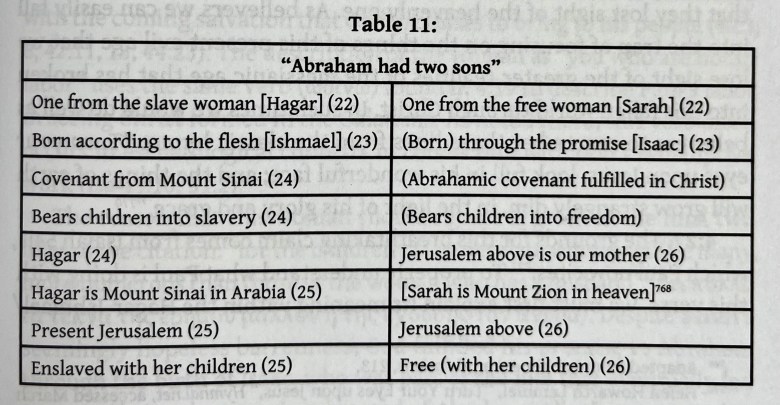
- Gal 4:1–7: Paul is working with both Greco-Roman background and the promised new exodus (seen in Paul’s use of “redeem” and “adoption” language). Harmon provides a helpful table comparing Gal 1:4; 2:19–20; 3:13–14; and 4:4–5 seen below.

- Gal 4:3: the elements of the world are “basic elements of the material world,” represented the old age of the fallen world. Looking at themes in Galatians, this includes “sin, works of the law, being under sin, being under law, the flesh, curse, being imprisoned under sin, being confined under the law, being under a guardian, being enslaved, dividing humanity along ethnic, socioeconomic, and gender lines, being under guardians and stewards, observing special days, circumcision, the desires and works of the flesh, biting and devouring one another, inflated self-esteem, etc” (220–21).
- Gal 5:26: The proof of being born again and living by the Spirit is seen in how we live. Is the Spirit producing fruit that reflects God’s character? This is both an individual and a corporate activity.
Although placed at the end of the book, you may want to read the Biblical and Theological Themes first. Harmon dives into nine different themes through 106 pages. Some themes are the Servant of the Lord, Seed/Offspring, the Law, Justification and Righteousness, Faith, Paul’s Use of the OT, and more. Since the law, justification, and faith play key roles in Galatians, I would recommend reading these themes first. Harmon surveys Galatians with each theme in mind and lays out the evidence for his views. He provides a four-page long table of the OT references (citations and allusions) used in Galatians. Harmon helpfully draws out how righteousness language in Isaiah shaped how Paul thought about the topic. References where God as a judge will grant people the status of righteous as a result of his judgment, see Isa 45:8; 46:13; 48:18; 51:5, 6, 8; and 54:17.

Recommended?
Matthew Harmon offers a great commentary on Galatians within an evangelical Reformed lens. He is careful to bring in the OT to show us how Jesus fulfilled God’s promises to his people in the OT, particularly how God would bless the whole world through Abraham and his seed. Harmon brings in the story of Scripture (biblical theology) so that you can understand Galatians, the previous role of the law, and the role of faith in Christ’s work now. He is consistent and clear in his exegesis, showing how Scripture helps interpret Scripture. This is written at a semi-technical level. While it is not devotional, it is not full of technical jargon and comes with bridges of application. The applications Harmon gives are not specific (this is the NIVAC or SGBC commentary), but they help guide us into how we should think as God’s justified people who have his long-promised Holy Spirit. This is a worthy commentary for any teacher or pastor.
Pair with Moo (BECNT), Schreiner (ZECNT), Keener, and Gupta (SGBC).
Related Posts
Other Series Reviews
- Joshua — David Firth
- Job — Barry Webb
- Psalms (vols. 1&2) — James Hamilton
- Romans — David Peterson
- 1–2 Timothy and Titus — Andreas Köstenberger
- Hebrews — Tom Schreiner
Lagniappe
- Series: Evangelical Biblical Theology Commentary
- Author: Matthew S. Harmon
- Paperback: 531 pages
- Publisher: Lexham Academic (December 1, 2021)
Buy it on Amazon or from Lexham Press
Review Disclosure: I received this book free from Lexham Press. The opinions I have expressed are my own, and I was not required to write a positive review. I am disclosing this in accordance with the Federal Trade Commission’s 16 CFR, Part 255 http://www.access.gpo.gov/nara/cfr/waisidx_03/16cfr255_03.html.
Amazon Affiliate Disclosure: As an Amazon Associate I earn from qualifying purchases.
 spoiledmilks
Great review. EBTC has become my favorite Commentary series. I have followed you on and off for years. Encouraging to see the growth in your thinking!
LikeLiked by 1 person
Thanks, David! Yes, this is one of my top favorite series.
LikeLike