


When you read (or slog) through Leviticus, do you think it is encouraging? Do you think it is good news? Do you think it is, as Derek Tidball writes, “good news for sinners who seek pardon, for priests who need empowering, for women who are vulnerable, for the unclean who covet cleansing, for the poor who yearn for freedom, for the marginalized who seek dignity, for animals that demand protection, for families that require strengthening, for communities that want fortifying and for creation that stands in need of care”? Or would you prefer to skip the book entirely because Jesus fulfilled every jot and tittle of it? Is it too irrelevant? Too severe in its punishments? Is it even the word of God?
According to commentator Derek Tidball—visiting scholar at Spurgeon’s College, the Jewish attitude of Jesus’ day was to value it “so highly that it was made the first book of the Torah to which they introduced their children at school. It was the place they started when instilling the values and rules necessary for daily living. Jesus would have known it well, along with the rest of the Pentateuch, and respected its authority.” Instead, it’s often the last book we want out kids to know about (second to Song of Solomon, I suppose).
Just Give Me the Simple Gospel
Can’t we just stick with the New Testament?
The gospel as we know it cannot be understood without Leviticus’ concepts of sacrifice and atonement, law and grace, sin and obedience, defilement and cleansing, priesthood and temple curtains. Applications certainly have changed in the coming of Christ, “but the guiding ethical principles remain as firm as ever.”
Introductory Bits
Tidball believes it was written by Moses (authorship) during his life (date), and if not by him then one of his contemporaries. Modern scholarship has made a big hooplah about sources, which texts come from which source, and when they were written. But no one can seem to agree on anything, to the point that the book might as well be Mosaic in its authorship. Leviticus is a legal document similar to but not exactly like other ANE legal documents. Yet, unlike many other OT books (even the Psalms), Leviticus has very few imperatives. Leviticus “encourages [Israel] to use their imagination and conceive of an ideal society where, because it is ideal, certain things are done and certain things are avoided. The tone is much more one of ‘Of course, you will not steal,’ rather than ‘Thou shalt not steal.’”
As well, as others have noted the supposed “obsession with cleanness and matters of ritual purity is confined to a few chapters, whereas words such as ‘freedom,’ ‘liberty,’ ‘atonement’ and jubilee,’ some of which are unique to Leviticus, abound. The whole cast of the book is much less restrictive and much more uplifting and inspiring than its popular image suggests.” Leviticus is really not a stuffy book, but one that offered freedom and liberty to its ancient readers, and dare I say, to us today who pick it up and read it with a new covenant lens.
Analogies from Order to Chaos
Leviticus has a more relational way of thinking than a logical one. It makes connections based on Israel’s social experience instead of some empirical proofs. Israel’s daily practice of their religious rituals served as a microcosm for their understanding of the larger picture of God’s relationship to his creation. For example, unclean animals would remind them of the threat of disorder and the resulting chaos that could ruin God’s creation and which was associated with death. Life, when disordered, leads to death; obedience to disobedience; the sacred to the profane. Tidball provides a table adapted from Gordon Wenham’s commentary.

Life was where God was, and God’s presence was in the Most Holy Place. The priests were confined to the Holy Place, and Israel to the camp. Gentiles and the unclean were outside the camp. The dead were in Sheol. When we interpret Leviticus’ laws, we need to look for the analogy that stood behind them. Then we can begin to understand the thought-world of the Israelite. (Tidball also provides a table on spatial, personal, ritual, and temporal dimensions on what sorts of things are in the lived experience of an Israelite and where they fell on the spectrum of very holy–holy–clean–unclean–very unclean.)
I won’t go into this here, but Tidball provides a very helpful survey of approaches by scholars on how to find the principles behind a law (referencing Richard Bauckham, Daniel Hays, Christopher Wright, and C. S. Rodd). All three approaches help us to arrive at the levitical law and walk away with a much better grasp on their meaning for us today.
Why the Sacrificial System?
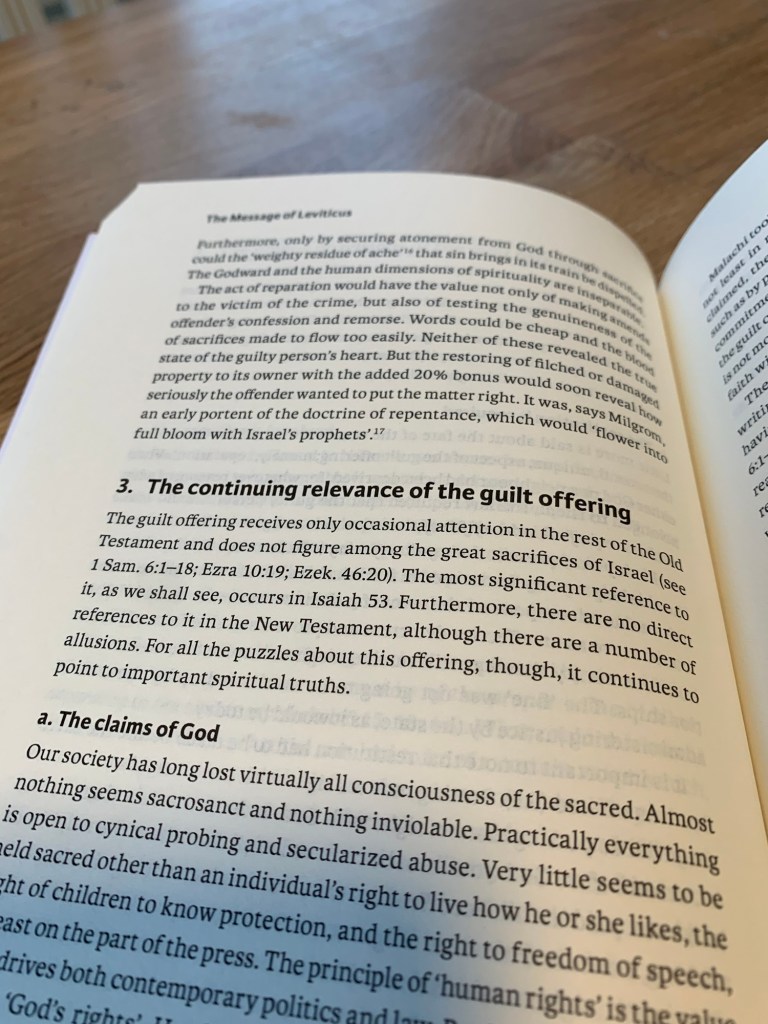
Tidball notes that Leviticus gives no justification for its sacrificial system. But we need to be careful because Leviticus does not stand alone. It is the third in a series of five books called the the Pentateuch (in case you forgot) and is part of a story. In Exodus Moses is able to talk to God seemingly whenever he wants to (almost). But the very last verse states that when the tabernacle was completed, God’s presence came down and not even Moses could enter it. If Moses couldn’t enter it, who could? And how? As well, Israel had only just recently been near to the presence of God, and it terrified them. Then when they sinned, 3,000 were killed for their idolatry. It didn’t take a rocket scientist among them to know why they needed to offer sacrifices.
Gracious Variety
While the instructions for these sacrifices may often seem like dull, strict commands, Tidball skillfully shows God’s grace in the sacrificial commands. For example, the grain offering could be offered in a variety of ways, giving a flexible approach which mirrored its flexible purpose. A worshiper (vv. 4-13) could bring a baked offering, which might have been cooked in an oven (4), on a griddle (5) or in a pan (7). These may be boring for us moderns, but God gives options and variety. If one day they wanted to bake their grain offering in the oven and another day on the griddle, they could! It was allowed.
In the “variety mix” was the mundane. It was the crunch and munch mixed into the M&M’s bowl. The priests were to keep the lamps burning continually (Lev 24:2). This was completely unspectacular, mundane, and repetitive. But because God commanded it, it was no less important than the large feastly celebrations held three times a year. Christians enjoy their conferences, but serving to pick up the tables and chairs is just as important.

Food Laws
The food laws and their focus on what is clean and unclean apply more than we might initially expect. Some people eat horse meat or snails, bugs and dogs. Is it wrong? We have numerous regulations on how food can be stored, packaged, when it ought to be sold, what can be sold, and how to keep it clean. Our attitudes may be do to science and hygiene, but we hold to “clean” and “unclean” as strongly as Israel did. The principle has to do with what we think is safe and orderly in our world (129). We don’t allow for a pile of dirt in the middle of our living room floor because it is out of place of the orderly and safe world we envision.
We ought not equate being “unclean with being a guilty sinner” (131). Sin does make one unclean, but ritual impurity did not equal someone being sinful. A woman who loses blood in the process of giving birth has not broken God’s law. She has experienced the consequence of living in the natural (fallen) world. Tidball writes, “While these regulations stress the need to approach God in a state of ritual purity, the greater stress is on the wonderful provision God makes to enable those to whom the pollutions of the world cling to be cleansed and restored to active participation in the community of those who worship him” (131).
Benefit of Clean vs. Unclean
One benefit of the clean vs. unclean distinction was that classifying a dead animal as unclean meant that you couldn’t exploit its carcass for your own economic gain. This was something I had never thought of, and probably because I’m not much of an outdoorsman. Living animals were of more worth alive, and they were not worth killing. They could not be skinned. Fur or leather coats could not be made from them. “No buttons or combs made from their bones and no musical strings created from their gut” (132). This resulted in ensuring fertility and the survival of the species.
Paul sees this in force, but in a different way for Christians (2 Cor 6:14–7:1). The purity laws pointed to God’s holiness and how Israel should live as his holy people. As Walter Kaiser wrote, “God looked for wholeness, completion, and separateness in every aspect of one’s life-style” (142). God had drawn a line for Israel, and by holding to what he allowed them to eat they showed themselves to be a different kind of people than the surrounding nations. In Christ, his blood cleanses all people, any person, no matter what they have done. He makes the most unclean holy instead, in him, a pleasing aroma to God.
Recommended?
I could go on. This is really a wonderful commentary and a pleasure to read. The BST series is written for the layperson, and it truly shows. Tidball takes the “trudgery” out of Leviticus, slogging our way through a few chapters at a time, one day at a time. He shows the goodness and graciousness of our God, who is the same yesterday, today, and forever. He points us to Christ and the benefits we have as new covenant believers, but not before he points us to the text so that we know what we should praise Jesus for. Tidball here (as well as Sklar, Shepherd, Wenham, and Morales), will help you read, understand, and perhaps even teach Leviticus with pleasure.
Other BST Series Reviews:
- Jeremiah by Christopher Wright
Lagniappe
- Series: The Bible Speaks Today
- Author: Derek Tidball
- Paperback: 336 pages
- Publisher: IVP Academic; revised edition (January 25, 2022)
Buy it from Amazon or IVP Academic!
Disclosure: I received this book free from IVP Academic. The opinions I have expressed are my own, and I was not required to write a positive review. I am disclosing this in accordance with the Federal Trade Commission’s 16 CFR, Part 255 http://www.access.gpo.gov/nara/cfr/waisidx_03/16cfr255_03.html.
Amazon Affiliate Disclosure: As an Amazon Associate I earn from qualifying purchases.
 spoiledmilks
Thank you so much for the incredible insight into God’s word!!! They have truly been a blessing! Keep up the good work
LikeLiked by 1 person
Thank you, Millie! I really appreciate that.
LikeLike
Your post are very inspiring and I really enjoy reading them. They help to uncover God’s truth and unveiling for what is being spoken! Keep it up!
LikeLiked by 1 person
Thank you! I do try.
LikeLike