
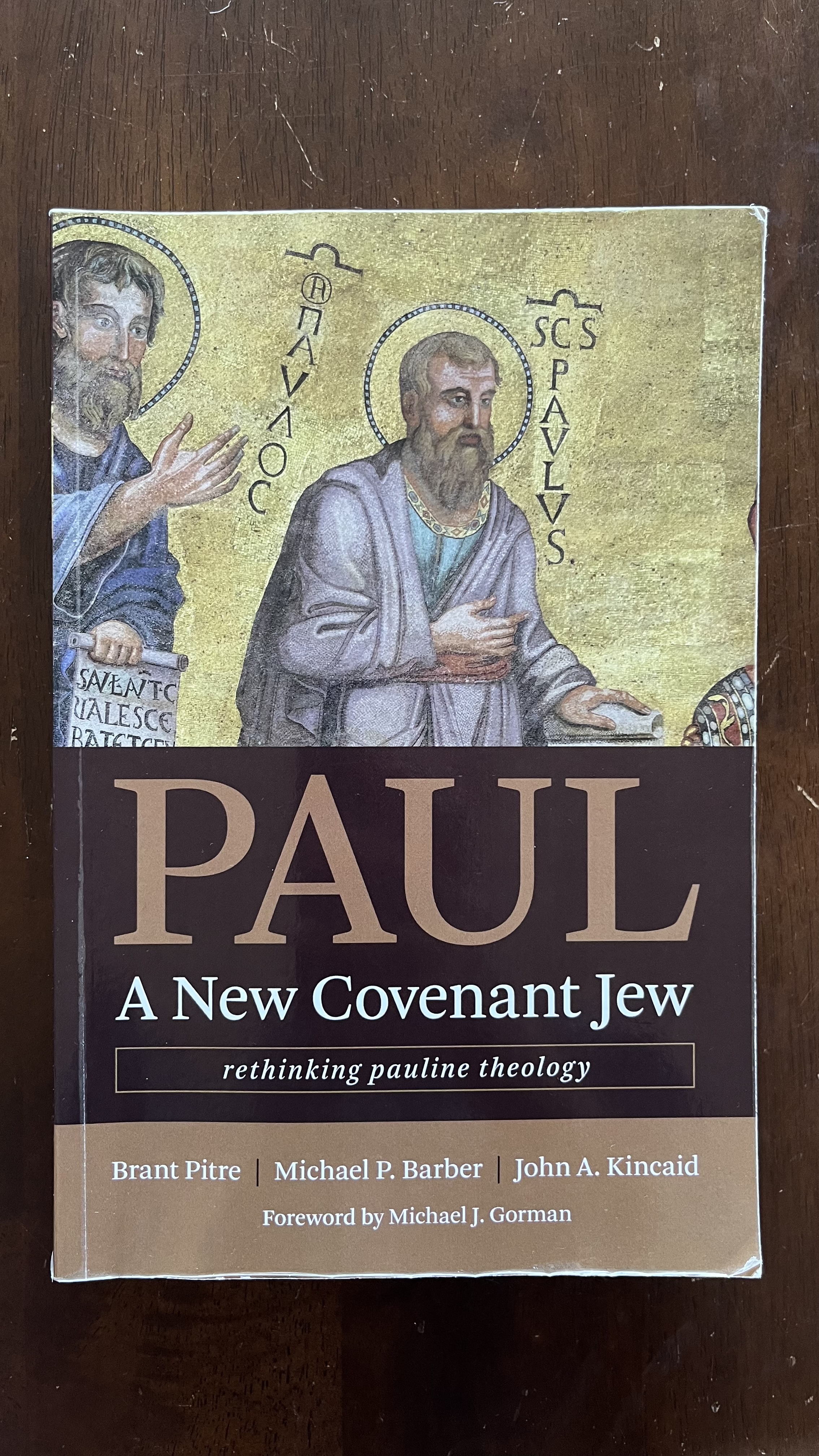
In a world already full of books on Paul, a reasonable person may ask: do we really need another one?
If the goal is to understand Paul according to how he understood himself, a “minister of the new covenant,” then yes, there’s still room for more. Whether “new covenant Jew” is the best way to describe Paul is something I’ll come back to. But at the very least, this book offers a fresh and helpful reframing of Paul.
Chapter 1 — What Kind of Jew Was Paul?
The authors Brant Pitre, Michael Barber, and John Kincaid, argue that “the apostle is best understood as a new covenant Jew,” which is founded on Paul’s language in 2 Corinthians 3 (p. 4). Their aim is to interpret Paul on his own terms and within his original context (pp. 7 10), which, compared to books like this that exist, is always a very good sign.
The opening chapters focus on Paul’s relationship to Judaism and the debate around whether Paul saw himself as having left Judaism or as still standing within it. The authors lean strongly toward continuity; Paul remained a new covenant Jew.
They explore Paul’s view of the Torah, his expectation that “all Israel will be saved” (Rom 11:26), and his language of “turning” to Christ (2 Cor 3:16). This turning isn’t just about recognizing Jesus as Messiah; it also involves adopting a new way of reading Israel’s Scriptures (46). As they write, God’s promises to Israel about a new covenant, they say, were fulfilled in Christ “in ways that could not have been anticipated” (5).
Their engagement with the New Perspective on Paul is brief but helpful, offering some needed corrections without getting lost in the weeds. One strength here is their treatment of “works of the law.” While they acknowledge boundary markers like circumcision, they also argue, rightly, in my view, that Paul includes all attempted law-keeping. His quotation of Psalm 32 in Romans 4 suggests that “works of the law” includes all works. The law exposes sin, but it cannot solve it.
In Christ, Jews are no longer required to keep the Mosaic law, although they are not forbidden from doing so either. Meanwhile, Gentiles are grafted into the same covenant people. The church, then, is the righteous remnant of Israel.
Chapter 2 — Paul and Apocalyptic
This chapter explores how deeply Paul’s theology is shaped by Jewish apocalyptic thought, with the authors taking a both-and approach. Paul’s thinking is rooted in earlier Jewish apocalyptic traditions, but it is also radically reshaped by the revelation of Christ (66).
Just to give one example, early Jewish theology held to the belief that there were two ages: the present age and the age to come. But for Paul there was an overlapping of these two ages. The old world is currently passing away, and those in Christ are already participating in the new creation (2 Cor 5:17; Gal 6:15). This is right in keeping with other books I’ve reviewed here, and the authors present their case clearly.
Chapter 3 — Pauline Christology
Here the authors shift to Paul’s understanding of Christ. Jesus is identified as God’s Son who fulfills Israel’s covenant promises in ways no one expected. Jesus’s own claims and acts, as well as what the New Testament authors, specifically Paul, write about him, reshape how we think of monotheism.
According to the authors, Paul presents Jesus as the Davidic Messiah, the pre-existent divine Son, who pours out God’s Spirit, and who shares in God’s identity. Paul rereads the Shema (Deut 6:4–6) in light of Christ. Paul writes that there is “one God” (1 Cor 8:6; Deut 6:4–6) and that “the Lord of the Shema’—is Jesus Christ” (117).
Chapter 4 — The Cross and Atonement
The authors take another both-and approach to the crucifixion of Jesus.The cross is both an apocalyptic revelation of God’s love and the new covenant sacrifice of redemption (130). One helpful thread is how the authors explain Jesus bearing the “curse of the law,” Christ takes upon himself the covenant curse that hung over Israel, removing the barrier that prevented both Israel’s restoration and the inclusion of the Gentiles (154).
This act was done in accordance with Israel’s Scriptures, and the result is not just forgiveness, but transformation. Through union with Christ and the gift of the Spirit, believers become sons and participants in the new covenant.
At this point in the book (chapters 2–4), I found myself largely in agreement. Much of this aligns with what I already believe. So one the one hand, I felt like I was reviewing familiar ground. On the other, I’m happy to see that so much quality content can be found in one place.
Chapters 5–6: Justification and the Lord’s Supper
This is where things start to diverge for me, a Protestant, due to the authors’ Catholic commitments on justification and the Lord’s Supper.
Chapter 5 — New Covenant Justification through Divine Sonship
In this chapter, the authors connect helpfully justification to Paul’s new covenant framework. They argue for what is an infused righteousness. They emphasize Israel’s heart problem and the new covenant solution: a transformed heart, which they refer to as “cardiac righteousness” (172).
Now, I haven’t read much about the Catholic view of justification by Catholic theologians themselves. So I enjoyed getting to read this chapter just for that perspective. And to the authors’ credit, they made a very compelling case for their view. If the old covenant failed at the level of the heart, then the new covenant must succeed there, not just legally, but morally too.
Still, for what it’s worth, I remain unconvinced.
From a Protestant perspective, I believe justification is fundamentally declarative: God declares us righteous. We are transformed, but it is due to the Spirit’s work in us, not to justification itself. The authors don’t deny the work of the Spirit. They emphasize it too! I just think they collapse the legal declaration and the Spirit’s work into the definition of what justification is and does.
Paul emphasizes the Spirit’s transforming work. The Spirit “gives life” (2 Cor 3:6), and believers are being transformed “from glory to glory” (3:18). The Corinthians, despite their flaws, are still called “saints” (1 Cor 1:2; 2 Cor 1:1). But this is because we are called “holy” or “saints” immediately upon salvation because we have received the Spirit. However, we must too grow in that holiness through the Spirit’s work in us.
Chapter 6 — The Lord’s Supper and the New Creation
The final chapter presents the Lord’s Supper as a new covenant sacrifice through which the church participates in the new creation. In order not to make this review more unwieldy, this chapter reflected a Catholic sacramental theology, and while there are interesting insights here, I found myself unpersuaded as a whole. I appreciate the discussion about how we participate with Christ excluding that we consume his body that is present through the Spirit, in some way (249).
Recommended?
Overall, this is an excellent and worthwhile book that sits among the Apocalyptic Paul, New Perspective, and and Paul Within Judaism views. This was an enjoyable book, even when I disagreed. I’m still not entirely convinced that “new covenant Jew” is the best summary of how Paul understood himself, especially given the variety of ways Paul describes his own ministry (apostle, slave/servant of Christ, minister of Christ Jesus to the Gentiles, father/mother, builder, soldier, prisoner, etc.). But as a theological lens, this angle is a productive one.
If you’re looking for a Scripture-driven and theologically rich study of Paul, this is well worth your time.
Buy it on Amazon / Eerdmans / Adlibris!
Lagniappe
- Authors: Brant Pitre; Michael Barber; John Kincaid
- Paperback: 304 pages
- Publisher: Eerdmans (August 2019)
Review Disclosure: I received this book free from Eerdmans. The opinions I have expressed are my own, and I was not required to write a positive review. I am disclosing this in accordance with the Federal Trade Commission’s 16 CFR, Part 255 http://www.access.gpo.gov/nara/cfr/waisidx_03/16cfr255_03.html.
Amazon Affiliate Disclosure: As an Amazon Associate I earn from qualifying purchases.
 spoiledmilks