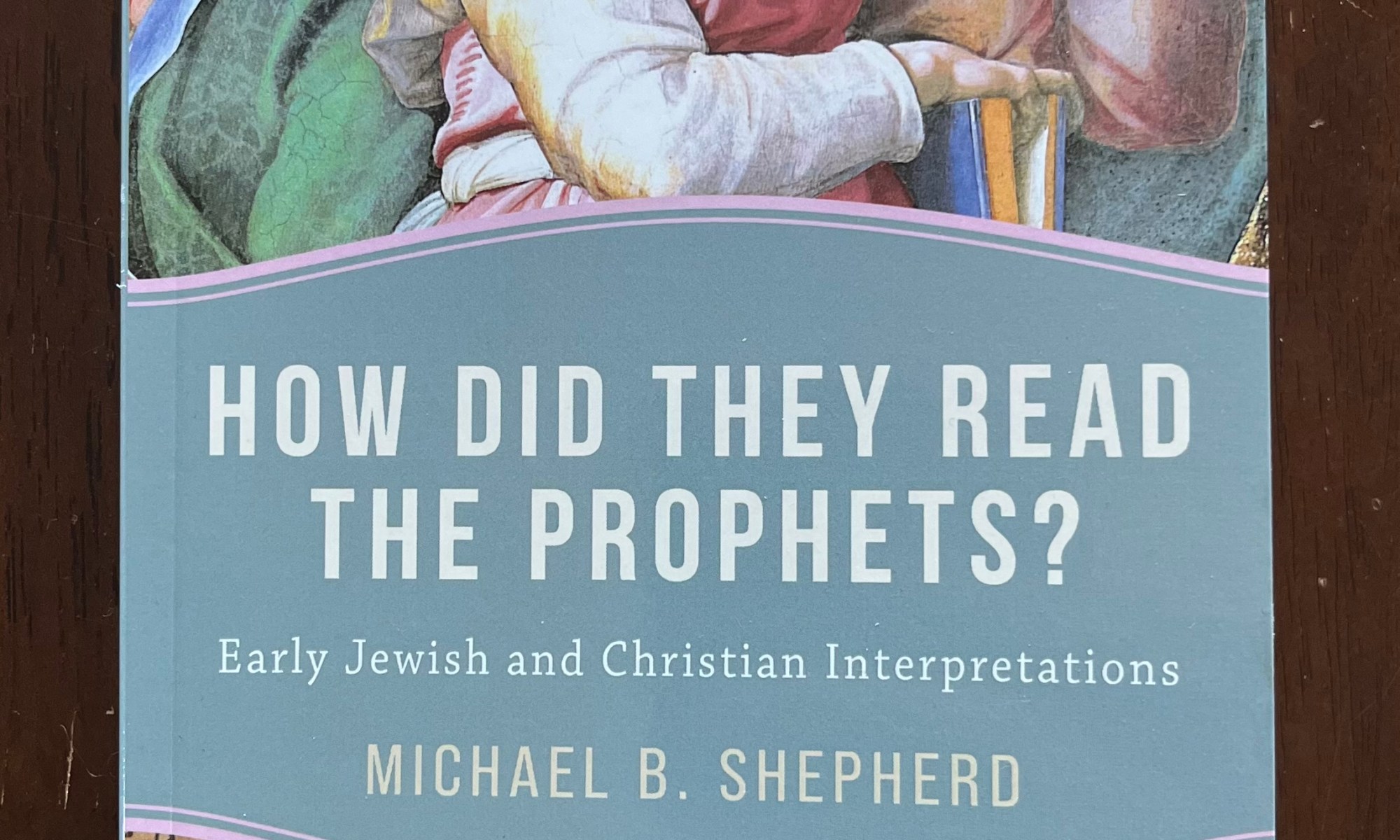

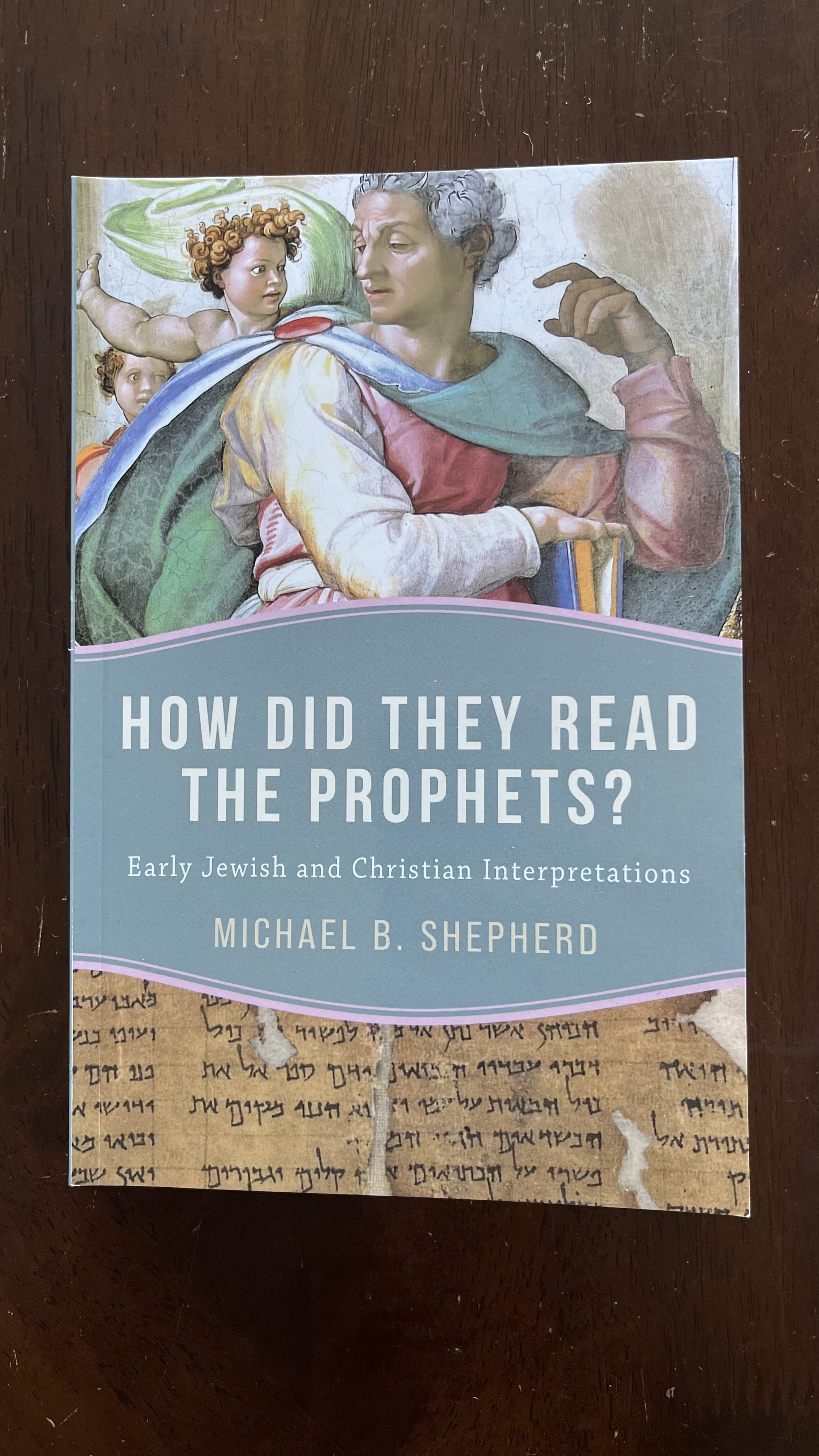
Michael Shepherd’s How Did They Read the Prophets? (pub: Eerdmans) is a deep dive exploring how early Jewish and Christian interpreters engaged with the prophetic books of the Old Testament. As Shepherd himself explains, the goal of the book is to offer “an accessible foray into the world of ancient interpretation of the prophets” and show its ongoing relevance for readers today (ix). He certainly highlights the depth, richness, and complexity of early interpretation, but it’s not always clear how the value of that information carries over to us today nor to which audience it is directed.
Michael Shepherd is professor of biblical studies at Cedarville University.
Structure and Purpose
The first four chapter of the book (Shepherd mistakenly writes “three”) give representative examples of ancient interpretation within the Latter Prophets: Isaiah (ch 1), Jeremiah (2), Ezekiel (3), and the Book of the Twelve (4). The final chapter (5) considers how the very concept of a prophet is redefined within Scripture and received by later interpreters.
If the earliest interpreters of Scripture are the biblical authors themselves, then their interpretations are original (5). Those who interpreted the Scriptures in other non-canonical texts (both those between the Testaments and the early church fathers, see below) can be extra, albeit not infallible, assistance in understanding biblical interpretation.
Shepherd expands outward from later biblical authors who exegeted earlier texts1 e.g., the Torah to scribes, translators, and later traditions. Such sources include the Apocrypha2 e.g., Sirach, Pseudepigrapha3 e.g., 1 Enoch, Dead Sea Scrolls4 including pesher and rewritten Bible texts like Jubilees, and the writings of early church fathers and rabbinic midrashim (8–9). Casting this wide a net reinforces his central claim: interpretation is not a later addition to the biblical tradition but is embedded within its formation.
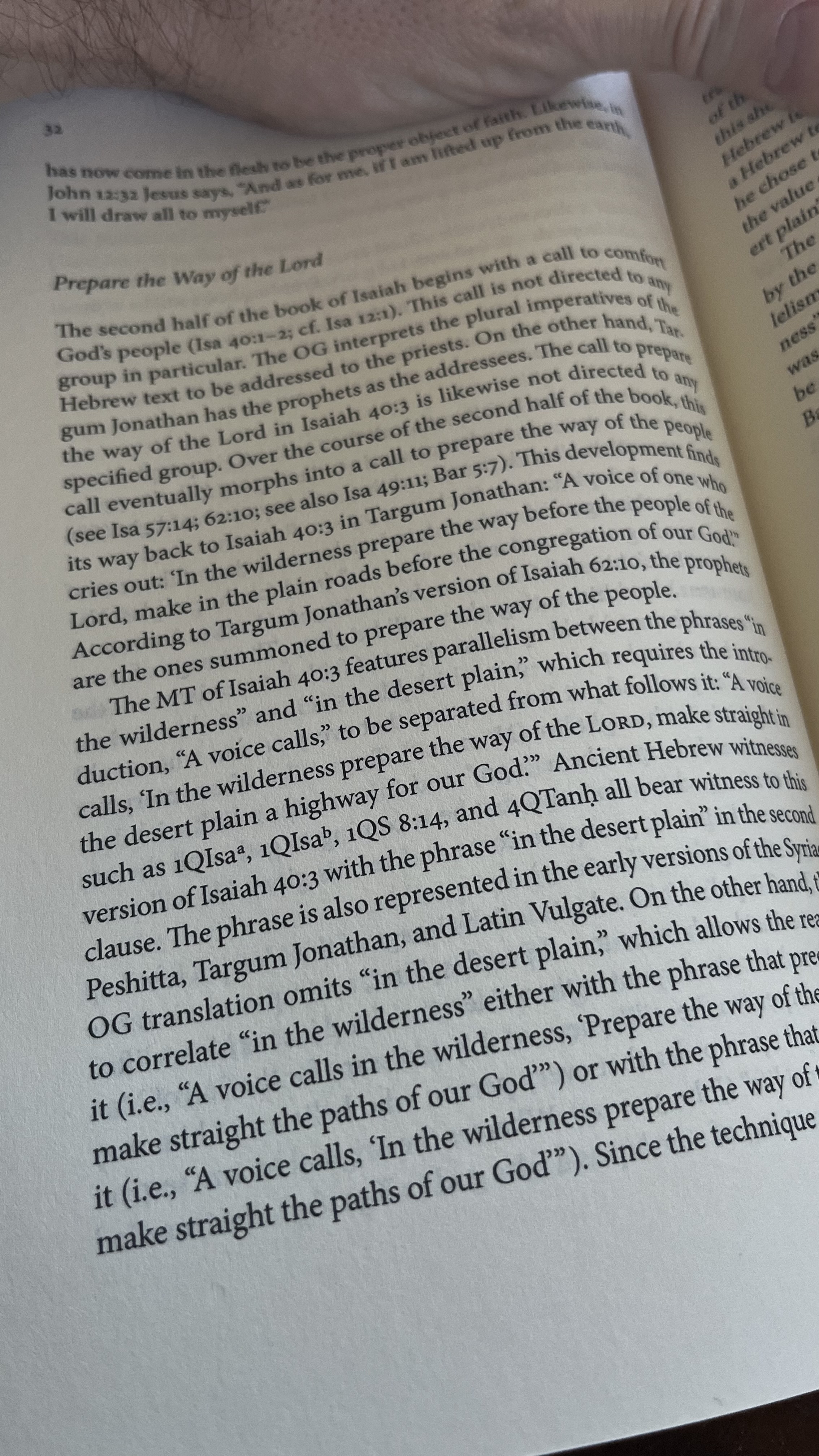
Going even deeper, Shepherd briefly surveys key textual traditions like the Masoretic Text (MT), the Septuagint (LXX), the Old Greek (OG)[1] According to Shepherd, the LXX refers more to the books of the Pentateuch (written in third century BCE) and the Old Greek refers to the other Old Testament books (written in second century BCE). and its basis on an older Hebrew textual text (Vorlage), the Syriac Peshitta, the Aramaic Targumim, and Jerome’s Latin Vulgate. He does this to highlight how these textual witnesses both preserve and interpret the prophetic books.
Unfortunately, Shepherd doesn’t give any immediate indication as to why he includes all of these various text types. It isn’t until the reader begins the next chapter on Isaiah that they understand. I mention that because Shepherd’s exegesis is incredibly detailed and careful in order to give proper answers. But he isn’t usually clear on why he does what he does. More on that later.
The Uniqueness of the Latter Prophets Unlike the OT narrative texts, the Latter Prophets are not arranged chronologically and certainly are not straightforward narratives. Yet Shepherd argues that these books are ordered by sophisticated compositional strategies involving framing devices, repetition, parallel structures, and “seam work.”[2] “Seam work” means editorial connections that bind separate texts into a unified whole (12–13).
Because ancient interpreters were closer to this compositional process than we moderns are, Shepherd contends that their interpretations deserve serious attention from modern readers and interpreters. However, any attention Shepherd gives to the compositional strategies of the original authors are sprinkled throughout his chapters as small crumbs. There is no extended discussion on the shape of these writings. That can be found in his other books.
A Few Points
Here I will focus on some of his points regarding Jeremiah and Ezekiel.
Jeremiah
Shepherd argues that the significantly shorter version of Jeremiah found in the Old Greek and some Dead Sea Scroll fragments (written in Hebrew) likely represents the earlier edition, while the longer Masoretic version reflects later expansions. These additions, he suggests, are “exegetical in nature,” demonstrating that the art of interpretation was already happening within the book’s textual history (47).
Most of the themes in this chapter here work well: the prophet like Moses, the temple, the good shepherd, the enemy from the north, the seventy years, the nations, and the new covenant. One section that doesn’t quite fit is the image of a “tree planted by water” seen in Jer 17:5–8 and Psalm 1. Instead of comparing textual traditions or later interpreters, Shepherd shows that neither text is interpreting the other. It’s not wrong, per se, it just feels out of step with the rest of the chapter.
Ezekiel
In Ezekiel 4, the OG edition has the prophet lying on his sides for a total of 190 days, while the MT has 430 days. Shepherd argues these reflect different interpretations: the OG connects Judah’s punishment to wilderness wandering, while the MT frames it as a return to Egypt (80). As for what we are meant to do with that information, Shepherd doesn’t venture to say.
Shepherd also looks at Ezekiel 28 (the king of Tyre) and compares the OG, MT, and Targum Jonathan. Again, it is difficult to know how this helps us with interpretation today.
Prophets as Exegetes
In what was easily my favorite chapter, “Prophets as Exegetes” (ch 5), Shepherd looks at how prophecy becomes textualized, that is, how it moved from being primarily oral proclamation to being the interpretation and reapplication of earlier Scripture. This chapter was superb. I especially enjoyed his discussion on how the prophets early on in the Bible became seen as those who exegeted the scriptures, and how this fits with what Paul wrote in 1 Corinthians 14 and the Pastoral Epistles. In some ways, I think the content of this chapter would’ve helped understand this book better if it had been placed at the beginning of the book.
The Chocolate Milks
Shepherd’s greatest strength is his close attention to the biblical text. He consistently questions how later biblical authors interpreted earlier Scripture and how those earlier texts shaped their understanding of God’s word and its trajectory. These are pivotal questions for biblical theology, and Shepherd teases out these finer points for us.
The Spoiled Milks
At the same time, those strengths make it difficult to see how this book is an “accessible foray” or how it clearly shows the “continuing value” of ancient interpretation (ix). Shepherd doesn’t explain what his audience ought to consider when faced with the differences between the OG and MT. Should one edition always be preferred over the other? As well, who is this book written for? That this is an “accessible foray” doesn’t quite match the depth of exegesis found in this book.
Shepherd’s introduction leans heavily on James Kugel’s book The Bible as It Was without explaining who Kugel is or why his “four assumptions” matter. After the first few pages, references to Kugel disappear except in a few footnotes. Shepherd is not clear about why certain examples are included or how they fit into the larger argument.
And finally, despite the title How Did They Read the Prophets?, even though we learn that “they” interpreted the Latter Prophets in various ways which we can see through the textual variants, the reader learns neither how “they” read the Prophets nor how the intended audience should discern these variants and come to a proper conclusion of the text.
Recommended?
How Did They Read the Prophets? is packed with textual details in the study of biblical interpretation, and it will reward careful readers who can linger over its details. This sort of book is likely meant for specialists with training in textual criticism. Shepherd’s efforts show that extensive technical knowledge of the Bible, hermeneutics, textual studies, and variants is important to understand its meaning.
At the same time, this is blurred by Shepherd’s unclear aims and direction, and it isn’t always obvious how everything coheres. I’ve seen this with all three of Shepherd’s books that I have reviewed. The content itself is dense and very good. But ironically, for as much as Shepherd emphasizes the shape of the Old Testament text, his own texts lack that same shape, which is disappointing given the excellent content Shepherd is capable of giving.
Buy it on Amazon or from Eerdmans!
Other Reviews on Shepherd’s Books
- An Introduction to the Making and Meaning of the Bible
- A Commentary on the Book of the Twelve (KEL)
- Textuality and the Bible
Lagniappe
- Author: Michael B. Shepherd
- Paperback: 190 pages
- Publisher: Eerdmans (July 2025)
Review Disclosure: I received this book free from Eerdmans. The opinions I have expressed are my own, and I was not required to write a positive review. I am disclosing this in accordance with the Federal Trade Commission’s 16 CFR, Part 255 http://www.access.gpo.gov/nara/cfr/waisidx_03/16cfr255_03.html.
Amazon Affiliate Disclosure: As an Amazon Associate I earn from qualifying purchases.
 spoiledmilks