
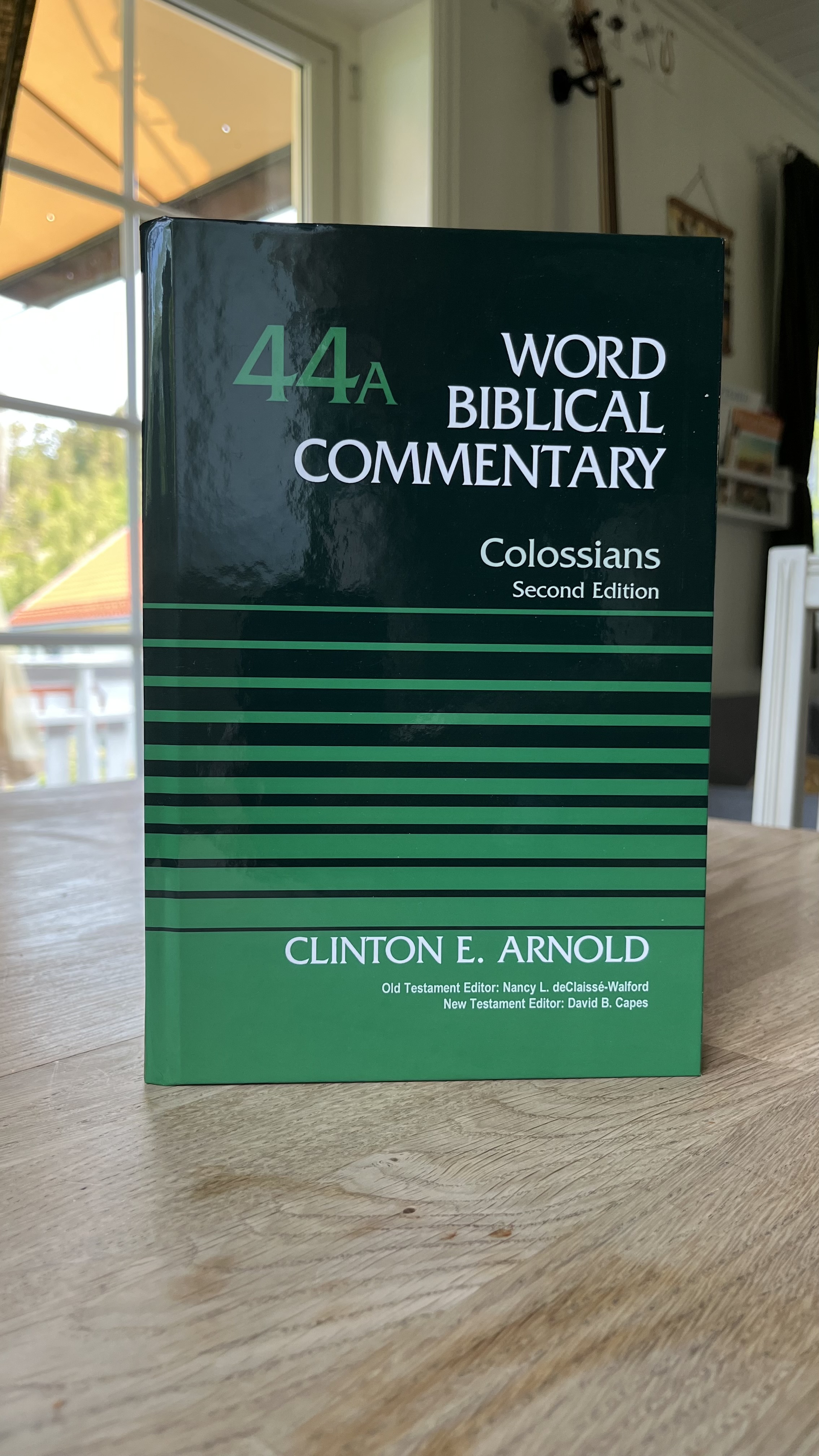
Clinton Arnold’s volume is a masterclass in historical exposition, which includes archaeology, inscriptions, magical papyri, and understanding the history and local context of Colossae and the nearby cities. Arnold is driven by questions like: What did Colossae look like? What religious forces were active? How did magic, Jewish practices, and local cults interact, and how did the Christian community navigate these waters?
Clinton E. Arnold is Dean and Professor of New Testament at Talbot School of Theology in La Mirada, California.
His volume on Colossians (864 pp.) replaces Peter O’Brien’s former volume on both Colossians and Philemon (330 pp.).
Arnold devotes 250 pages to his introduction, illustrating to us his belief that, in order to understand Paul and his letter to the Colossians, we need to understand the city of Colossae, its history and cultural milieu. Beyond this, Arnold brings extensive evidence from regional cults, syncretism, and the pervasive spiritual fears of those in the Lycus Valley. While reading about the Lycus valley is not exactly breathtaking, the insights Arnold gives open up the door to understanding how the Colossians were syncretizing their belief in Jesus with the other religions and why Paul wrote as he did.
We better understand how the rulers, authorities, and cosmic powers, are not something abstract. Paul writes pastorally into a real environment of fear (See Michael Heiser’s The Unseen Realm for even more on this.) Arnold covers aspects of magic, syncretism, and “Jewish Shamanism” where he rejects simplistic “proto-Gnosticism” explanations and avoids caricaturing Judaism as mere legalism.
He understands Colossians 1:1 as referring to the actual in-the-flesh Apostle Paul. He engages objections about style, vocabulary differences, theological development, and composition, and he defends the authentic Paul. He does not dismiss critical scholarship, but he (refreshingly) models how to engage modern criticism without surrendering to it. Arnold argues as well that the false teaching was a syncretistic blend involving spiritual protection practices, ritual observances, and visionary experiences tied to the cosmic intermediaries. Paul’s response in all of this is to show Christ’s power and supremacy over the so-called powers.
Arnold follows the six-section WBC format:
- Each new section/pericope begins with a bibliography of curated scholarly resources relevant to that passage. Arnold uses footnotes in place of in-text citations.
- Translation: Arnold’s English translation of the Greek.
- Notes: A technical analysis of textual variants, linguistic details, and syntax.
- Form/Structure/Setting: Arnold offers a look at the literary context, setting, and structure.
- The Comment section gives a detailed, verse-by-verse interpretation of the text.
- The Explanation section synthesizes this information to offer a “theological understanding of Scripture,” and focuses on the meaning and intention of the text for the contemporary church (9).
Interpretive Summaries
Bearing Fruit (1:6)
Arnold disagrees that “bearing fruit” in Colossians 1:6 is a fulfillment of the creation mandate (Gen 1:26–28). He acknowledges the broad OT background, but focuses on the effect: the gospel is advancing worldwide and people are being transformed and growing in Christ. The false teaching is geographically and ideologically narrow while the gospel is globally fruitful. Besides that, the only shared term between Col 1:6 and Gen 1:26–28 is “increase”, he writes in a footnote, “In my view, it is too big of a stretch to reason that Paul was working with a typological framework in which he saw the numerical growth of the creation mandate as ‘a type for the new creation that had been inaugurated with Christ’ and then to see ‘increase’ and ‘multiply’ now as reference to Christian growth in virtue as Beetham, Echoes of Scripture, 41–59, has argued” (p. 281, fn. 51).
Filling Up What is Lacking in Christ’s Afflictions (1:24)
Arnold lists eight different interpretations of this verse and believes that the most compelling view is a combination of options 2 and 3: Paul suffers with Christ (union with Christ, opt. 2) through his missionary work, continuing the Servant’s role (opt. 3) as a light to the nations. Arnold rejects the idea that Christ’s suffering was insufficient. Paul suffers for the sake of the body of Christ, especially among the Gentiles. Following the series’ style, Arnold backs up his interpretation with evidence from the Greek.
Circumcision and Baptism (2:11–12)
When Paul speaks of a “circumcision not made with hands,” he isn’t talking about a physical rite but about the decisive work Christ accomplishes in his people. Through union with Christ in his death, believers are cut off from the dominion of the flesh and transferred into a new realm of life. This circumcision is God’s act, which is language echoing the Old Testament’s emphasis on God’s divine action. Moving into verse 12, baptism doesn’t create this reality. Rather, it is a public declaration of our participation in Christ’s burial and resurrection. It is the visible marker of an inward work accomplished by God through faith.
Excursus: The Stoicheia (2:8, 20)
Arnold has laced some excursuses throughout his commentary. One concerns the elusive meaning of the phrase τὰ στοιχεῖα τοῦ κόσμου (“the elements of the world”) in the context of Paul’s letters, particularly in Galatians and Colossians. He lists nine interpretive options, some being rudimentary religious principles (e.g., Jewish law), stars and planets, the four elements (earth, air, fire, water), celestial powers, and demonic powers, which is what Arnold lands on. He lists texts outside of Paul’s corpus, such as Alexander Romance, Testament of Solomon, 2 Enoch 16:7, as well as Greek magical papyri and an exorcistic phylactery from Xanthos (an ancient inscribed amulet discovered at the city of Xanthos in Lycia).
The usage of στοιχεῖα in Galatians 4:3 and 9 makes most sense if it refers to demonic spirits who enslaved humanity before the coming of Christ. They are not true gods (4:9). In Colossians 2:8, στοιχεῖα would then refer to demonic spirits who inspire these philosophical teachings, while in 2:20 it would refer to how believers have been freed from these demonic powers by dying with Christ. The opponents’ teachings appear spiritual, but they are actually inspired by these malevolent forces.
According to Arnold, the Colossians “have entered into a new existence in which these forces, though still existing and exerting their influence, no longer have governing jurisdiction over their lives. Paul now interprets death with Christ as also including death to another category of powers associated with the present evil age: they have died to the influence of evil angelic powers” (578).
Arnold argues that the rival teachers likely believed the στοιχεῖα were powerful, harmful spiritual forces that affected everyday life. They caused illness, disasters, curses, and other misfortunes. According to this view, these powers had to be neutralized through ritual practices, taboos, and even appeals to angelic intermediaries (cf. Col 2:18). However, through Christ’s death and resurrection, the status of these powers has fundamentally changed for believers. Christians are not inherently immune to spiritual forces, but in union with Christ they have died to the στοιχεῖα’s authority. “The Colossians are not automatically immune to the powers in and of themselves, but in Christ they are “dead” to their influence and are filled with his resources for resisting (Col 2:10)” (579).
Recommended?
Arnold provides a beefy commentary on Colossians, clearly the longest commentary on the letter that I can find. Arnold’s emphasis is on the historical and archaeological facts rather than redemptive-historical. He brilliantly reconstructs the cultural background of the letter and is less concerned with situating Colossians within the unfolding covenantal drama of Scripture. I don’t mean that he doesn’t compare life in the new covenant against the old, but that’s not where his emphasis lies.
While not all may be convinced of Arnold’s take on the “rival teaching,” and some may wonder how specific we actually need to be to understand Paul’s letter, considering most of church history hasn’t had this information. But Arnold has been very thorough and careful in his discoveries and exegesis, and he has made great gains in understanding Paul’s letter and moves us beyond generic “Colossian heresy” theories. This is an excellent and significant commentary on Colossians.
Other WBC Reviews
- Acts 1–9:42, Steve Walton
Other Reviews on Colossians
- Colossians and Philemon (BECNT), G. K. Beale
- Hidden with Christ in God (NTT), Kevin McFadden
Buy it on Amazon or from Zondervan Academic!
Lagniappe
- Series: Word Biblical Commentary
- Author: Clinton E. Arnold
- Paperback: 864 pages
- Publisher: Zondervan Academic (March 2025)
Review Disclosure: I received this book free from Zondervan Academic. The opinions I have expressed are my own, and I was not required to write a positive review. I am disclosing this in accordance with the Federal Trade Commission’s 16 CFR, Part 255 http://www.access.gpo.gov/nara/cfr/waisidx_03/16cfr255_03.html.
Amazon Affiliate Disclosure: As an Amazon Associate I earn from qualifying purchases.
 spoiledmilks