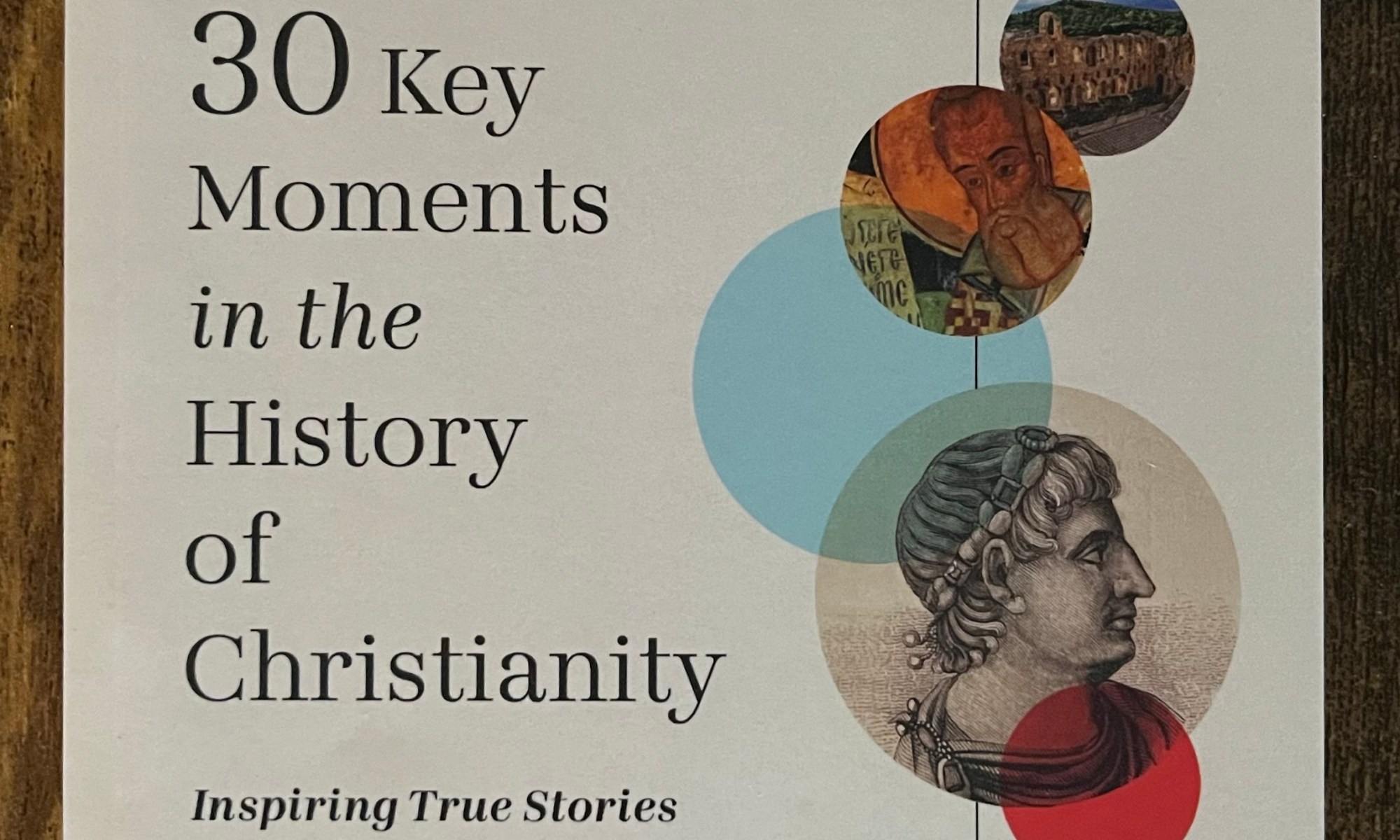

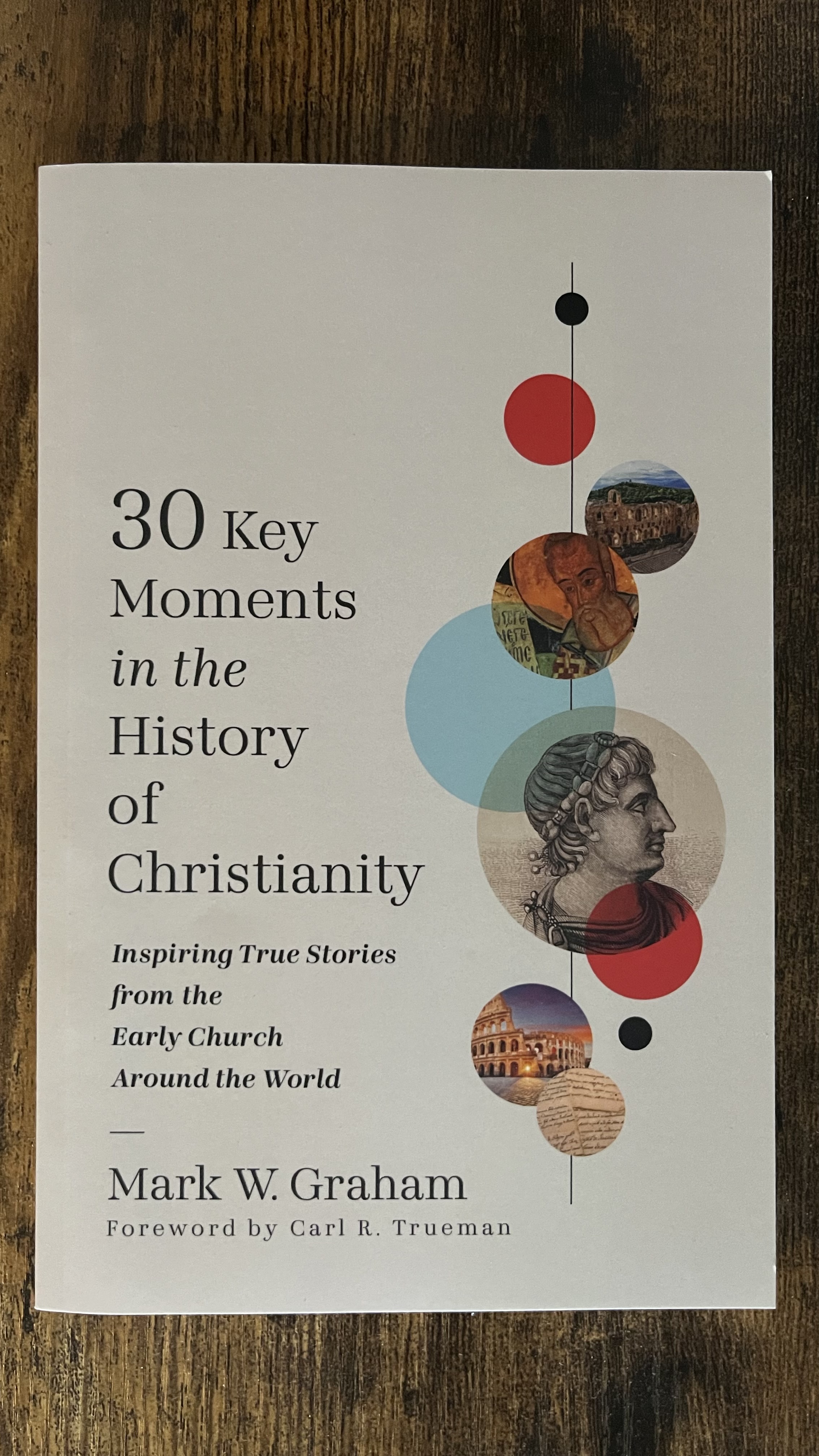
In 30 Key Moments in the History of Christianity, Mark Graham argues that Christianity has been a truly global faith from its earliest days. He highlights moments in the first millennium often overlooked in traditional church history, showing both the faithfulness and the failings of believers. Even amid the failures, God advanced the gospel across cultures, over empires, and through crises.
I was pleasantly surprised by the thirty key events (or moments) in this book, most I had never heard of. Each chapter is structured around three sections:
- Background—explains the bigger picture around the event;
- the Moment—explores crucial persons and events;
- the Mathēma (“that which is learned”)—offers a concluding theological reflection, an opportunity for us to learn from those who went before us.
Graham refers to the ancient believers as “Our People,” the transnational, transethnic body of Christ across time. Rather than focusing only on famous turning points, he chooses lesser-known events that reveal the life and struggles of the church.
Turning Points
Constantine Embraces Christianity (Chapter 8)
Graham presents Constantine as a complex ruler whose embrace of Christianity changed the church forever. Before this, persecution had been the church’s normal condition for nearly three centuries. Constantine’s policies, especially the Edict of Milan, ended state-sponsored persecution and gave Christianity legal protection and social influence.
But Graham’s focus is on what came with this favor. Christianity gained safety and resources, but it also inherited the patterns of empire: hierarchy, political calculation, and state influence over church affairs. Bishops quickly became advisors to emperors, and theological disputes often required state enforcement. This moment reshaped Christianity—for better and for worse.
The Council of Nicaea (Chapter 10)
Graham examines Arius, a pastorally-minded theologian who desired to protect monotheism but ended up denying the full deity of the Son. This teaching threatened Christology and even salvation itself. Graham emphasizes that Nicaea was not a political power play. It was a real theological crisis. He explains the term homoousios (“of the same substance”) as a safeguard of the biblical truth about Christ. The council wrestled faithfully with Scripture. It was neither an invention by Constantine’s hand nor was it a suppression of theological diversity.
Lesser Known Events
Christianity in Aksum, Ethiopia (Chapters 16–17)
Graham shows that Ethiopian Christianity did not come through colonial imposition, but rather grew organically within the local culture. The church survived isolation, Islamic expansion, and geographic distance from Rome. It preserved Scripture, liturgy, and sound theology while staying connected globally through trade. Although Ethiopian Christianity developed distinct practices and cultural expressions, it remained orthodox. Graham’s point is clear: Christianity did not depend on Western empires or governments to thrive. Even on the margins, the gospel flourished.
John of Damascus and the Defense of Icons (Chapter 22)
Rather than turning the controversy over icons into a simplistic “images vs. no images” debate, Graham’s places it within its theological and political contexts. Writing under Muslim rule, John defended the use of Christian images by pointing to the incarnation: because God became visible in the physical, human Jesus, material things can help direct attention to God without being worshiped themselves. Graham doesn’t argue that modern churches should copy John’s practices. He simply shows how early Christians’ beliefs about Jesus shaped their worship.
Recommended?
This book will be useful for pastors, missionaries, and teachers who want to broaden their view of church history. The benefit of learning history isn’t found in bare facts, but in seeing how the early Christians struggled against culture and thought through the implications of their faith for life and worship. Graham shows the global-ness of Christian history, and shows the reality of persecution against the church and the ease of misusing power and authority when the church obtains it.
Graham bases his study in academic scholarship but writes for a general audience. Graham combines his historical-theological acumen as a historian of ancient and early medieval empires with his many years serving as a Sunday school teacher and elder in his church. His book is replete with illustrations, warnings, and encouragements toward this end. Many of these chapters could easily be fodder for sermons or adult Sunday School classes.
Buy it on Amazon or from Baker Books!
Lagniappe
- Author: Mark Graham
- Paperback: 272 pages
- Publisher: Baker Books (January 2026)
Review Disclosure: I received this book free from Baker Books. The opinions I have expressed are my own, and I was not required to write a positive review. I am disclosing this in accordance with the Federal Trade Commission’s 16 CFR, Part 255 http://www.access.gpo.gov/nara/cfr/waisidx_03/16cfr255_03.html.
Amazon Affiliate Disclosure: As an Amazon Associate I earn from qualifying purchases.
 spoiledmilks