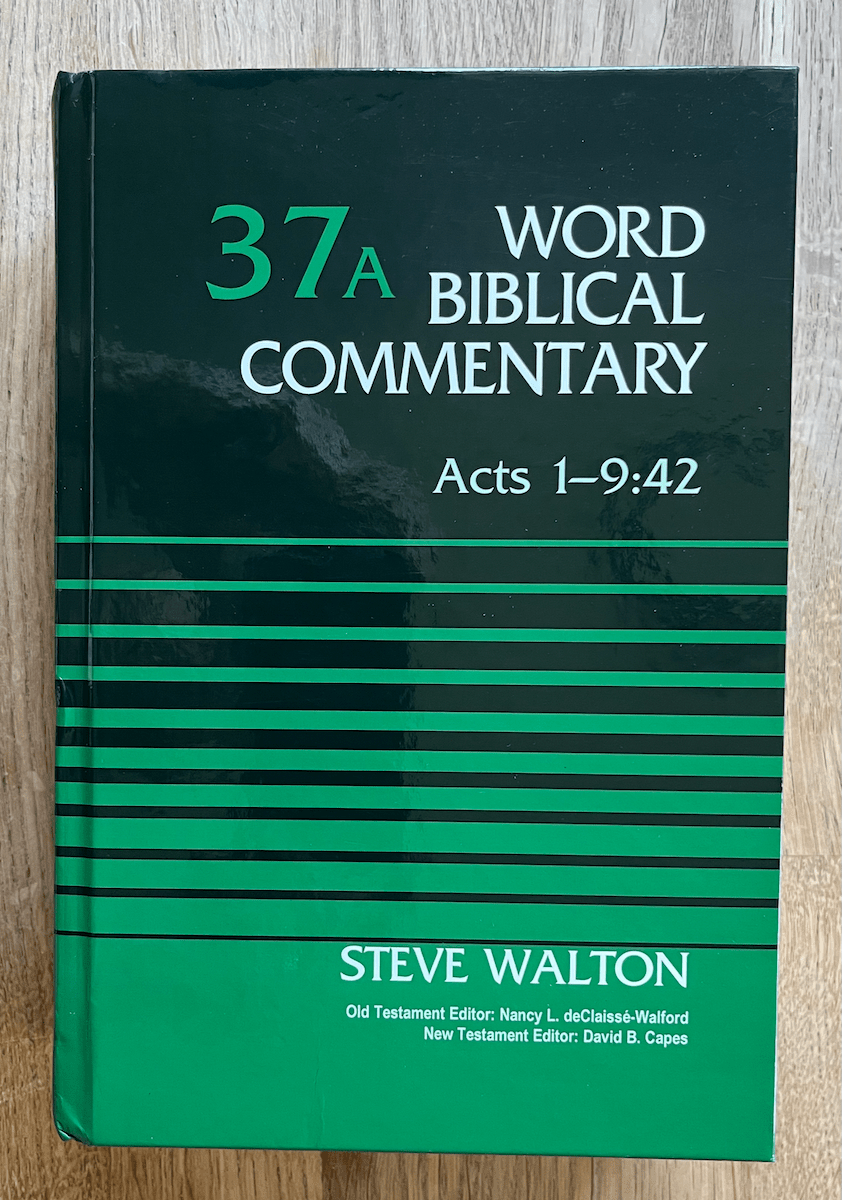

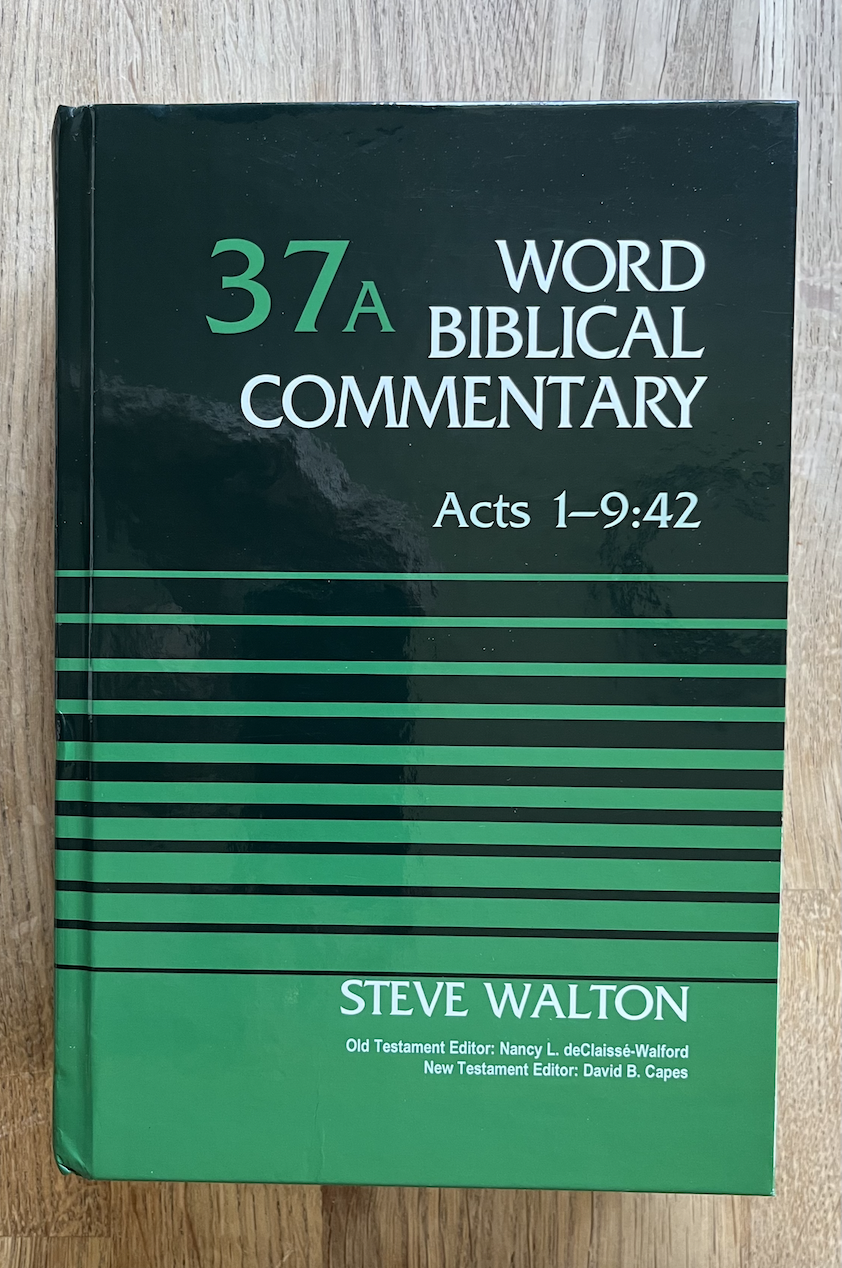
The Word Biblical Commentary series was begun in 1977. While many of its volumes are being either revised or revamped by new authors, up until now no one had written the volume(s) on Acts! Steve Walton is set to produce three volumes on Acts in the WBC series. This first covers Acts 1:1–9:42. While these will likely not be as hefty as Keener’s set, there is still plenty here!
Steve Walton is Senior Research Fellow at Trinity, College, Bristol, where he supervises research students through their research programme. He had the privilege of serving as Secretary of the British New Testament Society.
Walton envisions himself with other scholars or intermediate students sitting around a table with the Greek text in the center. His focus is on the text of Acts, not what everyone has already said. He explains constructions and issues that intermediate students need to be reminded of. Walton advises readers (especially pastors and students) to read the Explanation section first. It serves as a theological and narrative map that makes it easier to wade into the details of his more technical sections. Walton seeks to be sensitive to the deep Jewish roots (his scriptural allusions) from which Luke writes and to understanding the Greco-Roman world to which Luke wrote.
Walton does not include introductory matters such as authorship, date, theology, and such. While he does believe Luke wrote Acts, he doesn’t elaborate much further on these matters. He shares C. K. Barrett’s “conviction that one should discuss such things after reading through the text of the book rather than in advance,” as “theories about these questions should be constructed in the light of careful exegesis of the text, for only then can all the data be considered, as far as one mind is able to do so” (88). While this ensures the exegesis drives the theory, it seems a quirky choice for those using the first volume in isolation.
Walton utilizes the standard (and occasionally critiqued) six-section WBC format:
- Each new section/pericope begins with a bibliography of curated scholarly resources relevant to that passage. One important update is that Walton uses footnotes in place of in-text citations.
- Translation: Walton’s English translation of the Greek.
- Notes: A technical analysis of textual variants (primarily Alexandrian), linguistic details, and syntax.
- Form/Structure/Setting: Walton offers an analysis of genre, potential sources, and historical context.
- The Comment section gives a detailed, verse-by-verse interpretation of the text.
- The Explanation section synthesizes this information to offer a “theological understanding of Scripture,” and focuses on the meaning and intention of the text for the contemporary church (9).
An Interpretive Taste Test
Repentance, Forgiveness, Baptism (2:38–39)
Writes that baptism “presents forgiveness from God as a gift received (as is the Spirit…)” (204). Unlike the male-only initiations into the Jewish community (performed through circumcision), both women and men are baptized “in the name of Jesus Messiah,” and thus, into the Christian community. Walton believes the Greek to suggest “that repentance and baptism together lead to forgiveness: baptism both expresses repentance and assures of forgiveness” (206). The “promise” of 2:39 refers to more than the outpouring of the Spirit, but that “the Spirit is ‘the new covenant fulfillment of the ancient covenant promise’” (208).
Does 2:39 teach infant baptism? According to Walton, 2:39 does not necessarily entail infant baptism, and that we don’t know the ages of the hearers’ children. But, on the other hand, he does note that the Jewish audience (like any ancient audience) to whom Peter spoke would think in terms of corporate or family solidarity. Walton writes, “Joel’s prophecy indicated that young children and old people were included in the promise (Acts 2:17), portraying the whole family in miniature” (208).
The next phrase, “all who are far away,” echoes Isa 43:6; 57:19 LXX, and “whoever the Lord our God calls to himself,” echoes Joel 3:5b. This call “indicates a summons, not merely an invitation” (208). These are “those whom God has drawn” and thus come to God and receive the Spirit (209). Luke’s story develops this category as salvation goes out from Jerusalem to the Samaritans (8:5–25), an Ethiopian eunuch (8:26–40), and then to the gentiles (11:18; (22:21; cf. Eph 2:13, 17).
Ananias and Sapphira (5:1–11)
The Greek word behind the phrase “he [Ananias] kept back for himself” (ἐνοσφίσατο), echoes Josh 7:1 LXX (354). Walton notes that both Leviticus 27:28–29 and Numbers 18:14 speak of voluntary gifts given to God, which could not be redeemed. Ananias and Sapphira’s sin here “was to offer a voluntary gift but then (secretly) to keep part of it. In such a situation, people who sought to withdraw or hide voluntary gifts to God were to be destroyed in the same way as things mandated by God to be given to him were to be destroyed— as Achan and his family were (Josh 7:24–26)” (358).
Other Texts and Themes
- God is the driving force of history. Walton writes, “Acts is fundamentally a book about God, for its author presents the key moments in the story first and foremost as God’s actions. Acts is not a story of human planning and strategy—rather the reverse, for regularly God does something new and the believing community is swept along by God’s purposes” (79). So much that occurs throughout the book of Acts does so of God’s initiative.
- Even though Jesus has ascended to the Father, “the exalted Jesus himself continues to act within the ongoing story of Acts; although physically absent, he is powerfully present” (108). But it is not only that he works through the Holy Spirit; Luke presents “the exalted Jesus himself acting from heaven” (108). He pours out the Holy Spirit, he stands and welcomes Stephen into heaven, he confronts Saul, and he works through his Spirit-empowered new-covenant people.
- Eschatological Israel: The twelve apostles represent the restored twelve tribes of Israel. The restoration is happening (Acts 1:6). It began with the Spirit’s power and would move out from Jerusalem to the ends of the world. In Acts 5:11, Luke refers to the “whole church/congregation.” In 6:38, Stephen makes a typological connection between this new covenant congregation and the congregation who wandered in the wilderness. This is not to say they are exactly the same, but these Israelites (in Acts) are now following the One to whom the Old Testament pointed.
Recommended?
Walton excels at drawing out the meaning of the text from the Greek without belaboring the point. I appreciated Walton’s emphasis on this new covenant community’s continuity with the Old Covenant community, while showing this community as being the fulfilled eschatological Israel who will move out to the nations. Walton is judicious, balanced, and humble. He is quick to admit he stands on the shoulders of giants, although he easily shows himself to be among giants in this excellent volume. I look forward to his forthcoming volumes.
Other Recommended Acts Commentaries
- If Walton teases out the meaning from the Greek text,
- Patrick Schreiner’s shines on theological reading,
- Craig Keener excels in socio-historical and rhetorical readings,
- David Bauer and Robert Tannehill are the go-tos for a literary-narrative interpretation,
- David Peterson offers a solid systematic-theological reading.
Buy it on Amazon or from Zondervan Academic!
Lagniappe
- Series: Word Biblical Commentary
- Author: Steve Walton
- Paperback: 704 pages
- Publisher: Zondervan Academic (October 2024)
- Read more from Walton’s blog
Review Disclosure: I received this book free from Zondervan Academic. The opinions I have expressed are my own, and I was not required to write a positive review. I am disclosing this in accordance with the Federal Trade Commission’s 16 CFR, Part 255 http://www.access.gpo.gov/nara/cfr/waisidx_03/16cfr255_03.html.
Amazon Affiliate Disclosure: As an Amazon Associate I earn from qualifying purchases.
 spoiledmilks