

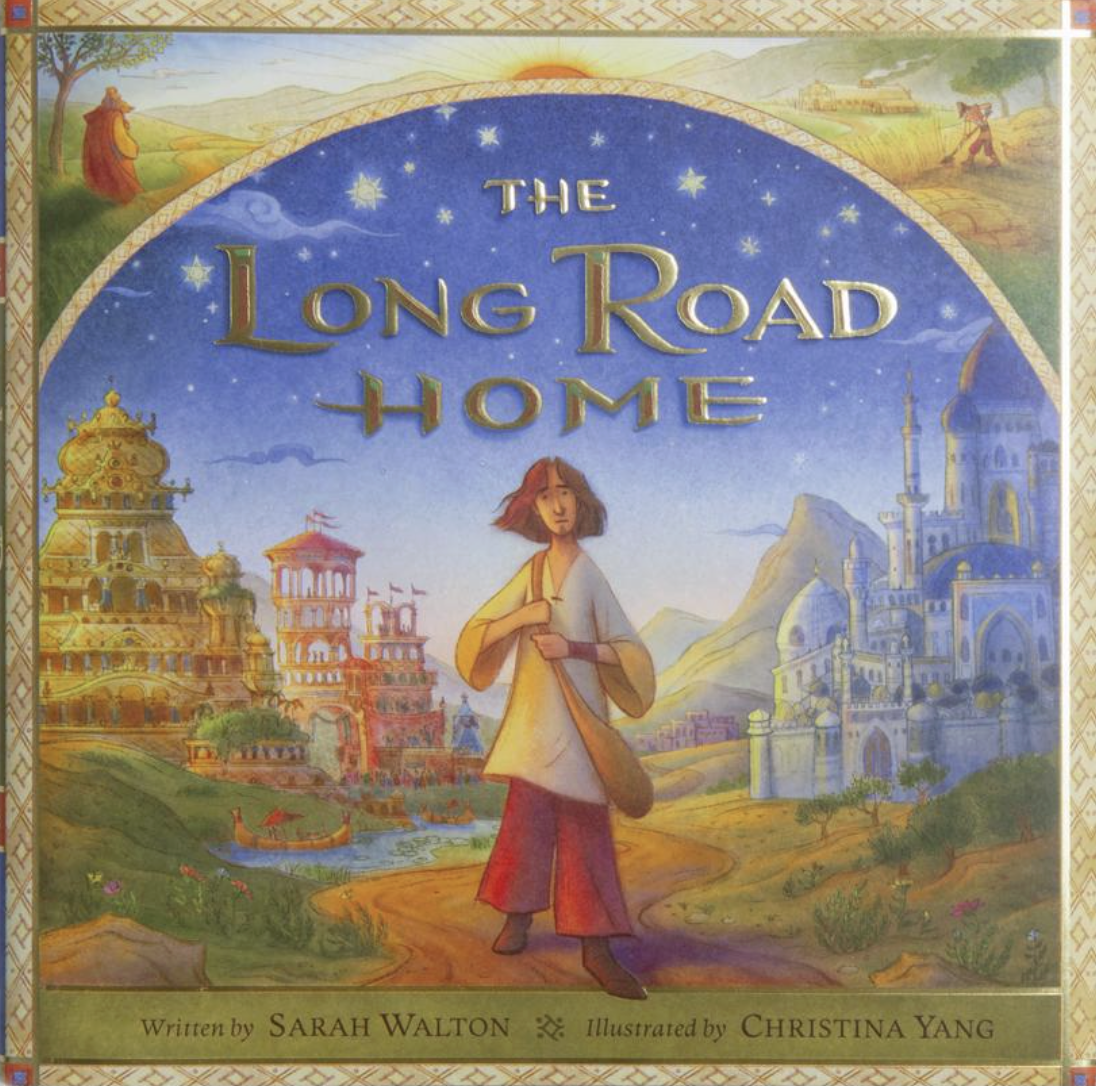
Sarah Walton’s The Long Road Home is a creative retelling of the parable of the prodigal son. In five chapters, she combines Jesus’ parable with John Bunyan’s famous allegory The Pilgrim’s Progress. This works really well, especially if your kids are familiar with Bunyan’s story, particular through Lithos Kids’ Little Pilgrim series. Walton uses allegory in the names of the towns Wanderer passes through: Perfection, Prosperity, Popularity, and Desperation, representing his spiritual journey.
Throughout the story, your kids get second-hand experience what the prodigal son learned: true joy is not found in the world, but in the never-ending love of the father who provides worth, hope, and identity when one trusts in him. The book focuses on Wanderer, the prodigal son/younger brother of the parable. His brother, Goodness, represents the self-righteous older brother.
Summary
After the introduction of the characters, Wanderer leaves home with his inheritance, the father affirms his never-ending love, and Goodness proudly judges his brother (ch 1). In chapter two, Wanderer searches for fulfillment in the towns of Perfection, Prosperity, and Popularity, where his pursuits of performance, riches, and fame fail him, leaving him exhausted. In chapter three, Wanderer is overwhelmed by shame and hunger in the Village of Desperation, symbolizing his spiritual emptiness. He remembers and finds a shaking-hope his father’s words of never-ending love. In chapter four, Wander walks back the same way he came, seeing the idolatrous towns as mere distractions. He prepares himself to beg for forgiveness, but before he even reaches the gate his father runs to meet him. The father interrupts his confession, embracing him with overwhelming joy, and commands a feast be held (out of his unconditional grace). Chapter five brings us to Goodness’ proud perspective. He now feels unappreciated, undervalued, and overlooked. The father seeks him out and reminds him that his value is rooted in his identity as a son, not in his complete “perfect” works.
A Never-Ending Love
The father tells his son about his never-ending love, and this is an oft-repeated line throughout the book on the son’s journey. This is a reminder that, no matter where he is, the father loves him and will take him back. As wonderful as this is, initially, this was the only thing in the book that I didn’t like. There are a number of levels to this. We don’t know quite what we can assume of what the original hearers of Jesus’ parable would have thought about the father in the parable. Was it natural for fathers in Israel to tell their sons they would love them forever (with a never-ending love)? At the same time, being a parable, Jesus flips the script and reveals to everyone that this father forgives his rebellious son, even throwing him a party like it’s 1699.
In teaching this to kids, it makes sense to add this line about the father’s never-ending love to his son. That’s what children need and long to hear. But it also isn’t seen in Jesus’ parable. The son asks for his part of the inheritance and then just leaves the family. The tension is that the hearers don’t know if the father will take back the son. On the other hand, the God of the Bible tells us continually not to fear, he is with us, and that he will never leave us nor forsake us. And yet, sometimes we may still fear coming to him out of trepidation that he will, this time, reject us.
The repetition of the father’s never-ending love, pointing to God’s never-ending love, in the end serves to teach children that God actually does love us with a never-ending forever love. The father didn’t offer Wanderer a job as a hired worker; he restored him as a son. Goodness complains about how he has been so good but has never been given a party in return. The father responds in grace that everything he has is the son’s too.
Recommended?
There is a note for parents at the end of the book that having answers to these struggles requires that one goes to the gospel. The only resolution to this is found in the hope of Christ. On our best and worst days, God the Father, through the sacrifice of his Son, stands ready to forgive and receive us. One way to strengthen this book would be to add this gospel focus to the end the story yet as part of the story itself. God’s never-ending love comes to us through Christ. Jesus’ parables were set within a larger story, that of his life, death, and resurrection. His parables give us only a snapshot of God’s character through a single angle. The Gospels give us the wide-angled view.
So make sure that you, the parent or Sunday School teacher, read the ending note for parents and emphasize what Christ did to answer the struggle that the sons in this parable experience. God’s grace is seen in the cross.
Buy it from Amazon or Crossway!
Lagniappe
- Author: Sarah Walton
- Hardcover: 56 pages
- Publisher: Crossway (October 2024)
- Read the Introduction and Chapter 1
Review Disclosure: I received this book free from Crossway. The opinions I have expressed are my own, and I was not required to write a positive review. I am disclosing this in accordance with the Federal Trade Commission’s 16 CFR, Part 255 http://www.access.gpo.gov/nara/cfr/waisidx_03/16cfr255_03.html.
Amazon Affiliate Disclosure: As an Amazon Associate I earn from qualifying purchases.
 spoiledmilks