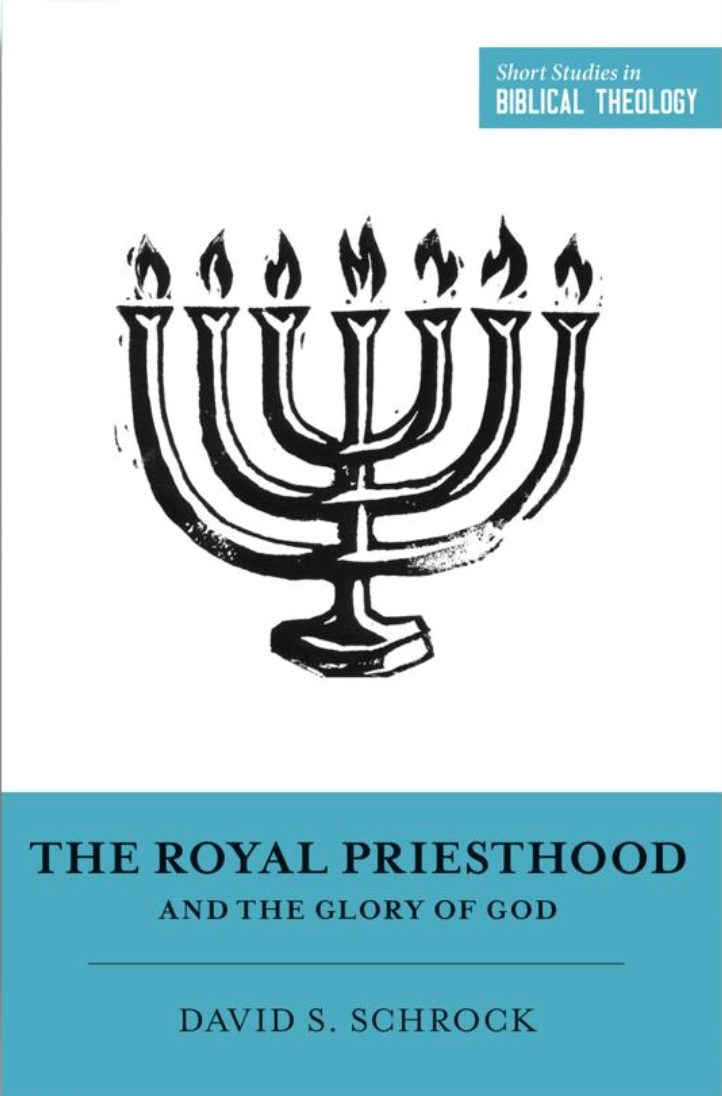

Having just reviewed Matthew Emadi’s The Royal Priest, I thought it would be a great time to read David Schrock’s Priest and Priesthood. Both of these guys come from the progressive covenantalism stream, so they view the Bible through a biblical-theological lens based on the covenants, the backbone of the Bible. They believe, rightly, that the New Testament authors understand the Old Testament, and that the connections they make are valid.
While Emadi’s volume focused on who Melchizedek is, how he fits into the Bible, and how he is connected to Jesus, Schrock surveys priesthood throughout the whole Bible (which, of course, includes a look at Melchizedek). Schrock writes,
“Priestly glory is also found when we enter the Bible. From the first use of the word in Genesis 14:18 (“Melchizedek . . . was priest of God Most High”) to the last in Revelation 20:6 (“Blessed and holy is the one who shares in the first resurrection!… they will be priests of God and of Christ”), priesthood is central to redemptive history” (16–17).
Understanding the purpose of the priesthood in the Bible will help us better understand God’s work of redemption. As the church shares in Christ’s royal priesthood, “learning what priests do is essential for discipleship” (17)
David Schrock is pastor for preaching and theology at Occoquan Bible Church in Woodbridge, Virginia. He is a founding faculty member at Indianapolis Theological Seminary, where he teaches theology.
In chapter one, Schrock looks at the creational design of priesthood in Genesis. Schrock shows how Adam, commissioned to “work and keep” the garden (Gen 2:15), was tasked to serve as a priest (service in God’s presence) and exercise dominion as a king (rule over the earth). Schrock surveys hints of this in Noah, the patriarchs, and Melchizedek.
In chapter two, Schrock moves to the conditional and provisional arrangement of the Aaronic/Levitical priesthood under the Mosaic Law. This system was designed for the specific needs of God’s covenant people after the fall. But it had its limitations, which, as Schrock shows, pointed to the future, better priest.
Chapter three moves through sections of both the historical books and the prophetic books, tracing how the priesthood ultimately failed to obey the God of the covenant after Sinai. The prophetic books show us the tension between compromised priests and prophets who called for repentance. The prophets also tell how God would establish an obedient, everlasting priest, who would work alongside the promised messianic King.
Chapter four brings us to the Writings (particularly the Psalms and Wisdom books) and their expectation for the messianic Royal Priest. The central text here is Psalm 110, which identifies the coming Messiah as a King and a priest forever after the order of Melchizedek. Schrock shows us that the Levitical cult was never the end, but a parenthesis until the new, eternal, and superior priest-king arrived.
In chapter five, Schrock analyzes how the Gospels present Jesus Christ as the great High Priest. Jesus’s actions are understood as priestly. His clean body is the ultimate sacrifice, he denounces the corrupt temple system, and as the perfect Son and perfect Israel he perfectly fulfills the necessary obedience. His covenantal obedience, sacrificial death, victorious resurrection, and heavenly intercession offer the basis for his eternal priesthood.
The final chapter explores the ecclesiological significance of Christ’s work by surveying the rest of the New Testament books. Schrock shows that believers become a “royal priesthood” (1 Pet 2:9) through their union with Christ. The church’s vocation fulfills Adam’s original commission. It rules by proclaiming the gospel (kingly function) and worship by offering spiritual sacrifices of praise and service (priestly function). This vocation will be fulfilled in the New Creation.
Schrock handles the Bible very carefully, and impressively makes many cross-testamental connections in such a short book. He ably takes a foreign and obscure theme, that of priesthood, and reveals its importance through seemingly boring passages about Adam, the Levitical system, and mysterious promises in the Psalms that are tie directly to Jesus and the New Testament church. Showing how the church picks up Adam’s role gives us an aim for our lives today. It can be all too easy to feel the daily grind of life, wondering what the real point of it all is. Schrock helps us realize our purpose in the world (witnessing) and toward God (worshiping). He does this by emphasizing Christ’s “better” work under the “better” New Covenant in the book of Hebrews, as well as how Jesus fulfills the purposes of the Tabernacle and Temple.
Recommended?
A few years back I reviewed Desi Alexander’s Face to Face with God. While informative, I would recommend Schrock’s book as a go-to resource on this topic. Although, depending on where you are in the your journey of understanding the Bible, it may be helpful to get your teeth into a few other short, biblical-theological writings first.
What I mean is, this book will either make a lot of sense or be a bit confusing. One doesn’t have to accept all of Schrock’s theological positions (which are within Progressive Covenantalism), but not all of his assertations can be fully developed (e.g., why the historical books [Joshua–Kings] and prophetic books [Isaiah–Malachi] are grouped together as “the Prophets,” or why some of the books within the Writings [Chronicles, Ezra–Nehemiah] are separated from the historical books). For more on that rationale, read Stephen Dempster’s Dominion and Dynasty.
That said, as someone who both has read plenty of biblical theological treatments and who agrees with the Progressive Covenantalist stream, this book was a true treat. Schrock does explain more of the church’s identity than the practical ways on how we can live out our identity. But knowing the biblical theological basis for our identity and function as the church gives us a place to start. This book comes highly recommended!
Buy it from Amazon or Crossway!
Lagniappe
- Author: David S. Schrock
- Hardcover: 208 pages
- Publisher: Crossway (February 2022)
- Read the Introduction and Chapter 1
- 10 Things You Should Know About the Presthood
Review Disclosure: I received this book free from Crossway. The opinions I have expressed are my own, and I was not required to write a positive review. I am disclosing this in accordance with the Federal Trade Commission’s 16 CFR, Part 255 http://www.access.gpo.gov/nara/cfr/waisidx_03/16cfr255_03.html.
Amazon Affiliate Disclosure: As an Amazon Associate I earn from qualifying purchases.
 spoiledmilks