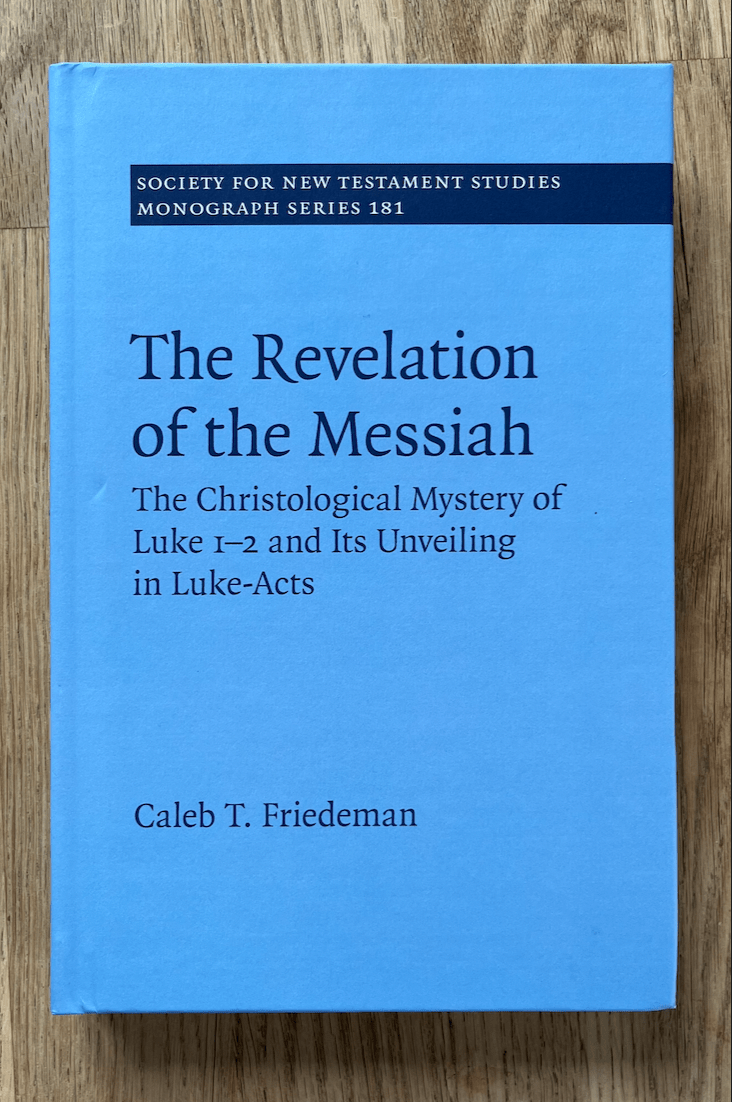

In Caleb Friedeman’s Revelation of the Messiah, he explores Luke’s infancy narrative (Luke 1–2), highlighting the paradox of how some recognize Jesus as Messiah while others in the rest of Luke’s Gospel remain ignorant. Friedeman argues that Luke presents a progressively revealed Christological mystery, preserved in Mary’s heart and fully unveiled after the resurrection.
Caleb Friedeman is David A. Case Chair of Theology and Ministry and Associate Professor of New Testament at Ohio Christian University. This monograph is a revision of his PhD dissertation at Wheaton.
In his introduction (ch. 1), Friedeman points out a paradox I had sensed before but couldn’t articulate. Zechariah, Elizabeth, Mary, Anna, and Simeon identify Jesus as Messiah, Son of God, and Lord (Lk 1:32–35; 2:11, 26). These titles echo Old Testament passages about YHWH and hint at Jesus’ divinity. Yet no other human characters understand who Jesus is until after his resurrection from the dead.
After surveying four scholarly solutions, Friedeman suggests that Luke presents a Christological mystery: the speeches of human characters exceed their own comprehension. God says more than they understand. Mary, like Daniel, preserves this mystery in her heart (2:19, 51), and others realize it after the resurrection (24:45). Luke presents a dual picture that (1) Jesus is the divine Messiah and Lord from the beginning and (2) as the narrative progresses, his identity is gradually revealed.
A few other things to note about this chapter would be that Friedeman assumes the unity of Luke–Acts, emphasizes narrative criticism and intertextuality, engages often with Daniel, and upholds divine Christology. That is, Jesus is the personal presence of Israel’s God. His point is to show how Luke’s infancy narrative foreshadows the entire drama of revelation in Luke–Acts.
The first two chapters of Luke unfold in seven episodes, each ending with inspired speech, whether that be angelic messages, prophetic hymns, Spirit-filled blessings, or Jesus’ first words. Friedeman shows that Luke 1–2 is primarily revelatory and establishes a pattern of revelation and concealment: the divine message is given but veiled and will be revealed later in Luke–Acts.
From this, chapter three develops the concept of veiled divine Christology. Inspired speakers declare Jesus to be Messiah, Son of God, and Lord, yet their comprehension is limited. For example, Elizabeth’s exclamation that Mary is “the mother of my Lord” (1:43) illustrates this theological depth: Jesus is not merely a master but the divine Lord. Inspired speech, like biblical prophecy, contains layers of meaning beyond human awareness.
This leads to chapter four, where Friedeman highlights Daniel as one of the key (inter)texts shaping Luke’s presentation of mystery. The angel Gabriel reflects Daniel 8–9 (the last time he was seen), showing that divine truths are revealed in part, sealed for later understanding, and fully unveiled at God’s appointed time. Luke uses these texts in Daniel to frame his infancy narrative as mystery revelation. Similarly, in Luke 1–2, the inspired speeches reveal Jesus’ identity as the divine Messiah, but their full meaning remains veiled until later revelation (Lk 24).
Chapter five focuses on how the mystery is preserved through Mary. Twice Luke notes that she treasured all these words in her heart (2:19, 51). Friedeman argues these statements are theological (rather than sentimental). Mary alone preserves the inspired speeches of Luke 1–2 for later interpretation, helping explain why other human characters are ignorant of who Jesus is. According to Friedeman, Mary functions like Daniel (cf. Dan 7:28), keeping the mystery until its time of unveiling. The statements about Mary treasuring these words in 2:19 and 2:51 function as a frame around the infancy narrative in order to highlight that the revelations are not immediately understood. In Acts 1:14, Mary is shown to be among the disciples (Acts 1:14), showing that she, too, comes to understand what she had preserved.
Chapter six connects Luke 1–2 to the rest of Luke–Acts. Friedeman gives a fuller account of how Luke’s Christological mystery is gradually unveiled and is only fully revealed after the resurrection. Peter confesses Jesus as the Messiah (9:20), but he does so without grasping Jesus’ suffering and divinity. Demons call Jesus the Son of God, but they do so in distorted ways. Even those who recognize him misunderstand his mission. The mystery is unveiled in Luke 24 when Jesus opens his disciples’ minds to understand the Scriptures (24:45), which his death and resurrection fulfill. After this, Acts portrays the community proclaiming Jesus as Lord and Messiah with full understanding, empowered by the Spirit.
Freideman’s final chapter, his conclusion, synthesizes the book’s argument, and he highlights three contributions. First, the narrative of Luke 1–2 is designed to be what it is. Second, Daniel provides a hermeneutical key for Luke’s presentation of mystery. Third, Mary’s role bridges revelation and unveiling. Throughout this, we see that Luke invites his readers to journey with the characters: to hear divine revelation, to wrestle with its mystery, to preserve God’s words in faith, and to experience full understanding of God in the person of Christ through his death and resurrection.
Recommended?
Friedeman’s book offers a fresh solution to the Christological puzzle of Luke 1–2. His insights into the intertextual use of Daniel offers a framework for mystery and revelation, making sense of what Luke is doing. I have noticed the similarity between Mary and Daniel before (even Jacob in Gen 37:11), but I haven’t known what to do with it. How does it shape what Luke is doing? Friedeman draws the connections and helps make sense of Luke 1–2.
Overall, Friedeman sets Luke’s introduction within Jewish apocalyptic traditions, elevates Mary’s role in discipleship and revelation for us today, and draws connections between Luke and Acts to show their coherence and the unity between them.
Buy it on Amazon or from Cambridge Uni Press!
Lagniappe
- Series: Society for New Testament Studies Monograph Series
- Author: Caleb T. Friedeman
- Paperback: 275 pages
- Publisher: Cambridge University Press (January 2023)
Review Disclosure: I received this book free from Cambridge University Press. The opinions I have expressed are my own, and I was not required to write a positive review. I am disclosing this in accordance with the Federal Trade Commission’s 16 CFR, Part 255 http://www.access.gpo.gov/nara/cfr/waisidx_03/16cfr255_03.html.
Amazon Affiliate Disclosure: As an Amazon Associate I earn from qualifying purchases.
 spoiledmilks