

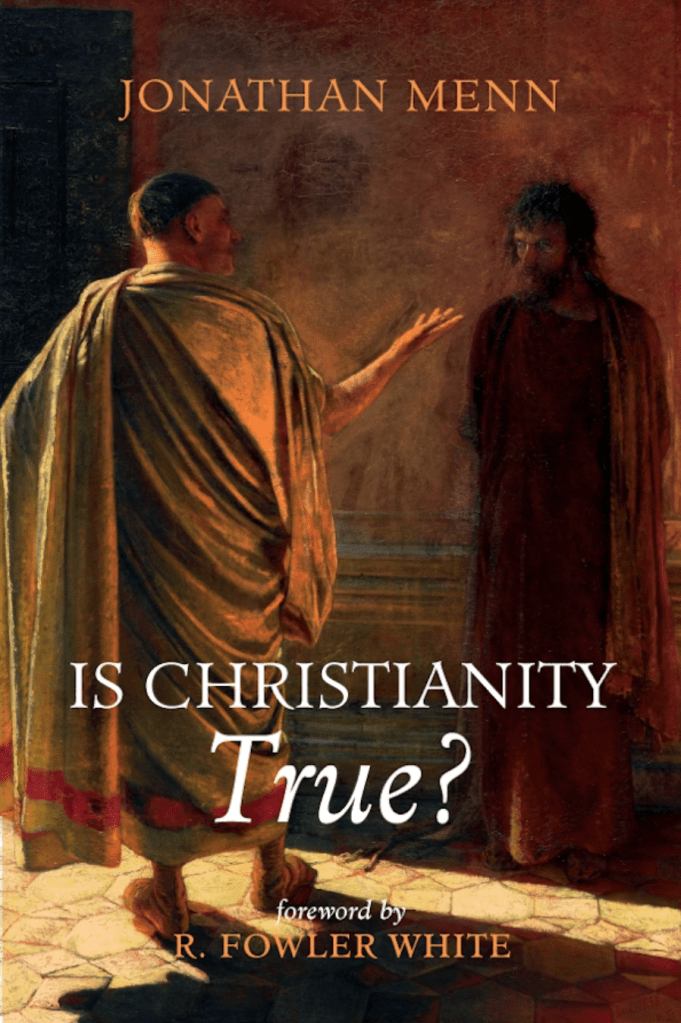
Can the Bible truly be trusted? Does Christianity make sense in a world dominated by science and skepticism? In this compelling work, Jonathan Menn tackles these questions head-on, offering historical, philosophical, and scientific arguments that defend Scripture and affirm the divinity of Jesus Christ. Years ago I got the opportunity to review Menn’s Biblical Eschatology (both editions!)—the gold standard. Here Menn shows his abilities again at clear thinking and writing in an important work of evidentialist apologetics.
Jonathan Menn has a JD froom Cornell law School and an MDiv from TEDS. He is the President of Equipping Church Leaders East Africa, Inc. (ECLEA), and he travels regularly to East Africa where he teaches pastors and church leaders.
In chapter one, Menn begins by establishing the Bible as the unique and trustworthy foundation of Christianity. Composed of 66 books, written by some 40 authors over the span of 1,500 years across three continents and languages, the Bible demonstrates an amazing unity. Menn stresses the uniqueness of the Bible as historically reliable, supported by archaeology, textual transmission, and fulfilled prophecy (see ch 3). Although skeptics claim it is full of errors, truly studying the Bible reveals contextual consistency. Jesus himself affirmed the Old Testament as the Word of God. Even narratives that moderns find difficult (such as Noah’s flood or Jonah and the whale) were regarded by Jesus as historical fact. The authority of all Scripture rests on Christ Himself. To accept Jesus but reject Scripture is logically inconsistent.
Chapter two argues that the existence and identity of Jesus Christ serve as the clearest demonstration that God exists. Jesus claimed divinity, and Scripture presents Him as God in the flesh.
After a survey of biblical texts affirming Christ’s deity (John 1:1; Col 2:9; Titus 2:13; Heb 1:8), Menn gives examples from the narratives that demonstrate Jesus’s divine attributes (miracles, authority over nature, forgiveness of sins, and His own resurrection). In addition, Jesus accepted worship from others, something that was reserved for God alone. Menn also discusses the doctrine of the Trinity.
In chapter three, Menn covers some of the 300 prophecies that detail Jesus’s lineage, birth, ministry, betrayal, crucifixion, and resurrection—something he could not have orchestrated himself (if he were a mere mortal man). The apologetic power is this: it makes Christianity historically verifiable. Biblical prophecy is specific, falsifiable, and fulfilled in history. It validates Scripture as divine and Jesus as the promised Messiah.
Chapters four through six cover the historical facts of Jesus’s crucifixion and resurrection. Menn argues against alternate theories of the crucifixion, such as the swoon theory or that put forth by the Qur’an. He rules out naturalistic explanations and presents the evidence for the resurrection being factual. One such example is the explosive birth of Christianity. No one at this time would follow a Messiah that had been embarrassingly crucified, and they certainly wouldn’t have lied about a resurrection. The Greco-Romans disregarded the physical body, and the Jews believed the resurrection was to take place at the end of the age. No one would believe this, unless it actually happened.
Chapters seven through eleven cover Christianity and science, or naturalism, to be more specific. Menn shows how Christianity and science are not at war with each other (which is really a byproduct of Enlightenment polemics), and many pioneers of science—Kepler, Newton, Pascal—were Christians motivated by theology. Science answers “how” questions, but Christianity explains “why” things are so (ch 7). Naturalism, more specifically, which holds that only matter and physical forces exist, is much more a philosophical presupposition than it is an empirical discovery (ch 8). It provides no meaning, purpose, or morality. Menn warns that if naturalism is true, then concepts like truth, love, or human rights are illusions—which is true. If we all evolved from animals who eat and kill the weaker, why isn’t it acceptable to do that today? What makes us so different?
Menn argues that naturalism is self-defeating. For example, it cannot justify induction—the assumption that the future will resemble the past (ch 9). Naturalism cannot explain laws of logic, mathematics, or morality. Menn highlights that, according to naturalism, we are nothing more than chemical processes. But if thought is nothing more than that, we lose any basis for trusting our reasoning. Reason is just something that seems to work, but just based on chemicals.
Chapter ten critiques naturalism, in the Darwinian guise. Menn outlines random mutation, natural selection, gradual change, and adaptation—principles that fail against the evidence we see from genetics, probability, and the fossil record. Genetic mutations are typically harmful or just neutral. They do not produce the vast amounts of new information needed for macroevolution. Fossils show abrupt appearances, not gradual change. Menn cites even leading scientists who acknowledge these problems, though many cling to evolution out of philosophical commitment to naturalism.
Chapter eleven brings the final blow—naturalism utterly fails to explain reality as we experience it. Menn surveys consciousness, morality, science, and meaning, and shows the inadequacies of naturalism.
It cannot explain the origin of the universe nor life itself. Consciousness and the mind, not to mention near-death experiences, dreams, and self-awareness, defy being reduced to mere material realities. These facts suggest humans are more than biochemical machines.
If God is all-good and all-powerful, why does evil exist? In chapter twelve, Menn grounds his argument in Scripture’s doctrine of providence: God is sovereign over all things, yet humans are responsible for their choices. Menn explains this through the doctrine of concurrence. That teaches that God works through secondary causes without being the author of sin. Like a playwright and characters, God ordains events while creatures remain accountable. Thus, God ordains evil for greater purposes, but He Himself remains holy.
The first Appendix lays out a clear summary of the Christian gospel. The second Appendix provides a table of biblical examples where the same event is attributed both to God and to human or natural agents. For instance, Joseph tells his brothers, “You meant evil against me, but God meant it for good” (Gen 50:20). This doctrine shows how God’s sovereignty and human responsibility coexist without contradiction. The third Appendix responds to Richard Dawkins’ famous objection, “Who created God?”
Recommended?
Menn provides a one-stop-apologetic-shop for proofs of the Bible and its claims about Jesus. Its claims are historically verifiable, and the alternative, naturalism, doesn’t hold water. But can the Bible account for suffering? Yes, it does, Menn argues. Even more so, the God of creation stepped into our world as a human and entered into death to save us. Jesus experienced the misery of the crucifixion so that we could join his family.
While some sections can be dense, Menn provides you with a full-orbed worldview that explains history, science, morality, and suffering. He presents historical and scientific proofs for his claims. He appeals to both biblical and non-Christian sources (like Tacitus and Josephus) regarding the crucifixion. And while he cites mathematical improbabilities, discontinuities in the fossil record, and the claims of leading scientists in his critique of evolution, Menn consistently anchors his arguments in the Bible.
Menn doesn’t caricature his opponents (skeptics like Dawkins and Hume). He presents their arguments, often in their own words, and then carefully deconstructs their argument. This shows respect for readers who may be sympathetic to those thinkers, which gives Menn more credibility.
This book will strengthen your confidence in Scripture and equip you in defending the authenticity and truth of God’s word. This book is not meant to be a club that you beat people over the head with. It is to give you the facts by which you can helpfully take off the blinders that lie over people’s eyes as you point them to Christ.
Buy it on Amazon or from Wipf & Stock!
Lagniappe
- Author: Jonathan Menn
- Paperback: 367 pages
- Publisher: Resource Publications (October 2024)
Review Disclosure: I received this book free from Wipf & Stock/Resource Publications. The opinions I have expressed are my own, and I was not required to write a positive review. I am disclosing this in accordance with the Federal Trade Commission’s 16 CFR, Part 255 http://www.access.gpo.gov/nara/cfr/waisidx_03/16cfr255_03.html.
Amazon Affiliate Disclosure: As an Amazon Associate I earn from qualifying purchases.
 spoiledmilks