
Summary
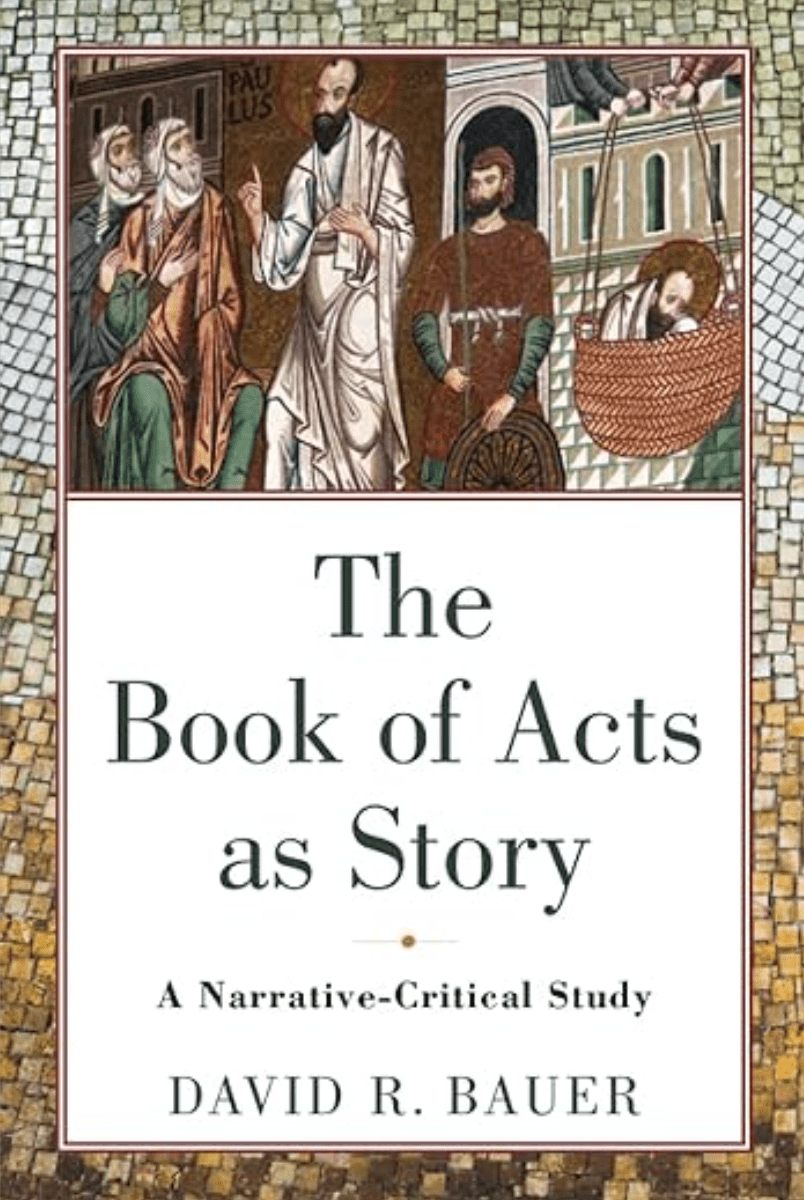
David Bauer’s The Book of Acts as Story reads the book of Acts as a unified, theologically rich narrative. This helps readers see how Luke crafted the story to highlight God’s mission through Jesus, the Spirit, and the early church.
How do we read the book of Acts? Is it mere history meant to inform us of how the church got from Point A to Point B? How should we derive our theology from it? Do we need another Pentecost (Acts 2:1–4)? Should we always split teams when we argue about someone’s fickle cousin (15:36–41)? Should we shake off any ol’ snake that bites us (28:3–6)? In his new book The Book of Acts as Story, David Bauer, through narrative analysis (“criticism”), seeks to discover how understanding a book’s narrative (or understanding it as narrative) can help us understand more accurately what the author of the narrative wished to communicate.
The first three chapters cover the book of Acts, narrative criticism as it relates to Acts, and the literary structure of Acts. The second “half” of the book divides Acts into four sections, covered by four chapters.
In Chapter 1, Bauer makes his case for reading Acts as a coherent, purposefully-written narrative. He argues that Acts functions primarily as narrative, bridging the life of Jesus (in Luke’s Gospel) with the life of the early Church. Bauer brings in narrative elements such as plot, characterization, and the roles of the implied author and reader (which I still have a hard time understanding the point of, at least when compared to the real author). This chapter sets up the analysis that follows in the rest of the book.
In Chapter 2, Bauer emphasizes that Acts is not just a collection of historical episodes or theological statements strewn about. It is a carefully crafted story. Bauer explains that narrative is composed of elements such as plot, characters, setting, point of view, and rhetorical strategies (he draws on literary theorists like Seymour Chatman and Boris Uspensky, whom I have never heard of). Bauer rightly critiques the older critical methods (source, form, redaction criticism). These methods treat the text as an ugly patchwork quilt of various tales and material pieced together haphazardly rather than a unified whole.
Bauer emphasizes the distinction between the implied author and the implied reader. The “implied author“ is not necessarily Luke himself (who is the real author) but the authorial presence discerned from the text—a literary construct that guides interpretation. (This concept is a bit ethereal, but it does make some sense.) Similarly, the implied reader is the ideal audience envisioned by the text. That is, it is the kind of person who perfectly understands the story’s narrative and theological logic and acts upon it. The actual reader (you and me) is invited to resemble this “implied reader” as closely as possible by entering the narrative world of Acts and embracing its values and vision for godly living.
In Acts, the real/implied author presents a coherent vision of God’s redemptive plan, continuity between Israel and the Church, and the empowering role of the Holy Spirit.
In Chapter 3, Bauer rejects traditional outlines based on characters (like a Peter/Paul distinction) or on geography alone. Instead, he emphasizes Acts 1:8 as the book’s structural and theological key (as do many others). The commission the disciples receive from Jesus—to be witnesses in Jerusalem, Judea and Samaria, and the ends of the earth—serves not only as an outline but as a guiding principle for the narrative’s progression.
Bauer points to internal signals like summary statements (e.g., Acts 6:7; 9:31), transitions, speeches, and repetition as signs of a carefully crafted narrative. These devices show that Luke wrote the book not just to report real events but to convey God’s sovereign, redemptive activity through storytelling.
According to Bauer, Acts’ prologue (1:1–5) links it to Luke’s Gospel and underscores its continuity with Jesus’ mission. The ascension (1:6–11) initiates a new phase in redemptive history where the risen Lord empowers his people through the Spirit. The story then unfolds in three movements based on Acts 1:8:
- the mission in Jerusalem (chs. 2–7),
- the spread to Judea and Samaria (chs. 8–12), and
- the expansion to the Gentile world (chs. 13–28), mostly through Paul’s ministry.
Bauer believes the Jerusalem Council (Acts 15) is a pivotal narrative moment. Beginning with Acts 10, there have been mounting tensions around Gentile inclusion and how to affirm the gospel’s universal scope. Yet we know that God himself directed the mission for we see visions, angels, and persecution throughout the book.
Chapters 4–7 serve as a full commentary on Acts. Rather than summarizing each of them, I will draw in a few highlights.
Examples
Peter’s Pentecost Sermon and the Gift of the Spirit (Acts 2)
When the Spirit is poured out, Peter doesn’t change Joel’s meaning, he explains that these days are “the last days.” This moment in time was the eschatological turning point of history. Joel referred to “calling upon the name of the Lord” as calling upon the name of Yahweh. But Jesus, the ascended Christ, is the Lord. Peter’s whole speech is central to the plot to the narrative of Acts (which Bauer draws out in much more detail).
Stephen’s Speech and Martyrdom (Acts 6–7)
Bauer understands Stephen’s speech to be the narrative climax of Acts 1–7. The Church’s witness to Jerusalem reaches its breaking point here. Stephen is the first non-apostle to be a central character proclaiming the gospel. This shows that the Spirit’s power extends beyond the twelve apostles. While Stephen performs signs and wonders, his speech to the Sanhedrin reveals the Spirit’s presence. Stephen reframes Israel’s story around their resistance to God. Israel’s identity as God’s people is questioned on their covenantal failure as well as their persistent opposition to God’s purposes. Stephen’s vision of the exalted Christ standing at God’s right hand affirms his testimony and the major theme that the risen Jesus remains the central actor in Acts. His standing conveys both approval of Stephen and active involvement in his martyrdom. This violent response—Stephen’s martyrdom—is a turning point in Acts: the gospel has now been definitively rejected by Jerusalem’s leaders. Saul’s introduction (8:1) links this scene to the next major movement of Acts.
The Spoiled Milks
Don’t expect much application here. Bauer encourages Christians to see themselves in Acts’ ongoing story, but more reflection on church life today would help us know how to apply the narrative of Acts. Bauer acknowledges the importance of character development (e.g., Peter, Paul, Barnabas), but he focuses more on plot and theme than how the characters actually develop. It would have been very interesting to see his take on how these characters developed (if they do at all).
Recommended?
Yes. Bauer’s book is a powerhouse that helps us understand Luke’s (or the implied author’s) train of thought throughout the whole book. This is extremely important and yet extremely difficult to follow in such a long book as this. What is Luke’s main idea? What is he trying to shape us into? It isn’t impossible to follow, but Bauer’s book is a huge help. This book is great for scholars, teachers, pastors, and even laypeople (although those who haven’t read much about narrative criticism may need to read these sections a few times).
If you want historical depth, pair with Keener (my review). For canonical and theological insight, pair with Schreiner (my review). If you want even more literary-narrative insights, pick up Tannehill’s work on Luke-Acts. Bauer differs in that he uses narrative to draw out the theological and canonical conclusions. Both are very handy. What Bauer offers, though, is a deeper look into Acts specifically (while still believing it follows after Luke).
Buy it on Amazon or from Baker Academic!
Lagniappe
- Author: David R. Bauer
- Paperback: 304 pages
- Publisher: Baker Academic (July 2021)
Review Disclosure: I received this book free from Baker Academic. The opinions I have expressed are my own, and I was not required to write a positive review. I am disclosing this in accordance with the Federal Trade Commission’s 16 CFR, Part 255 http://www.access.gpo.gov/nara/cfr/waisidx_03/16cfr255_03.html.
Amazon Affiliate Disclosure: As an Amazon Associate I earn from qualifying purchases.
 spoiledmilks