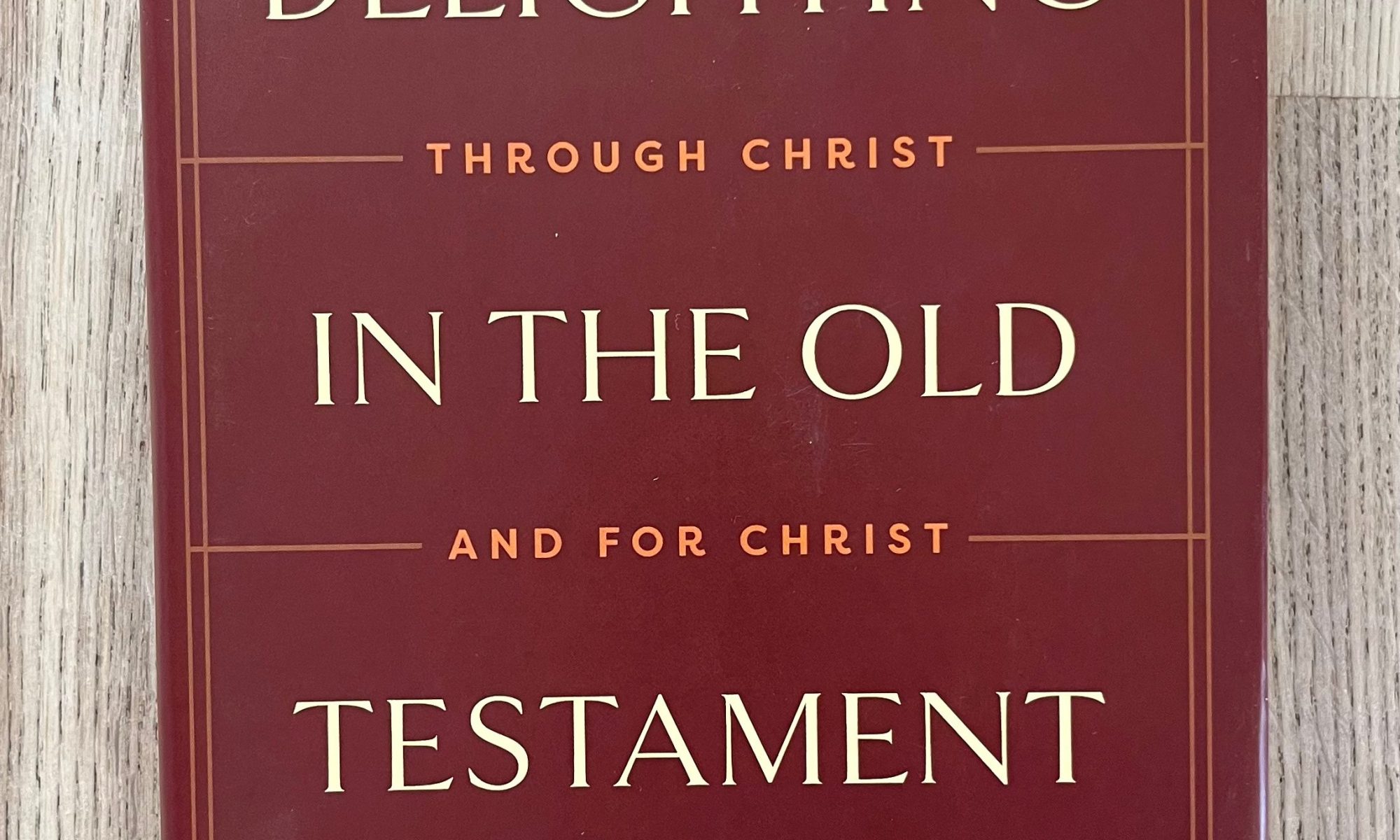


Years ago at Calvary Chapel Bible College York I had to read Michael Reeves’ Delighting in the Trinity for my theology class. It blew my mind. It was an incredible book that opened up the importance and necessity of the Trinity, and the comfort found in the Triune God. The content of the book went above and beyond in answering the question that came to mind when I first read the title, “Can we delight in the Trinity?” DeRouchie’s book does the same for the Old Testament that Reeves’ book did for the Trinity. Yes, we Christians really can delight in the Old Testament.
Jason DeRouchie is a research professor of Old Testament and biblical theology at Midwestern Baptist Theological Seminary and Spurgeon College.
DeRouchie’s book is set up along four parts, covering thirteen chapters before ending with a conclusion.
Part One: Read Well
Both the New and Old Testaments affirm the Old Testament was written for the messianic age. The Old Testament points to Jesus. The veil that covers our understanding is only lifted in Christ (2 Cor. 3:14). The three chapters in this section lay the foundation for Christ-centered interpretation, insisting that Christians, Spirit-indwelled Christ followers, have unique access to the OT’s full meaning.
These chapters show that Christians will understand the OT better if they value it just as Jesus did, a foundational revelation of God’s character and of his redemptive mission (ch 1). With that view, we will better understand the way Jesus interpreted His mission (through the OT texts) and understood how he fulfilled the OT prophecies (ch 2). Chapter three focuses on how the whole of the OT was written for our instruction, hope, and endurance (Rom 15:4; 1 Cor 10:11). These texts shape our Christian identity, our understanding of God, and how holiness should look. DeRouchie offers a typological approach that helps us apply the OT without falling into moralism or legalism. (See his How to Understand and Apply the Old Testament for more.)
Part Two: See Well
Rather than being hidden in the Old Testament, Jesus is proclaimed through it. He is not some hidden figure but the center of God’s self-revelation. Through these three chapters, DeRouchie trains us to see how Jesus is revealed in the Old Testament through prophecy, typology, structure, and storyline.
DeRouchie teaches us how the OT both pointed to Christ and is incomplete without him. He presents the biblical storyline through his KINGDOM acronym, which makes sense but I still found difficult to remember. Partly this could be due to my own busy life, as well as the fact that almost every author who puts the Bible together has a different acronym. What DeRouchie does do well is show how God’s glory is revealed through Christ in each section. DeRouchie helps us to see that Jesus is not only the climax but the center of God’s story (ch 4). Chapter five acts as a hermeneutical guide for us, offering seven ways we can see Jesus in the OT—such as typology, patterns, and the covenants. Jesus is found throughout the whole OT, not merely in its more obvious prophecies (Isa 53; Ps 22). Chapter six offers an illuminating case study on Genesis to show how the book sets the theological foundation for the rest of Scripture. It anticipates Christ’s person and work as the One who would bring blessing to all nations.
Part Three: Hope Well
Since all of God’s promises are “Yes” in Christ, DeRouchie addresses how Christians should understand Old Testament promises. It helps readers avoid overclaiming or underclaiming God’s promises. Instead, we should see his promises as gospel-saturated truths that sustain faith and holiness.
How can Christians “claim” OT promises without following the “gospel” of prosperity? Understanding the covenants is key to this question. DeRouchie shows that many of the OT promises were given within specific covenantal arrangements (such as the Mosaic Covenant). Such promises cannot simply be transferred to new covenant believers. We need to understand what the new covenant entails by having a Christ-centered reading, recognizing how Jesus (1) secures, (2) transforms, or (3) fulfills OT promises (ch 7).
Chapter 8 follows up on chapter 7. In it DeRouchie introduces three categories for understanding OT promises:
- maintained (extended/unextended) promises upheld directly or indirectly in Christ (e.g., God’s presence or blessing);
- transformed promises (like the land) are fulfilled in Christ’s cosmic reign over the earth and ultimately in the new creation;
- completed promises (like the atonement) were fulfilled in Christ’s first coming.
DeRouchie shows how the NT authors (DeRouchie focuses most on Paul) viewed the OT promises as having ongoing relevance filtered through Christ’s person and work. Chapter 9 applies these categories to practical examples such as light, presence, dwelling, and Israel’s blessings and shows how they are applied to the church through Christ.
Part Four: Live Well
What are Christians today supposed to do with the law of Moses? Christians are no longer under the Old (Mosaic) Covenant; however, the law still instructs us because it reveals God’s character, love, and concern for justice to us. DeRouchie evaluates other views like theonomy and classic Reformed tri-partite division (moral, civil, ceremonial), dispensationalism, and antinomianism. Instead, he proposes a Christocentric alternative with case studies showing how Jesus maintains, transforms, or annuls specific laws.
This section will likely interest the majority of Christians merely because we often don’t know what to do with the OT laws! DeRouchie advocates neither for legalism nor libertarianism, but joyful obedience grounded in gospel grace. We do not use the laws as a ladder to climb to God. Instead, they are windows into His holy character to understand his loving intent for human flourishing.
DeRouchie concludes with seven tips for reading and delighting in the OT for the purpose of worship that is fueled by God’s word.
The Chocolate Milks
For being as academic as he is, DeRouchie understands wide swaths of the OT in minute detail and yet can write clearly, carefully, and with care for you to understand God’s word fully. DeRouchie is able to follow the flow of the covenants, how both the OT and NT authors understood the OT, and how we should understand and apply the OT laws and promises. DeRouchie’s “Christ-centered lens” is not something you tack on to your Bible, as if to turn every stone into a rock crying out to Jesus. It is the framework to understanding the whole Bible. This book will really turn your Bible reading upside down if you let it (along with the book mentioned above, see his What the Old Testament Authors Really Cared About).
The Spoiled Milks
That isn’t to say this book is a walk in the park, though. Many laypeople aren’t familiar with terms like “typology,” “covenantal administration,” and “Christotelic.” A fuller explanation to how DeRouchie understands these sorts of terms would make this book more legible for the uninitiated. As well, what we could hope for in a follow up volume would be a focus on the difficult and strange OT laws, particularly dealing with holy war, slavery, and strange laws about women. It may seem obvious that we shouldn’t keep the holy war laws since we aren’t a theocratic nation state under God, but then how do we know which OT laws we should contextualize and apply (such as Deut 22:5) and, then again, which ones we shouldn’t?
Recommended?
This is a terrific volume that I can highly recommend. DeRouchie argues well for the progressive covenantalist lens without making it explicit (all references to anything PC are left in the footnotes). He argues for the biblical notion that the whole Bible actually points to Jesus and then shows you how it does so. He offers helps all throughout the book to understand how the Bible does just that.
Buy it from Amazon or Crossway!
Lagniappe
- Author: Jason S. DeRouchie
- Hardcover: 368 pages
- Publisher: Crossway (February 2024)
- Read the Introduction and Chapter 1
Review Disclosure: I received this book free from Crossway. The opinions I have expressed are my own, and I was not required to write a positive review. I am disclosing this in accordance with the Federal Trade Commission’s 16 CFR, Part 255 http://www.access.gpo.gov/nara/cfr/waisidx_03/16cfr255_03.html.
Amazon Affiliate Disclosure: As an Amazon Associate I earn from qualifying purchases.
 spoiledmilks