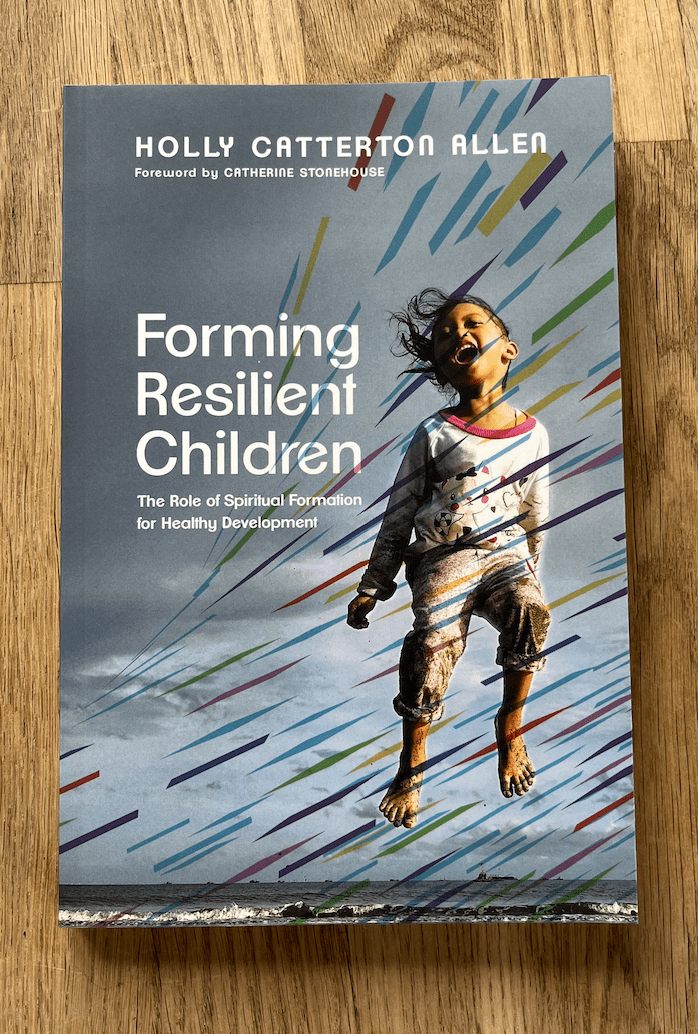


Holly Allen—formerly Professor of Christian ministries and family studies at Lipscomb University—cares about children—your children—and wants to see them not just survive life, but thrive in it. But life is tough, and at worst it can be filled with all sorts of brutality and evil. How can we raise our children to be resilient in all of life’s challenges, and how can we help those children (sometimes even our own) who have gone through unspeakable evils?
Overview
Allen believes that all children are born with an innate sense for spirituality (think of Blaise Pascal’s idea of a “God-shaped hole” in all of us, an idea later used by C.S. Lewis). She explores how nurturing a child’s spirituality can promote resilience in both Christian and secular environments. One of her big emphases is on nurturing children’s relationships with themselves, others, and God.
Part One looks at the foundational concepts that form the basis of Allen’s book. She defines children’s spirituality and a Christian understanding of spiritual formation (ch 1), Defines resilience and what it means (ch 2), and shows how spirituality and resilience are mutually supportive (ch 3).
Part Two covers how families help in forming resilience in children, offering practical tools for parents (ch 4) and for grandparents (ch 5).
Part Three highlights how resilience can be fostered in Christian settings—intergenerational faith communities (such as church—ch 6) and how Sunday School ought to teach children to know God as they engage with his story (ch 7). Chapter 8 surveys ways we can integrate the body and spirit connection through practices like prayer, dance, and labyrinths. While I’m not big on dancing and I’m skeptical to labyrinths, connecting the entire body God has given us is important for being a whole person. Chapter 9 focuses on cultivating wonder. Allen encourages connecting children’s grand sense of wonder with Godly Play, posing questions about a Bible story to help kids meditate on that story.
Part Four highlights how to support children who have experienced severe trauma (ch 10) or grief and loss (ch 11). To care for them as whole people, they need holistic care—physical, emotional, social, and spiritual resources. This can be done by walking alongside a child as they process their trauma and helping them make meaning out of loss, give them hope for the future (see ch 13 for more on hope), and reading books with them.
In chapter 12 Allen lists good books that can help spark conversations and help nurture children’s relationships with themselves, others, and God. Chapter 13 ends by looking at how hope carries and sustains one’s resilience.
The Chocolate Milk
Allen provides compelling evidence for what parents, relatives, and close friends can contribute to building up a child’s resilience to and endurance through life’s hardships. Her research highlights that resilience is not merely an internal trait only certain children are born with. It is formed through relationships within church communities, families, and supportive adult-child relationships (such as the intergenerational care, nurture, and advice in a church as seen in ch. 6). This book will benefit Christian educators, counselors, and Sunday school leaders.
In one way, there is a lot here that today, four years after this book was published, you could find on Instagram. This would be the advice to be calm with your children even when they (and you) are upset, the encouragement to get up and play with them, or validating their unnuanced feelings.
However, Instagram is flooded with “advice,” and not all of it is backed by long-term evidence to show it as helpful as it claims to be. While I can’t guarantee her conclusions will foster resilience in your children over time, Allen’s advice comes with the evidence to back it up. She grounds her work in developmental psychology, trauma studies, and spiritual formation research.
Allen blends practical strategies with theological reflection and developmental psychology so parents and caretakers can have both a better understanding of how a child’s mind works and so they can have some strategies on how to help form resilience into their children through the Christian faith and their relationships.
Through Allen’s book, one can also so that you don’t need to do things with your kids all day along (contra Instagram, which claims the same thing but shows otherwise). Of course it’s great to play with your kids, but Allen shows that it is being intentional that helps children thrive. We can’t keep them from difficult things in life, but we can walk with them and be a safe place for them to talk, feel, and worry.
Allen includes the broader community’s role in this too (“it takes a village”). Her book is grounded in the idea that Christian communities form children together, not just through random individual strategies parents have. Allen explores how children’s spirituality and resilience are intertwined, and how God’s presence is made known through both a child’s parents but also through trusted adults.
Although I would have liked seeing more explicit references to “Jesus” instead of the vague “God” and the generic term “spirituality,” but I understand that the aim of her book was to religious communities generally and Christians specifically.
Recommended?
Forming Resilient Children offers compassionate and research-backed guidance based in hope and the Christian community. Allen’s book is backed with theology and children’s psychology with an emphasis on how faith communities and spiritual practices shape long-term resilience.
If you want to start with an easier book on discipline and building resilience, pick up Kathy Koch’s Resilient Kids (and her Parent Differently). Then come around and grab Allen’s book for long-term resilience. Allen provides a broader communal vision, while Koch offers tools for day-to-day parenting.
Buy it on Amazon or from IVP Academic
Lagniappe
- Author: Holly Catterton Allen
- Paperback: 200 pages
- Publisher: IVP Academic (September 21, 2021)
Disclosure: I received this book free from IVP Academic. The opinions I have expressed are my own, and I was not required to write a positive review. I am disclosing this in accordance with the Federal Trade Commission’s 16 CFR, Part 255 http://www.access.gpo.gov/nara/cfr/waisidx_03/16cfr255_03.html.
Amazon Affiliate Disclosure: As an Amazon Associate I earn from qualifying purchases.
 spoiledmilks