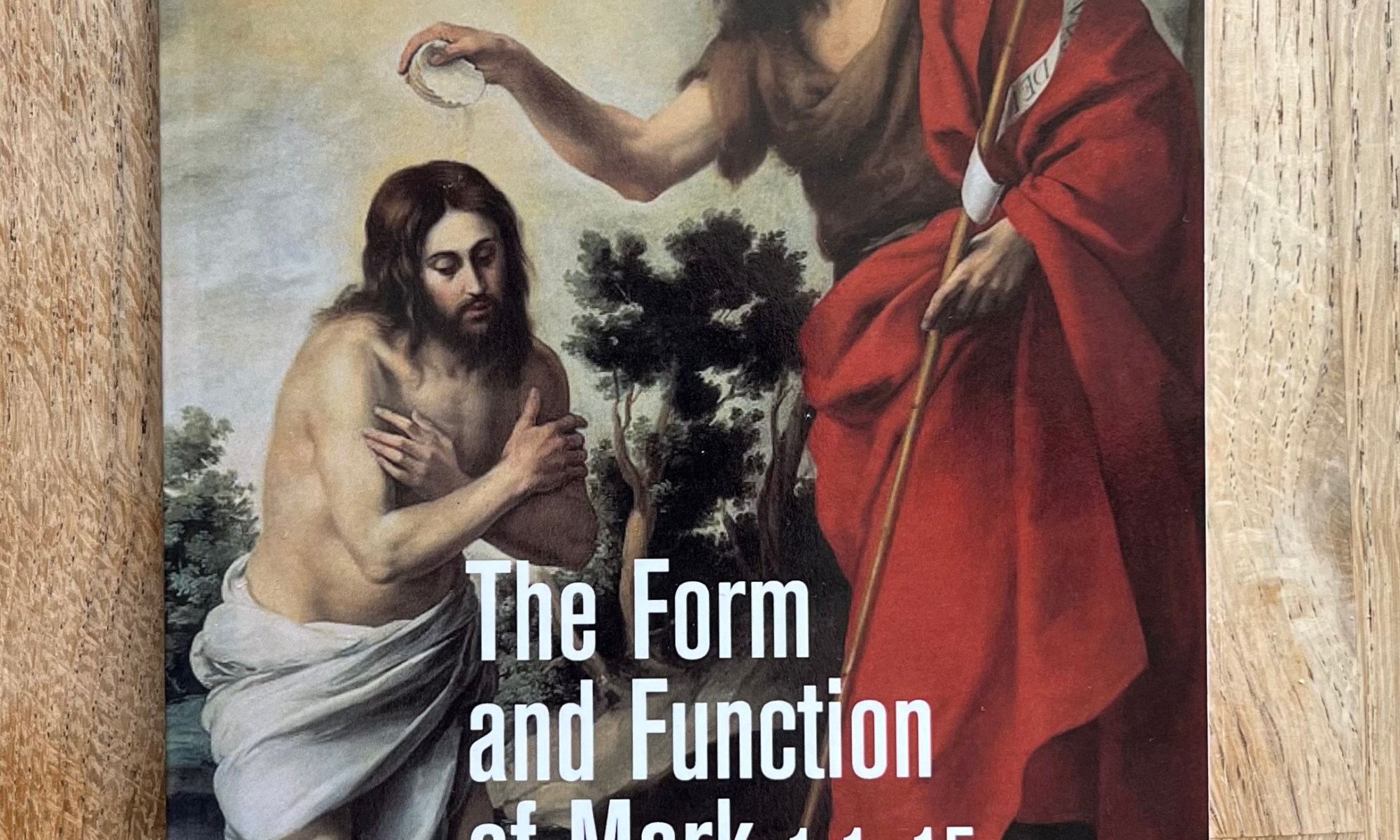


Mark begins his Gospel with the statement, “The beginning of the gospel of Jesus Christ, the Son of God” (1:1). Bradley Johnson notes that almost everything about Mark 1:1–15 has been debated by scholars. What does the word “beginning” mean at the beginning of Mark’s Gospel? Does this beginning end at v.8, v.11, or v.15? Is this similar to ancient biography, or did Mark write a different kind of document? To some, this might seem like a pedantic point, an unnecessary splitting of hairs. But the better we can define a passage’s boundaries, the better we can interpret it. In his book, Johnson proposes that Mark 1:1–15 is (1) a definable literary unit that (2) performs a rhetorical function (xv).
Bradley Johnson is Affiliate Professor at Asbury Theological Seminary and pastor of Wesley Chapel United Methodist Church.
In Chapter one, Johnson surveys recent scholarship and how scholars understand Mark’s introduction. He highlights the function of literary devices like prologues and summary statements as seen in Mark, as well as how the different analyses of narrative, genre, and rhetorical criticism are understood. He ends this chapter by noting that there is “clearly no consensus as to what constitutes the extent of Mark’s opening unit” (29). If that is so, then “there can be no clear consensus as to what Mark’s purpose—if any—may have been in drafting his opening material.” Johnson aims to show that, with Mark 1:1–15 as the opening unit, Mark legitimates Jesus as the Anointed Son of God.
In Chapter two, Johnson gets into the weeds of Mark 1:1–15. He begins with a textual analysis of important words or phrases and their textual variants, such as the debated phrase “Son of God” in Mark 1:1, whether Mark wrote “written in Isaiah the prophet” or “written in the prophets” in 1:2, among others.
Johnson then offers a syntactical analysis that pays attention to Mark’s main and subordinate clauses and conjunctions in order to show in what way Mark 1:1 is connected to 1:2–3. Johnson offers compelling evidence that Mark 1:1 is a coherent title of Mark’s prologue and that it is syntactically independent of 1:2–3.
He then gives a clausal analysis, focusing on the subject–verb relationship. This type of relationship can be seen as the individual bones of a skeleton, while the remainder of the text (prepositions, conjunctions, dependent clauses) is likened to the narrative’s flesh. Doing this highlights the grammatical roles of John and Jesus, when they appear, and when Jesus steps out on his own (1:14). The prior verses show us that “God is behind the scenes orchestrating matters for his son” (49).
After this, Johnson presents a literary analysis of 1:1–15. This type of thing is my favorite sort to read. Johnson notes the “good news” inclusio of 1:1 and 1:14–15; the recurring words and motifs of the wilderness language, baptism and repentance, and numerous other words; temporal markers; parallelism between John and Jesus; and the distinct break between v.15 with the following vv.16–20.
Chapter three moves behind the text as Johnson looks at the rhetorical function of this passage and how it would have been understood in Mark’s milieu. Johnson begins with “the aural nature of the NT world,” how Mark’s Gospel would have been heard before it was read (66). He compares Mark’s rhetoric with ancient Greco-Roman rhetoric, a common academic discipline then. At the end of the chapter, Johnson offers a few examples of Mark’s simple rhetoric in his prologue. These are basic examples in terms of rhetoric because Mark’s rhetoric “is of the more basic variety” (66).
In Chapter four, Johnson summarizes the ancient biographies Richard Burridge used in his book What Are the Gospels?. Johnson compares these works to identify both their shared elements and their points of divergence before comparing his findings with Mark’s Gospel. What he discovers is that Mark’s Gospel is both like and unlike these ancient Greco-Roman biographies. He writes, “Where Mark resembles such biographies, it resembles them strongly; but where it differs, it differs just as strongly” (110). Mark gives us no explicit purpose statement, but as Johnson shows, “biographies do not exist without purpose” (113). Mark’s purpose lies in his opening remarks. Yet it is here where Mark’s Gospel differs drastically from ancient biographies. What we can see is that Jesus is the “duly authorized representative of God on earth. Mark presents Jesus as the Son of God” (114). This is not done through human means, but through the work of the Spirit.
In Chapter five, Johnson provides us with the function or purpose of Mark’s prologue. If the boundary markers are 1:1–15 (not ending at v.13 as some believe), what difference does it make? What is Mark trying to explain to us in this section? Johnson gives the most space to the first four verses, because that is where the more significant scholarly issues arise. His conclusion summarizes his chapters, gives reasons for how Mark’s prologue prepares us for the rest of the Gospel (155–156), and suggests avenues for further study.
Recommended?
Johnson’s book takes us through different alleyways to understand Mark’s prologue. We are taken through, alongside, and behind the text. We read the text and may even consider listening to the text. While many might think it’s a bit too much to write a book on where Mark’s prologue actually ends, this is all part of biblical studies. How do we read the Bible? Did the authors write well enough so that we can know when sections end and new ones begin? Johnson proves that yes, we can know from Mark where the prologue ends, and it clearly gives us a guide to the main ideas of Mark’s Gospel.
Buy it on Amazon or from Pickwick Publications!
Lagniappe
- Author: Bradley T. Johnson
- Paperback: 173 pages
- Publisher: Pickwick Publications (October 2017)
Review Disclosure: I received this book free from Wipf & Stock. The opinions I have expressed are my own, and I was not required to write a positive review. I am disclosing this in accordance with the Federal Trade Commission’s 16 CFR, Part 255 http://www.access.gpo.gov/nara/cfr/waisidx_03/16cfr255_03.html.
Amazon Affiliate Disclosure: As an Amazon Associate I earn from qualifying purchases.
 spoiledmilks