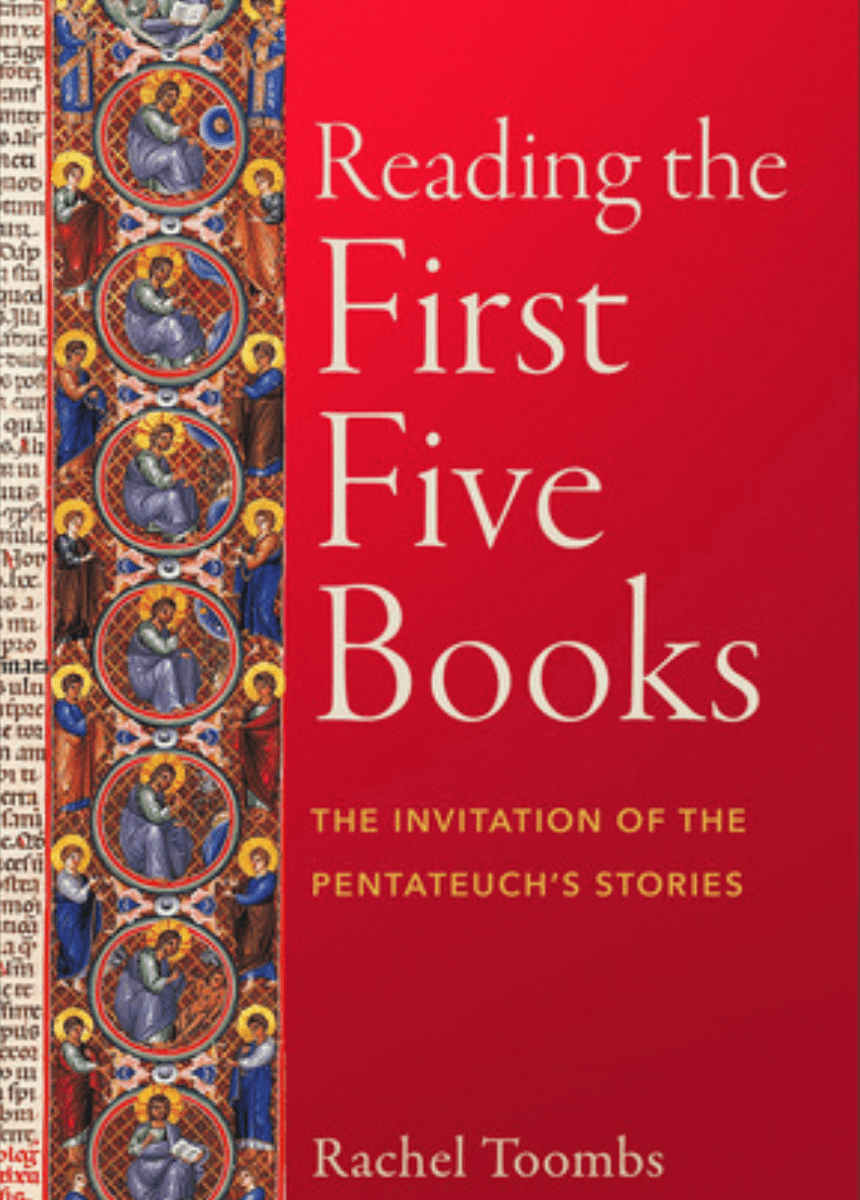

The Bible has impacted society for thousands of years, from the way we care for the poor and helpless to influencing philosophy and human rights. Why then do many Christians dread restarting their Bible reading plans each January and diving into the Pentateuch? With long lists of genealogies, laws, instructions, songs without melodies, and wars with the same different nations again and again, many Christians loathe renewing their Bible reading plan at the beginning of the new year.
Rachel Toombs—Assistant Professor of Old Testament at Church Divinity School of the Pacific—invites us to be changed through the act of reading (Chapter One). According to Flannery O’Connor, “[A] story is a way to say something that can’t be said any other way.”
The Pentateuch wasn’t meant to be skimmed for moral lessons or theological bullet points. It is rich, complex, and at times frustrating literature, and it needs to be read slowly, with both imagination and curiosity.
Toombs walks the line between overconfidence in interpreting Scripture and total subjectivity. She critiques the Chicago Statements (1978 and 1982) on biblical inerrancy and hermeneutics, especially the tendency to treat the Bible like a science textbook that has always just one “correct” meaning. Instead, she encourages us to read with humility, aware that we bring our own backgrounds and assumptions to the text. Reading is an event, she says. The meaning emerges in the dynamic space between text and reader.
Initially, I was skeptical when I read this. Toombs seemed to lean more toward a reader-response sort of interpretation. But she doesn’t go quite that far, even though she has scattered comments throughout that seem to lean that way. She simply doesn’t want us to come to the text looking for “the” answer, as if truth were a peanut hidden inside a shell that we just need to crack. Instead, readers inch toward the text’s meaning(s), and through the process, we are transformed.
On the one hand, we want our interpretations to be as correct as possible because that affects how we interpret other texts. We want our interpretation of a particular text to make sense so that it matches with the author’s intentions (see Hamilton’s excellent Typology) of other texts. But reading the Bible isn’t an exact science either. Peter Leithart is a good example of what it looks like to bring imagination to understanding the text. While some of his views are real head-scratchers, many of his connections are brilliant. He has imbibed (eaten) the Bible (see chapter 7).
Toombs explores how the Pentateuch communicates through brevity (ch 2), pacing (ch 3), characterization (ch 4), complex character development (ch 5), the grotesque (ch 6), and how to internalize these stories (ch 7).
Chapters Two and Three covers brevity and pacing, where Toombs asks, “Why is it that the most climactic and central moments of ancient Israel’s identity frequently take up significantly less space than more mundane events, descriptions, and instructions?” We need to pay attention to the pacing of the text and where the narrative time slows down. God makes all of creation in the first two chapters, but Genesis 3 spends a lot of time on two conversations: a temptation (3:1–7) and a declaration of judgment (3:8–20).
This was a fine chapter with a strong focus on both the sparse quality of Hebrew narratives and the function of the Hebrew wayyiqtol in those narratives. But English-only readers of the Bible will not benefit from that because they won’t know when the wayyiqtol is glossed over in English.
Chapter Four covers characterization. In narratives this includes details about one’s physical description, temperament, and inner emotions. We aren’t given many details about most characters in the Bible, and as a result, Toombs argues, “We get to know these central characters through our imaginations.” We have to learn how the biblical storytellers present their characters.
The second half of this chapter looks at God in the Pentateuch, who is “not simply another character in this cast” of motley characters. This section was, unfortunately, quite generic. All three sections (Exodus 3, the burning bush; Exod 4, Zipporah appeases God’s wrath; and Exod 19 and 24, theophanies on Mt. Sinai) repeat the stories while showing little of its characterization of God. For example, in Exodus 4:24–26 where God comes to Kill Moses (or his adult son Gershom?) at night, in the narrative “God is presented as elusive yet discernable.” Yes, but is that all?
While Zipporah can understand and negotiate with God, do we understand him here? What about his character do we explicitly see here? While it is an odd scene, the author of Exodus seems to assume that Moses knew about Genesis 17:14, “Any uncircumcised male, who has not been circumcised in the flesh, will be cut off from his people; he has broken my covenant.” Moses knew this, and yet had not acted upon this belief. His adult son Gershom had remained uncircumcised. If Moses would redeem Israel, he had to follow the covenant God made with Abraham.
In Chapter Five, Toombs delves into the nuanced nature of character development in the Pentateuch. Rather than portraying biblical figures as either saints or villains, Toombs emphasizes that these characters mirror real human beings—flawed, layered, and morally ambiguous. In this chapter, Toombs surveys Genesis 27, the narrative of Jacob stealing Esau’s blessing, which involves all four main family members—Isaac, Rebekah, Esau, and Jacob.
In Chapter Six, “The Grotesque,” Toombs explores how the disturbing, scandalous, and grotesque aspects of Scripture serve a deeper theological and narrative function. Most want to avoid the unsettling bits of the Bible, but Toombs argues that these pieces are essential to understanding the profound mystery of God’s interaction with a broken world, even if it is paradoxical. Toombs brings in insights from Flannery O’Connor who argues that the real problem occurs when moral confusion occurs—when wrong is portrayed as right and vice versa.
Toombs ends with a case study of Numbers 16 and Korah’s rebellion. She again uses a lot of space retelling the story and noting the shocking bits (like how the “little ones” stand with the guilty and their family). But how we are to understand God through this scene is still foggy, at least based on what Toombs writes. She helps set this story within the wider context of Moses as God’s chosen prophet who would lead God’s people into God’s land. However, how we should understand the grotesque parts of this story and what we should do with them, which is what this chapter is about, isn’t really touched on.
In Chapter Seven, Toombs looks at Deuteronomy (among other texts) and Moses’ commands to remember Israel’s past and (rep)eat their stories. They should internalize these stories as God’s special people and remind each other of God’s dealings with them. Storytelling shapes the identity, faith, and obedience of God’s people. We are meant to “eat” these stories—to take them in, live them out, and let them shape our lives.
Recommended?
Toombs doesn’t disregard that texts have meaning, but she wants us to dive into them and struggle with them. This is something I need to learn myself. I prefer picking up biblical theologies and commentaries to understand the Bible’s meaning than sitting and wrestling with it myself. Toombs pushes against microwave answers. We come to the text with pre-understandings or prejudgments, and we have to be willing to allow the text to shape our minds. If we impose our pre-understandings on the Bible without letting the Bible shape us, we will misunderstand the Bible and, thus, misunderstand God.
We are transformed by wrestling with the text. However, we do want our interpretation to be as correct as possible because it affects how we interpret other texts. We want our interpretation of a particular text to make sense and to match with the author’s intentions of other texts. Of course, the author is not sitting next to us telling us if our interpretations are correct or not. But in his book Typology, Jim Hamilton believes in both authorial intent and biblical artistry. More than finding a single moral lesson, he seeks to find how the biblical authors understood God’s intention, revelation, and promises from the beginning to the end.
Again, with that said, Toombs helpfully encourages us to engage with the text. Wrestle with it. Let us sit with it even when we don’t get “the answer” (or any answer) right away. Unfortunately, I found her case studies lacking in much helpful guidance.
I would pass on this book. Schnittjer’s Torah Story, C. John Collins’ Reading Genesis Well, Hamilton’s Typology, and Sailhamer’s The Pentateuch as Story would serve you better.
Buy it on Amazon or from Baker Academic!
Lagniappe
- Authors: Rachel Toombs
- Paperback: 192 pages
- Publisher: Baker Academic (October 2024)
Review Disclosure: I received this book free from Baker Academic. The opinions I have expressed are my own, and I was not required to write a positive review. I am disclosing this in accordance with the Federal Trade Commission’s 16 CFR, Part 255 http://www.access.gpo.gov/nara/cfr/waisidx_03/16cfr255_03.html.
Amazon Affiliate Disclosure: As an Amazon Associate I earn from qualifying purchases.
 spoiledmilks