
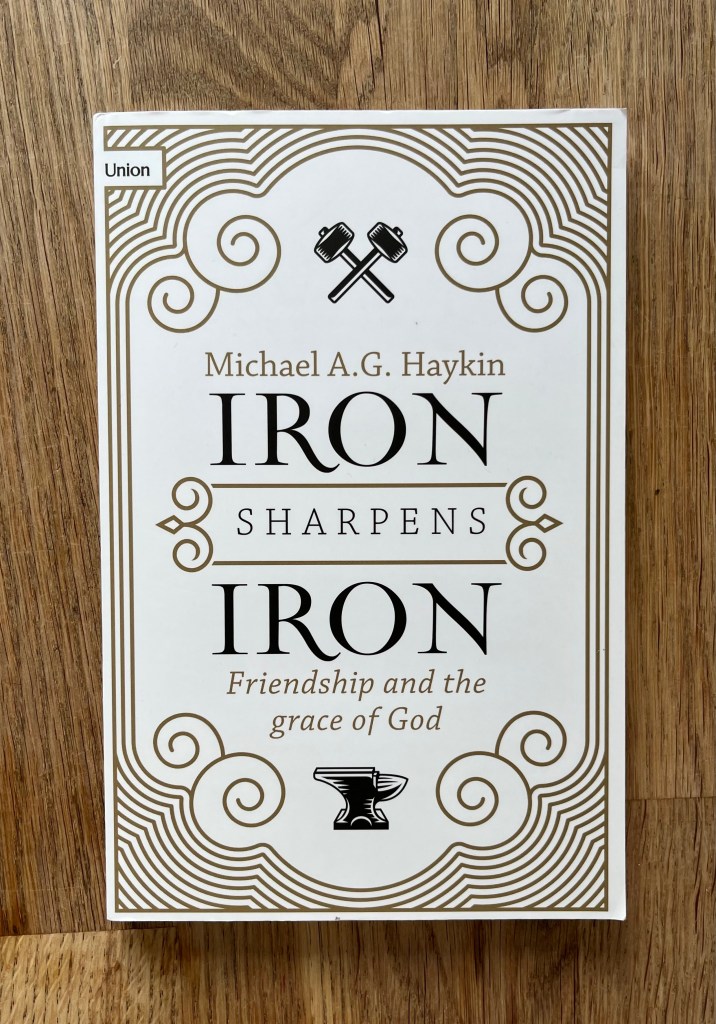
In Michael A. G. Haykin’s new book, Iron Sharpens Iron, he focuses on the friendships of two eighteenth-century pastor-theologians—Andrew Fuller and John Ryland—in order to help us think about what a deeper relationship looks like that many of the surface-level friendship people have today. For these Baptists (not to mention many others), friendship was one way a Christian could keep in step with the Spirit. According to Robert Hall, Jr., one of Ryland’s friends, friendship “is a reserve of strength, ready to be called into action when most needed: a fountain of sweets, to which we may continually repair, whose waters are inexhaustible” (15).
Michael A. G. Haykin is Professor of Church History & Biblical Spirituality at The Southern Baptist Theological Seminary.
Modern culture does not easily pave the way to long-lasting friendships. The West emphasizes busyness and efficiency, while friendships take time and effort to build, and Haykin notes the dearth of resources in Evangelical writings on the topic of friendship before recent years. Even Screwtape rejoiced over “the fact that ‘in modern Christian writings’ there is to be found ‘few of the old warnings about Worldy Vanities, the Choice of Friends, and the Value of Time'” (16). By highlighting a few eighteenth-century Baptists, Haykin’s goal is to show how friendship functions “as a vital means of grace in the Christian life” (17), and he makes his case through the historical evidence of letters between “actual friends” (18).
My favorite chapter was Chapter One, where Haykin surveys friendship from the Greco-Roman era (antiquity) up to the enlightenment (the Age of Reason). Friendship was one of the ancient Greek’s highest ideals in life. The Bible doesn’t have any extended discussions on friendships, but we can catch glimpses of it in the lives of Ruth and Naomi, David and Jonathan, and Paul and Timothy (see Phil 2:19–22). He then surveys how important a few theologians, such as Gregory of Nazianzus and John Calvin, considered friendship to be. While many consider Calvin to be overly harsh, Haykin notes how the French Reformed historian Richard Stauffer believed “there were few men at the time of the Reformation ‘who developed as many friendships; as Calvin” (33).
Chapter Two gives a brief historical dive into the lives and personalities of Andrew Fuller and John Ryland. Although it is important when you read a book to know who the characters are (I knew very little about Fuller and Ryland beforehand), this chapter felt out of place because it focused on many historical details and had very little to do with the theme of friendship.
Chapter Three then looks at the friendship Fuller and Ryland shared together. Chapter Four looks at the friendship between Fuller and a fellow Baptist pastor named Thomas Steevens. Chapter Five, looking back to the fountain of sweets that is friendship quoted above, returns to the friendship Fuller and Ryland shared, and it includes a mini-discourse on friendship by Robert Hall.
In between chapters Four and Five is an excursus over how the friendship of Edward Sharman and Andrew Fuller ended due to Sharman’s heretical views on the Trinity. Many a Twitter Troll could learn from how Fuller responded (or didn’t) respond to Sharman. While some blow up over the smallest spark, Fuller, a very busy man, respected his past friendship with Sharman. Sometimes, believe it or not, we don’t need to make our disagreements with others public. Haykin ends his book with an Afterword on the vital importance friendship is “for the advance of God’s reign in the world” (128).
One issue readers will be confronted with is the amount of historical detail. I took both of Haykin’s Church History classes in seminary, and they were phenomenal. He was able to weave history into a story, revealing what took place behind the scenes within history that led to certain events, such as showing what led to the Reformation and Martin Luther’s realization of justification by faith. I believe, however, that this book has too much detail. Almost every person introduced has their birth and death years beside them (e.g., John Rippon, 1751–1836). There is a lot of historical background information given about people, the church they pastored, where they lived, and what they did that is unrelated to the topic of friendships. As a work of history it really is interesting. But when these chapters are to be devoted to the topic of friendship, that topic gets choked out by the details.
As well, what this book has in historical detail it lacks in application. We can get a glimpse at how these men respected each other as friends, but how do we move that into the modern world? How can reading the friendship shared between these men help us fight the West’s emphasis on busy efficiency? Just as a personal anecdote, Haykin himself was very open in seminary to catching a bite to eat with anyone who asked. I took the liberty of asking him to breakfast. Besides having an extremely nice chat with him, I saw how an accomplished professor eager to physically meet and spend time with people, students even. He gave his time even though we likely would never meet again.
Recommended?
This book emphasizes the importance of friendships, not as a means of personal gain, but as a means of sanctification for both friends. This book would certainly have been a smashing hit if it had been written in the same vein as his book The God Who Draws Near. There is good to be gleaned from this book, but I honestly also don’t know if the average person, without a fair amount of willpower, will make it through due to the amount of detail. (Look for my review soon of The God Who Draws Near!)
Buy it on Amazon or from Union Publishing!
Lagniappe
- Author: Michael A. G. Haykin
- Paperback: 142 pages
- Publisher: Union Publishing (January 28, 2022)
Review Disclosure: I received this book free from Union Publishing. The opinions I have expressed are my own, and I was not required to write a positive review. I am disclosing this in accordance with the Federal Trade Commission’s 16 CFR, Part 255 http://www.access.gpo.gov/nara/cfr/waisidx_03/16cfr255_03.html.
Amazon Affiliate Disclosure: As an Amazon Associate I earn from qualifying purchases.
 spoiledmilks