
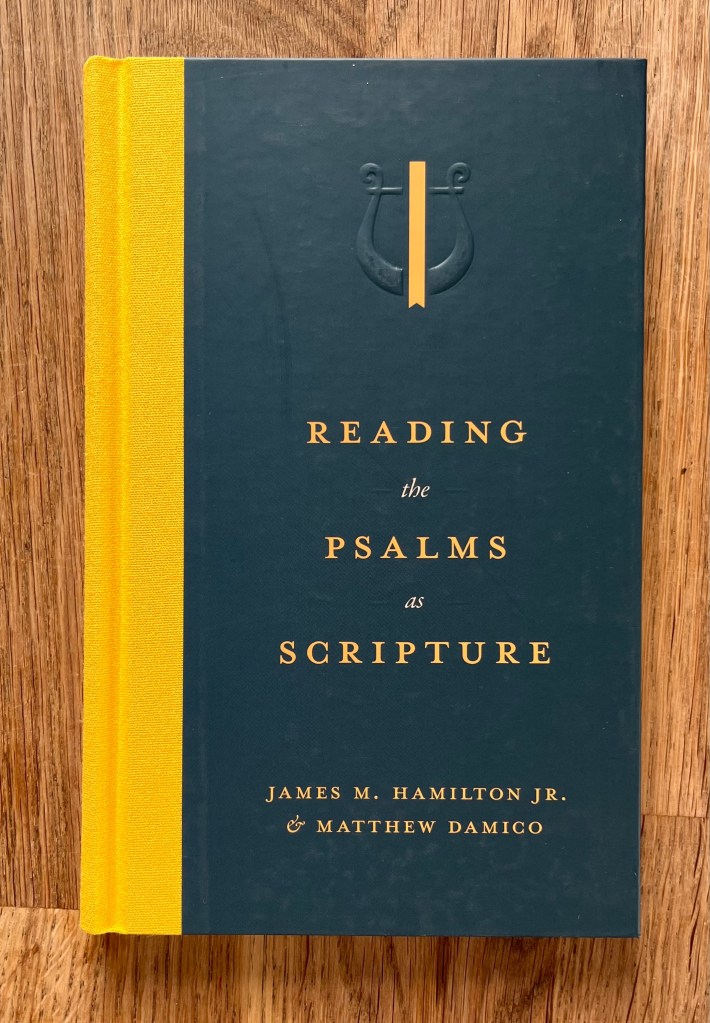
How should we read the Psalms? Are they Israel’s greatest hits? Perhaps the whole hymnal? Maybe they tell a story? Perhaps their arrangement… is actually intentional? In James Hamilton and Matthew Damico’s book, these authors believe that “[a]ll art is crafted to build culture and fortify the identity of the community for whom the art is made. So it is with the Psalms” (1). There are many narratives floating around like balloons today just waiting to be slipped on to our wrist in order to tie us down. The authors write, “These narratives are lies” that “will lead us to death and hell” (3). The psalms point us elsewhere, into the presence of God (Ps 16:11). They “fortify our identity as God’s people,” and they don’t “let us forget who we are and whose we are” (3).
In seeking to understand the way the biblical authors understood God’s world, themselves, and everything God has given us in this world to escape death and to live eternally with him, they want to understand and show how the psalms are designed “so that we can understand how they are intended to function in our lives, pointing us to the future king from David’s line, teaching us to call on the Lord with praise and thanks” (4).
Chapters one and two are very good, but I thought it was odd to begin a book by placing these detailed chapters here. The book of Psalms is made up of five books, and chapter one begins by looking at the seams of the psalms, where each psalm begins and ends. There are doxologies at the end of each book, and there is a new author (according to the superscription) at the beginning of each book. Since Psalms 1–2 open the Psalter, the authors show a number of works linking these psalms with Psalms 3–6, showing coherence between them. Chapter two looks at the inspired superscriptions that begin many of the psalms. Each book begins with a new author (except Book 5, which has no stated author). However, by looking at how many inscriptions are about David, or Moses, or Solomon, or others, the authors believe there is an overall flow in the psalms: a movement from
- the suffering historical David –>
- the reign of David –>
- from Solomon to exile / end of the historical Davidic house –>
- Mosaic intercession in the exile –>
- the New Exodus and the New David.
The authors also show some intentional arrangement with the inscriptions which is fascinating to see. The reason I think placing these two chapters in the beginning of the book is odd is because they are quite detailed (see the discussion of superscription placement on pg. 34). While I enjoyed it, and the writing style is easy to follow, it is still a lot to grasp for the average layperson.
Chapter three shows us how to read individual psalms, which means we have to know how to read poetry. The chiastic structures of some (all?) psalms can help us understand their flow. Seeing allusions to other passages in Scripture (Exod 33–34 in Ps 25) will also help us understand where the psalmist received his theology and how David places himself in an important position due to God’s promises.
Chapter four gives an overview of the flow of each book in the Psalter. Chapter five shows how David and Asaph knew the Scripture “like a native knows his homeland” (68). Psalm 18, 72, and 78 allude to earlier scriptures from the Pentateuch, showing their heavy reliance on earlier Scripture to shape their theology.
Chapter six looks at messianic typology in the psalms. Typology is like a reverse echo. It is quiet at first, but every time the sound comes back it gets louder and louder. The biblical authors see the God-ordained historical correspondences between God’s people and they drew the connections between them. This chapter looks at the connections between Joseph, Moses, and David, how to read the psalms as new covenant Christians after the long-awaited Messiah has already come, and what to do with imprecatory psalms.
Chapters seven and eight look at how later OT authors (7) and NT authors (8) interpret the psalms. The psalms show up in Proverbs, Zechariah, 1 Chronicles, and the authors argue that we can look to the psalms the way the Old Testament authors did. The NT authors accepted the superscriptions (see Matt 23:43–44; Acts 2:25; Rom 4:6), read the Psalms and the OT as a book (see Gen 15:6 and Ps 32:1–2 in Rom 4:3–12), and they understood the psalms typologically (Heb 2:10–13 and Isa 8:17–18).
Chapter nine looks at how, why, and to what benefit it is when Christians sing the psalms. A comment about knowing where to find some fitting melodies would have been helpful here. Chapter ten rounds up the book with seven theses on how to read the psalms. Each thesis has a paragraph to offer more clarity.
Recommended?
For such a small book there is a lot packed in here. And it’s no wonder considering Hamilton wrote a two-volume commentary for Lexham Press on the Psalms. If you are a scholar looking for more evidence on how the psalms cohere together as one book, I would point you to Hamilton’s commentary. But if you are a layperson who thinks his commentary would be too deep of a dive, then this book is for you. You won’t get a full understanding of each Psalms, but you will get an overall grasp on the movement and trustworthiness of the psalms. You will get a glimpse at how God has ordained the psalms to benefit his people, to point to Christ and to the new creation with him. This is a great book.
Pair this with Jim Hamilton’s two-volume commentary on Psalms.
Buy it on Amazon or from Lexham Press!
Lagniappe
- Authors: James Hamilton and Matthew Damico
- Paperback: 142 pages
- Publisher: Lexham Press (December 2024)
Review Disclosure: I received this book free from Lexham Press. The opinions I have expressed are my own, and I was not required to write a positive review. I am disclosing this in accordance with the Federal Trade Commission’s 16 CFR, Part 255 http://www.access.gpo.gov/nara/cfr/waisidx_03/16cfr255_03.html.
Amazon Affiliate Disclosure: As an Amazon Associate I earn from qualifying purchases.
 spoiledmilks
There quite a number of typographical errors in your review (quite for quiet, etc.). While the reader my get an overall understanding of your meaning, why not take the time to proofread more closely?
LikeLike
No, this is an important part I often neglect. Thanks for pointing it out!
LikeLike