
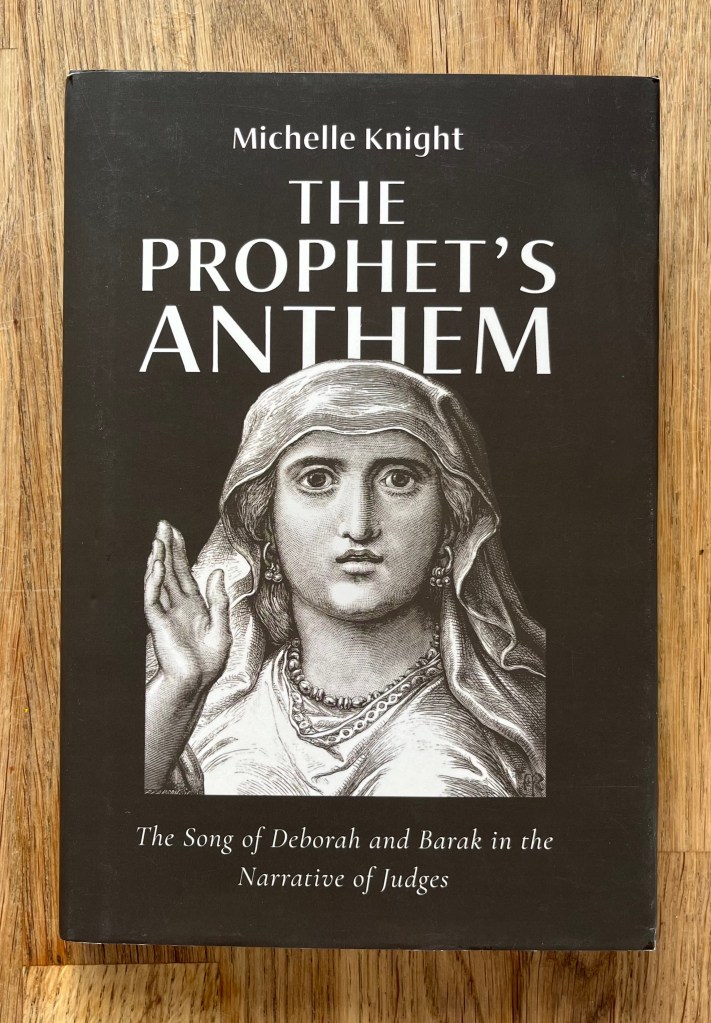
In Judges 4, Jael drives a tent peg through the head of the great war commander Sisera in her tent. Afterwards, Deborah, a prophetess, together with the judge Barak sing a song about the events that had just unfolded. The song highlights the importance of knowledge and revelation in the book of Judges, especially for a generation who “knew neither YHWH nor the deeds he had done for Israel” (2:10).
A number (that is, over one hundred) books, articles, and studies have been written on this chapter alone. What is unique about Knight’s approach? Her book is distinct because she follows the norms of biblical poetry, and she focuses on the song’s effect on the entire narrative of Judges (not just when compared with Judges 4). By applying narrative criticism—approaching Judges as a cohesive story—Knight explores the nature and function of the song, demonstrating how its placement significantly shapes the interpretation of the book.
One central concern of this book is why this song was placed here after the events of Judges 4. In biblical interpretation, this is often an important question to ask. What is the flow of thought, and why is this sentence/verse/chapter right here? (Such as why James 4:17 comes after 4:13–16.) According to Knight, Judges is a “book concerned with human responses to divine intervention,” and the song of Deborah and Barak “invites response, recalls YHWH’s past deeds, and offers an alternative interpretation” to the events of Judges 4 (4).
In Chapter one (Introduction), Knight summarizes the form and content of Judges 5. She provides her own translation of Judges 5, separating it into different sections and poetic cola. While many others are concerned with the origins of this song or the role it played in Israel’s history, Knight focuses on the final form of the text—both of this song and of how it fits into the final form of the book of Judges.
She agrees with Serge Frolov that the genre of the song is one of “prophetic historical exemplum,” meaning it is a “type of prophetic discourse that describes YHWH’s involvement in the past so as to teach something about his involvement in the present” (25). She ends her chapter with a summary of how she interprets Judges 5, which is filled with “theologically robust and pedagogically motivated language” (32). It was not just intended to be a nice poetic song, but to motivate Israel to trust in Yahweh to fight for them despite their weakness.
Chapter two presents Judges 5 in its narrative cycle setting. There are many cycles in Judges where Israel falls into sin, (sometimes) cry out to the Lord, he sends a deliverer who saves Israel, and the cycle repeats. Here, Knight looks at the plot of Judges 4 and 5 and the characters involved—the Israelites, Yahweh, Jabin, Sisera, Deborah, Barak, and Jael.
Knight argues well that Barak wasn’t indicted for asking Deborah, a woman, for assistance when he hesitated. Deborah told him, “The honor will not be yours, for the Lord will deliver Sisera into the hands of a woman” (4:9). Many people read that since Barak will not be honored, he will then be shamed. But where is he shamed? He simply doesn’t get the honor of killing Sisera. Instead, a women (aka, a civilian) would defeat Sisera. Some believe he is shamed for asking Deborah to go with him, but we have to stop and consider why he asked her instead of some military macho man. Judges 4:4 tells us Deborah was both “a prophet” and she “was leading Israel at that time”! Not only that, but this gives Israel another example of their mighty God stopping mighty foes (Jabin of Canaan with his nine hundred chariots of iron) with weak vessels (Jael). In fact, as Knight writes, “In almost every detail, the characterization of Jael mirrors that of the Israelites” (66).
Next, Knight gives us characterization (Chapter Three) and plot and themes (Chapter Four) in the Song and Savior Stories of the core of the book of Judges (3:7–16:31; the “Book of Deliverers”). Knight argues that the Song of Deborah plays a programmatic role within the book, separating stories that illustrate Yahweh’s great strength seen through weak vessels (Judg 3–5) from stories that the song actually evaluates. How does Israel respond when left in the midst of enemy nations and cultures? Will they stay faithful and worship Yahweh for his goodness to them, and will they fight against the nations to gain the land God gave them? Or will they instead worship the foreign gods and forget all about Yahweh until they can’t stand their suffering? Knight shows how Judges 5 is a chapter that ought not be skipped, even for those of you (like me) whose eyes glaze over when you reach poetry in the Bible. Judges 5 is a transitional chapter. Knight writes how the Song “underscores the restoration of Israel by YHWH while introducing the evaluative scheme that dominates the remainder of the book” (87).
In Chapter three, Knight examines the portraits of Israel, its saviors, the nation’s oppressors, and Yahweh and how the book takes shape around Judges 5. In presenting the plot development of Judges in Chapter four, she covers the divisions of the judges cycles, the words of Yahweh at key points in the book and how that gives shape to three different stages, and speeches of two of Yahweh’s spokespersons. What Knight presents is a really helpful and illuminating way to see how the inner core of Judges is structured (which I won’t give away here), but it makes a lot of sense. Knight also highlights themes of how much Israel forgot Yahweh, generational degradation, and how God tested Israel by keeping the nations in the land. Through Judges 5, “the criterion by which Israel is being evaluated is its willing participation in battle—an action contextually interpreted as obedience to the commands of YHWH” (135).
Chapter Five ends with a brief look at the narrative function of the Song of Deborah and Barak in the book of Judges. The Song has both a “pedagogical orientation and a prophetic quality” (142). God used a weak civilian to conquer a mighty foe, and the Northern tribes who responded to the call to war are celebrated in the song. They believed in God’s power. But the Song equally condemns. To hesitate in battle, to be hard-hearted and forget Yahweh, leads to a dark road, as we see at the end of Judges.
Knight ends with an Appendix, a lexical and text critical analysis addressing variant readings.
Recommended?
While I unfortunately haven’t read enough books on Judges, this was a great book on a chapter I have always neglected. I have never studied Judges 5, and never have I guessed that it played an important role in the literary function of the text. I must say that this book, though short, wasn’t an easy read, especially in the introduction and first two chapters. Maybe I was more awake afterwards or things just began to click. Whatever the case may be, if you find it difficult, keep going! Knight really pulls texts together and gives a broad view of where the book is going and how characters function, which will help you understand the smaller details. This is a great book, and I really look forward to Knight’s Judges commentary in the BECOT series.
Buy it on Amazon or from Baylor University Press!
Lagniappe
- Author: Michelle Knight
- Hardcover: 195 pages
- Publisher: Baylor University Press (November 15, 2024)
- Interviews
Review Disclosure: I received this book free from Baylor University Press. The opinions I have expressed are my own, and I was not required to write a positive review. I am disclosing this in accordance with the Federal Trade Commission’s 16 CFR, Part 255 http://www.access.gpo.gov/nara/cfr/waisidx_03/16cfr255_03.html.
Amazon Affiliate Disclosure: As an Amazon Associate I earn from qualifying purchases.
 spoiledmilks