
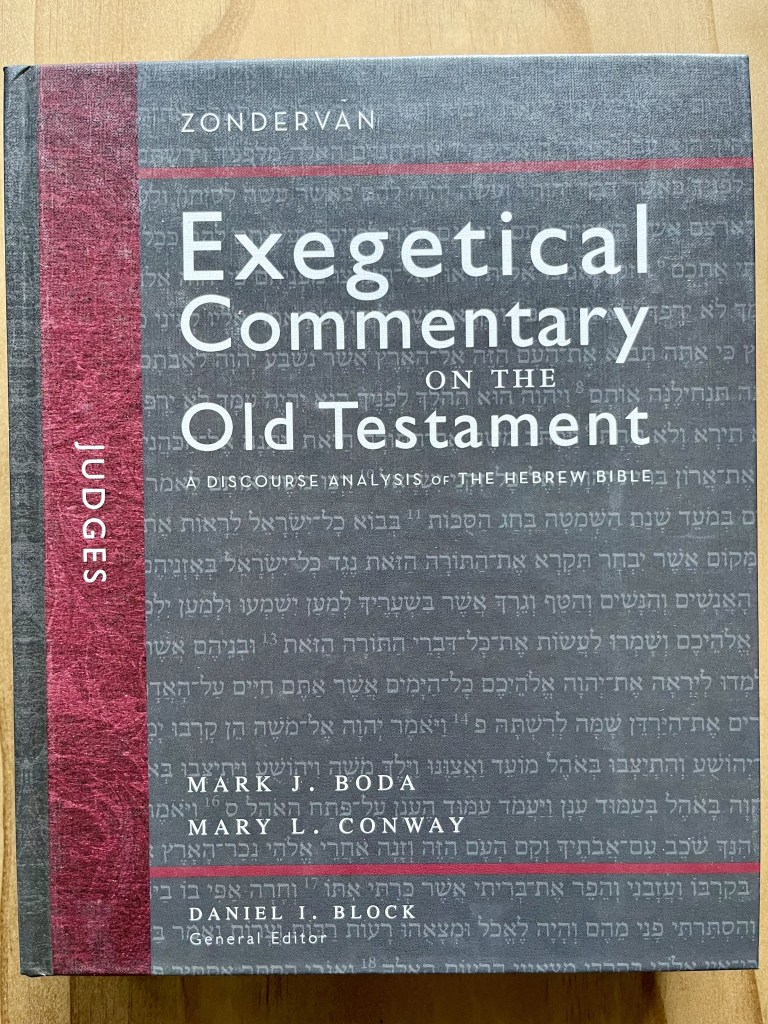
The book of Judges is fascinating. War, deceit, flaming foxes, and an entire tribe without wives. What in the world is going on in this book, and why is it in God’s holy Bible? Many Christians struggle knowing what to do with much of the book of Judges, and I am thankful to have this volume in this series.
Mark Boda is Professor of Old Testament and Hebrew, and Mary Conway is Associate Professor Emerita of Old Testament, at McMaster Divinity College.
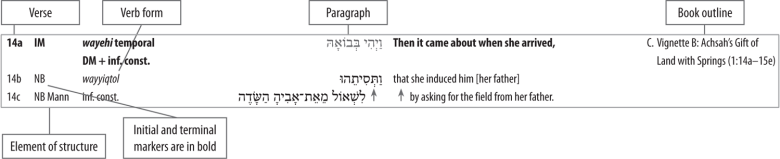
If you’ve read any of my reviews, you’ll know that the aim of this series is discourse analysis (also called macrosyntax). Discourse analysis (DA) is a tool used to understand the flow of thought. How words are built into clauses, clauses into sentences, and sentences into paragraphs, which serve “as the basic unit of thought” (x). In addition, the authors used “a recognized and robust methodology for determining the discourse structure” of Judges, developed in Roy Heller’s Narrative Structure and Discourse Constellations. Unlike the “signals” English uses to help readers follow a narrative—these would include capitalization, punctuation, indentation, and key words—Hebrew uses specific verb patterns and clause structures to signal the narrative’s structure and function. This includes the location of paragraph breaks, the presence and function of disjunctive comments, changes in the narrative sequence, and the type and function of spoken discourse. The authors provide definitions for different terms to help you understand the meanings of different clauses: narrative backbone-NB; prospective-PR; retrospective-RT, etc.
Judges 6:22–24

Judges 1:14
Judges 15:19

They acknowledge that their English translation is clunky, but that is due to their following Hebrew conventions to give you the best possible idea of how the Hebrew text functions.
After providing their own full English translation of the book of Judges, the Introduction covers aspects such as where and how Judges functions in the canon of Scripture and how past research viewed Judges. This commentary sets aside the Documentary Hypothesis. Instead it sees Judges as part of the narrative stretching from Deuteronomy to Kings (ultimately beginning back at Genesis, of course).
The emphasis on Deuteronomy is because the other books were “influenced by the thought and language of Deuteronomy” (159). While there are indications that parts of Judges were written during the monarchy, the book as a final unit took on a life of its own after the exile, being placed in connection with the other books in the Former Prophets.
A detailed chronology is impossible to make out. In Judges 2:10 “another generation” came after Joshua and his generation who did not know the Lord. The events in chapters 17–18 likely occur in that same “second” generation (see 18:30 and 20:28, pg. 48). Othniel would be from the third generation and is linked with the judges who follow him. Yet there is likely overlap between the judges (see Jephthah’s chronology in 11:26). The authors provide a very helpful section on the tribes, tribal confederacy, and how the judges functioned.
One difference between this commentary with others (even within this series) is that the Explanation of the Text sections are not structured verse-by-verse. This isn’t a downside though. First, the authors are not restricted by a particular verse in their efforts to explain the text’s flow of thought or its main issues. Second, there are many other commentaries that do this perfectly well (see Block and Younger). That allows this commentary to focus more on the flow of thought in Judges.
At the same time, because there are 116 chapters in this book (see the Spoiled Milks below), I believe a lot of space could have been saved and used instead for explaining the text if there had been fewer chapters (max 50?).
The Spoiled Milks
The point of this commentary is to help readers understand the bigger picture and the flow of the book of Judges. Yet in this volume Judges is divided into twelve macro-units and a ridiculous 116 chapters. I don’t understand why General Editor Daniel Block let this slide. Whole chapters are devoted to a few verses, sometimes one single verse alone. (Take a discourse analysis if you will of my redundancies there.) Just in the final macro-unit, five chapters examine one verse each (chapters 104: 19:30; 106: 20:16; 109: 20:37; 112: 20:48; and 116: 21:25).
In each chapter under Literary Context, the particular text of that chapter (say, Judges 20:16) is presented in a list of all the other chapters. Every time. For example, in Macro Unit 12, there are nineteen chapters and, thus, nineteen texts. In each of those nineteen chapters, under Literary Context whatever text that chapter covers is presented in a list with the other 18 chapters so you can be reminded of the surrounding literary context. Every time. Every chapter.
As well, nineteen chapters on Judges 19:1–21:25 is overkill, and having all nineteen chapters repeated nineteen times in the Literary Context is over the top. Younger separates Judges 19–21 into three chapters, Block and Webb five chapters/sections each, and Chisholm three sections. Do we really need nineteen chapters? Instead of guiding us along the author’s flow of thought, all of the re-re-re-repeated information clogs that pathway.
Recommended?
Despite my gripe above, the information provided in this commentary is fantastic. This is a terrific commentary, and I highly recommend it to anyone looking to study the book of Judges. The content of this commentary will be helpful for scholars and pastors. The DA elements will be helpful for scholars, but the atomistic presentation of the text (in 116 chapters) will be too detailed for many pastors. Despite that, they will be richly rewarded by having a commentary that focuses on the text’s flow of thought, and there is plenty here to grasp, even if you don’t understand the DA elements.
Whether you know Hebrew or not, pastors and teachers will benefit greatly from this volume. Highly recommended. Pair this with Beldman (THOTC), Block (NAC), Younger (NIVAC, review soon), and Webb (NICOT).
Buy it on Amazon or from Zondervan Academic!
Other ZECOT reviews
- Leviticus — Jay Sklar
- Ezra-Nehemiah — Gary Smith
- Hosea — Jerry Hwang
- Joel — Joel Barker
- Obadiah — Daniel Block
- Jonah — Kevin Youngblood
- Nahum — Daniel Timmer
- Habakkuk — Kenneth Turner
- Malachi — Dennis Tucker
Lagniappe
- Series: Zondervan Exegetical Commentary on the Old Testament
- Author: Mark Boda, Mary Conway
- Hardcover: 944 pages
- Publisher: Zondervan Academic (December 6, 2022)
Review Disclosure: I received this book free from Zondervan Academic. The opinions I have expressed are my own, and I was not required to write a positive review. I am disclosing this in accordance with the Federal Trade Commission’s 16 CFR, Part 255 http://www.access.gpo.gov/nara/cfr/waisidx_03/16cfr255_03.html.
Amazon Affiliate Disclosure: As an Amazon Associate I earn from qualifying purchases.
 spoiledmilks