

Christopher Wright is a missiologist, an Anglican clergyman and an Old Testament scholar. He has written commentaries on Exodus, Jeremiah, Ezekiel, as well as books on Old Testament ethics and preaching the Old Testament.
Part One
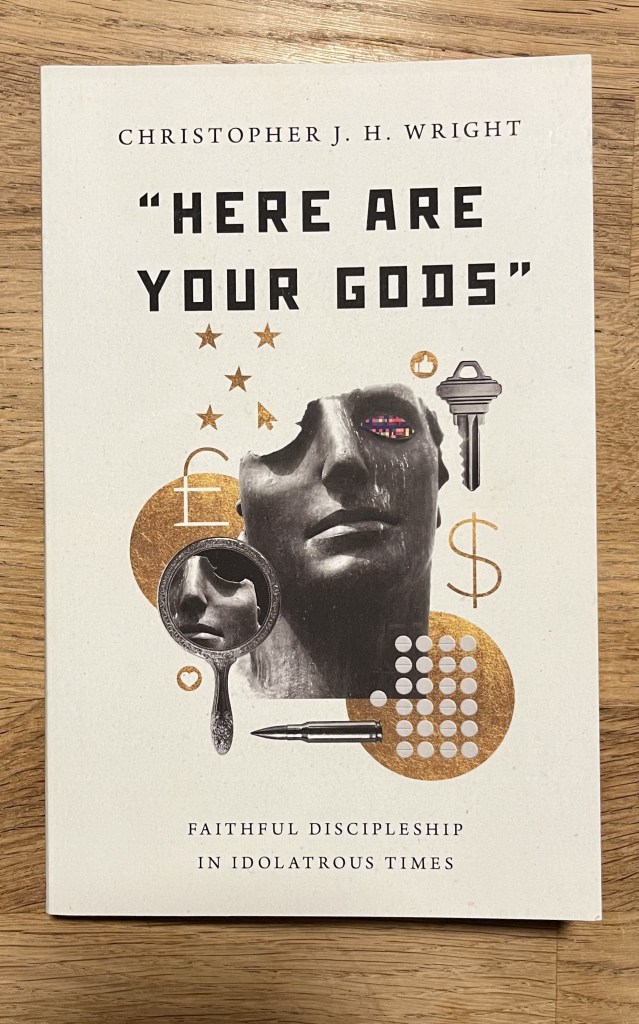
In Here Are Your Gods, Wright uncovers what idolatry looked like in the OT and how it pervades our modern world. He divides his book into three sections. Part One looks at idolatry, the gods behind them, and exposing our gods today. The gods behind idols would be either demons or just the works of human hands. Both are sinister, and both are created things.
We see that the gods are something, for the Old Testament reminded Israel not to follow those gods. Their promises for success were real, and demons laid behind those idols (Deut 32:16–17; Ps 106:35–38). Yet equally so, most often I the Old Testament do we read that the idols were the work of human hands. As Wright writes, “Idols and gods are human constructs!” (15). Both these idols “and the gods they are alleged to represent” were no stronger than the worshipers themselves because they were created by people (94). The gods they represented sat up in the heavens, looking down in horror, unable even to save their own idols from falling (Isa 46:1–2; Judge 6:31) because they weren’t real.

Idolatry is Self-Harm
Aside form the fact that Ps 82:1 speaks of gods in a divine council who caused Israel and other nations to fall (cf. Deut 32:8), since idols are nothing, worshiping them distorts the image of God in us. As a result, “Idolatry is radical self-harm” (43). We make empty objects that can’t rescue us from sin and death. Yet who are we? We are the work of God’s hands!
Psalm 138:8 says,
The Lord will fulfill his purpose for me;
your steadfast love, O Lord, endures forever.
Do not forsake the work of your hands.
Psalm 8:6 says that God has given mankind “dominion over the works of your hands,” which in clouds the vastness of “your heavens, the work of your fingers” (8:3). We sacrifice all of that for some lifeless wood? Or an electronic device that fits in our hands and gives us access to the world’s information and yet we waste time looking at pointless videos? So what do we do?
Part Two
In Part Two, Wright brings the Bible into the political sphere. As uncomfortable as it can be to talk politics, this is often exactly what the Bible itself does. The prophets constantly critiqued Israel’s political establishment and the idols they trusted in instead of God. Christians need to name and expose the false gods we are tempted to trust in. Doing so reminds us that there is a story we are living in (and for), a story “we are actually part of… not just the story that is being spun around us” (69). Part Two seeks to tell us how we, followers of Jesus the “Messiah, Savior, Lord, and King,” should live.
Chapter 5 looks at the rise and fall of nations. Nations fell and rose by the sovereign hand of God before (Psalm 33:10-11; Dan 4:17), but what about today? Wright lists a truckload or moral failings in the west:
- Historic and systemic violence,
- Poverty and inequality,
- Extreme forms of populism and nationalism,
- Sexual confusion and family breakdown,
- Ecological devastation,
- The war on truth.
Many might think that God hasn’t judged us, and millions couldn’t care less what God thinks. However, Wright notes that “the Old Testament shows the effects of historic injustice and oppression are felt for centuries, and retribution for such evils may fall generations later” (80). What can we do?
In chapter 6, Wright points to how God gave laws that governed the King. Those with power were supposed to care for the powerless. Our idols are prosperity, national pride, and self-exaltation. Judges is full of chaos, which led to them needing a strong king, right? After David (who was quite the failure himself at the end), the kings of Israel mostly made things worse, to the point of death and exile.
When people worship false gods, this is what happens. Even this was written for our instruction (1 Cor 10:11). But not just for Christians and preachers. Wright believes it was written for the world. Old Testament ethics are wise for all nations to follow. That doesn’t mean following Torah, but the principles within it.

Part Three
In 1990 Wright wrote a book called God’s People in God’s Land. Part Three examines how God’s people are now to live in an idolatrous world. How do followers of Jesus recognize the idols all around us, likely even ones we trust, reject them, and replace them with a superior Lord?
If we are a Bible people sent on a mission to proclaim and live out the kingdom of God, do we care about what the King cares about? How do we vote? Are we more than willing to vote for the person who will protect our religious rights (freedom of speech) but whose economic policies favor the rich to the disadvantage of the poor? Wright reminds us that from the first century Christians to most Christians today, they didn’t have the luxury of religious freedom like we have, but they were still commanded to care for others.
Similar to Tim Keller’s address at the Parliamentary Prayer Breakfast, Wright looks to Jesus’ words in the Sermon on the Mount (Matt 5:13–16) how Christians are to be salt light. Are good and faithful actions are supposed to be attractive to others (see Isa 58:6–10; 60:1–3) and like salt we preserve the culture from turning in on itself.
Yet in our world, there is plenty of reason for lament. The wide swaths not only of homeless adults but of their children too, while others sit in mansions with so much money they don’t know what to do with. There is reason to love. Because of what God has done for us in his Son, there are numerous ways we, standing on the shoulders of Christian giants, can help others. And we have hope. This can seem the most difficult. Will it get better? It can be difficult to be positive. How could one not grow cynical? But God has said he will bring justice. He will crush idols. He is the Judge of all the earth, and he will do what is right (Gen 18:25).
Recommended?
Wright offers an insightful book on idolatry, the idols we see in the west, how God thinks about them. And how we can begin to tackle them. More application of what to do would have been beneficial, but regardless Wright’s book is still a winner. He helps open our eyes to the idols the West, and perhaps you, clings to. Pair this with Stephen Fowl’s book Idolatry (besides his nonsense about “whiteness” in his conclusion).
Other reviews of Wright’s books:
Buy it on Amazon or from IVP Academic
Lagniappe
- Author: Christopher J. H. Wright
- Paperback: 176 pages
- Publisher: IVP Academic (September 29, 2020)
Disclosure: I received this book free from IVP Academic. The opinions I have expressed are my own, and I was not required to write a positive review. I am disclosing this in accordance with the Federal Trade Commission’s 16 CFR, Part 255 http://www.access.gpo.gov/nara/cfr/waisidx_03/16cfr255_03.html.
Amazon Affiliate Disclosure: As an Amazon Associate I earn from qualifying purchases.
 spoiledmilks